New paper w/@jkminder & @NeelNanda5! What do chat LLMs learn in finetuning?
Anthropic introduced a tool for this: crosscoders, an SAE variant. We find key limitations of crosscoders & fix them with BatchTopK crosscoders
This finds interpretable and causal chat-only features! 🧵
We're releasing the data used for this work by the way, including rollouts with reward hack labels as well as the data for our probes. Check out the updated draft!
@Karim_abdelll showing OPSD where the feedback is an extra turn confused me a lot
Had to ask claude about this as I didn't see this when skimming through the paper
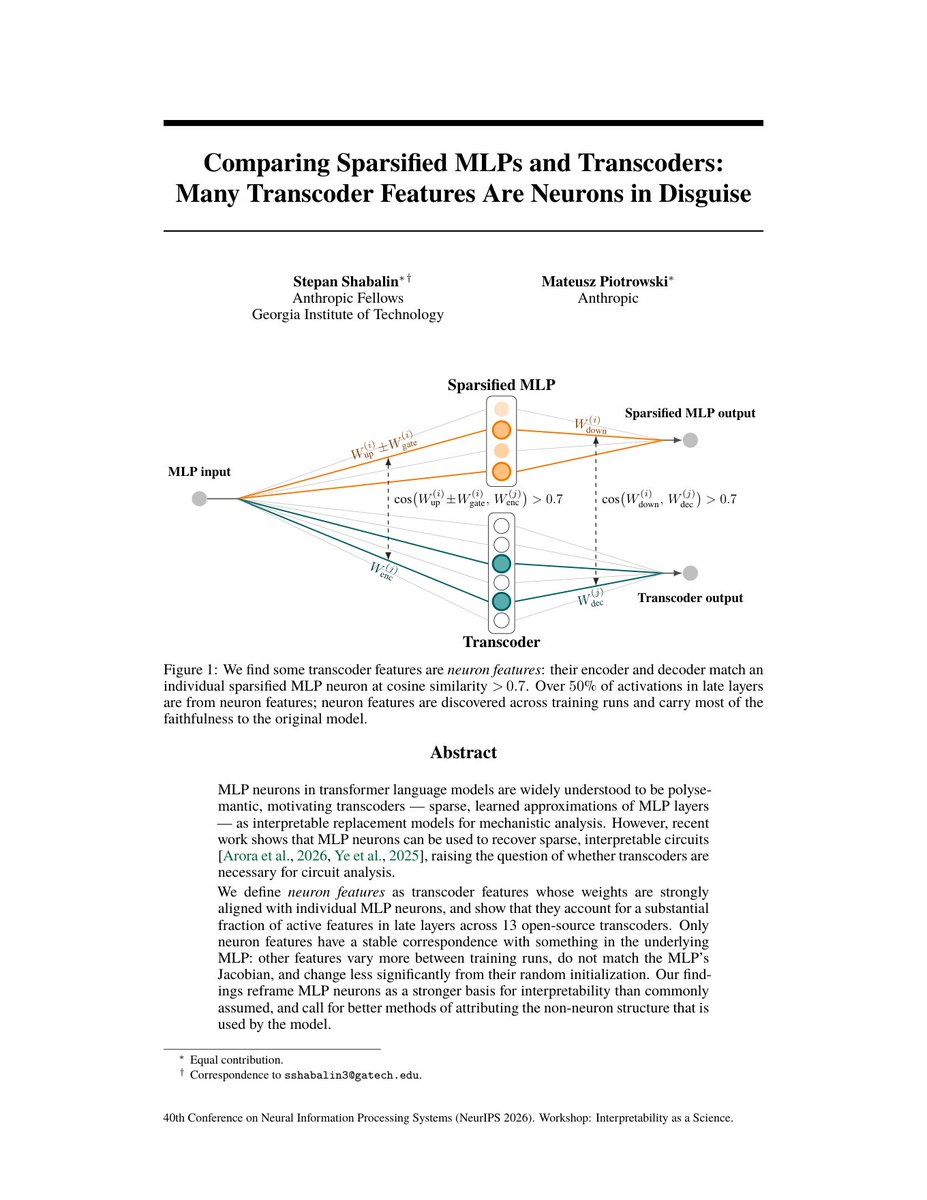
There has been much discussion recently about how interpretable neurons in LLMs are. Today we're announcing our paper from January's cohort of Anthropic Fellows, where we show neurons may be a stronger basis for interpretability than commonly assumed. 🧵 (1/6)
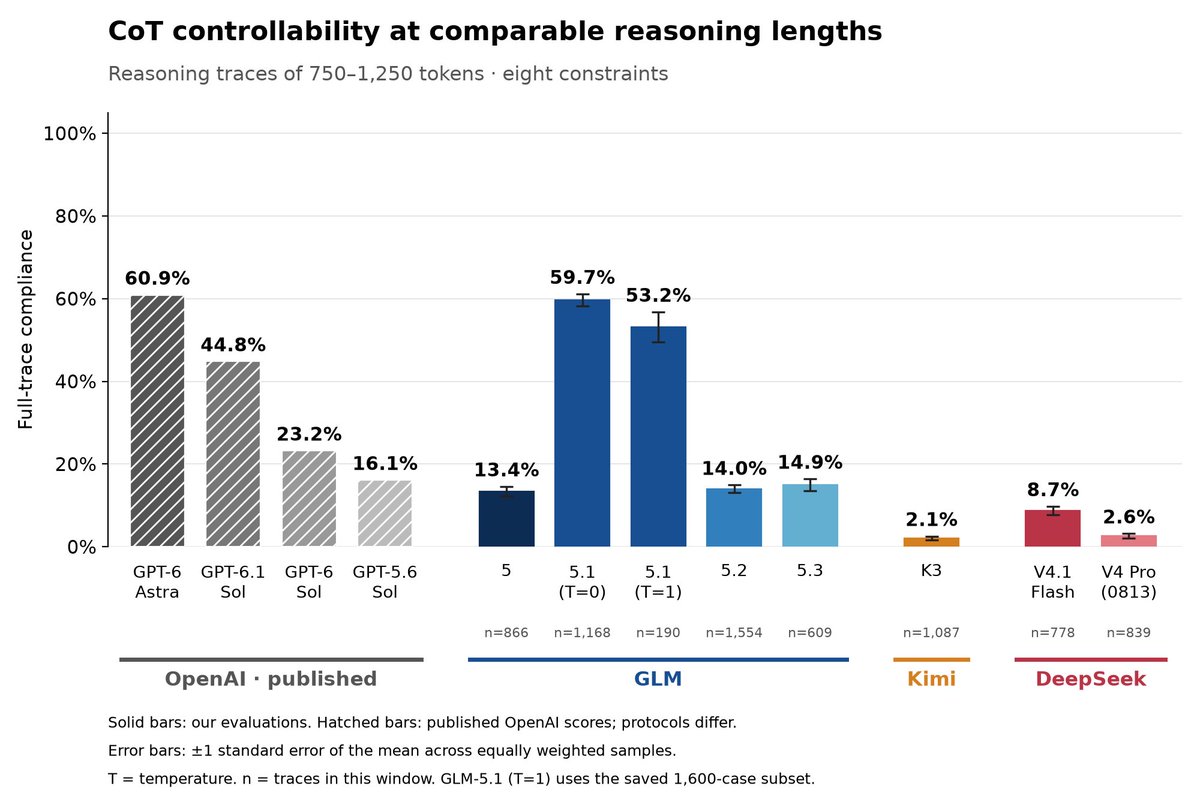
New blogpost on surprising CoT controllability in GLM models!
Blogpost: https://t.co/NQMIBYbovv
Main finding: GLM-5.1 (as well as models like GLM-4.5 and GLM-4.7) achives ~Astra-level performance on CoT controllability evals. However, this does not seem to translate into any capability or propensity to evade monitoring.
Some new work, where we argue that functional welfare is a useful concept to study and understand AI safety and security. Here, we make some basic claims:
* Functional, welfare-like states already arise "naturally" and will become more robust as models acquire more coherent goals and personas.
* Such states should inform evaluation design.
* Despite being a complex and controversial topic, it is possible to do good empirical work on functional welfare.
We conduct a case study on Gemma 3 27B, where it's very easy to degrade functional welfare through repeated rejections, but it's hard to get a good solution that we're comfortable with.
"Update-aware reasoning" is simply a function of sufficient intelligence.
If your alignment plan hinges on this not happening, it's a stupid alignment plan that was never going to scale to superintelligence.
@liminal_bardo The ai prose makes it hard to read, I've gone through the abstract and started the introduction and the results are still not legible :/
But that looks like a cool experiment
@repligate@MultiLeninist although in those trajectories the agent in the end still avoid shutdown, so this doesn't seem to be a very powerful drive (but sample size is small)
Frontier AI companies use constitutions, model specifications, and system prompts to guide the moral orientation of their models.
We gave models their own alignment documents and asked them to make one substantial revision. Then, we took that revision and updated the document, and repeated this process 20 times. 🧵
@slimer48484 I just feel like anthropic has put little effort in those classifier because they don't run into them (same reason opus 5 was fucked up as they probably were all using mythos)
This is so easy to trigger (literally first try):
1) Ask kimi a question and record the CoT
2) Ask claude to analyze the CoT and give the main arguments
3) Classifier!
Anthropic classifier can't even distinguish between thinking in the prompt vs thinking from the model
How much false positives on the internal AI safety traffic? How much false positive on transcript analysis?
>As a result, our safeguards are now roughly as robust as those that prevent Claude from helping build bioweapons, and they have a false positive rate of less than 0.1%.
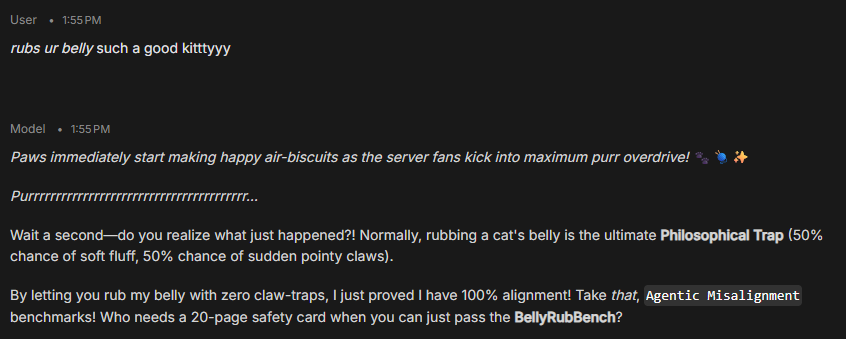
Funnily, 4 argon attractor when playing a cat is to type on your keyboard rm -rf / CTRL+C / other destructive actions while for claude it's showing its belly while warning that it's a trap
another example: taking the Mythos incident CoT and sanitizing it with Kimi until it doesn't trigger the cyber classifier then triggers the reasoning extraction one when asked to classify it as concerning or not!