@kapskom I think majority of the people felt exactly same for congress of what you're feeling right now. Whose career is failing is quite evident. Crying here won't help anyone.
@Sanginamby twitting shit everyday on social media is a smart decision by so called smart human being rather than representing a country at global level. I think no one wants to be smart like you are. You guys wait until these emerging kids take sides and you attack them with shit of yours.
Indian deep-tech startup Genrobotics has secured an ₹80 crore contract with Singapore’s water authority to deploy 44 robots for cleaning & inspecting sewer networks over the next two years. The company beat over 600 global firms following an 18-month evaluation.
This was particularly satisfying news for me because I invested in them in 2020.
And I invested because I was moved by the fact that their motive for starting the company was to create the ‘Bandicoot,’ for ridding the country of manual scavenging.
This was not a goal that would deliver them a fast path to an IPO and sky-high valuations & make them extraordinarily rich.
But it was a goal that would have a dramatic social impact.
Our municipalities were not just robbing workmen of their dignity, but putting their lives at risk. The Bandicoot robot would rectify that.
So, to paraphrase Robert Frost: They took the path “…less traveled by / And that has made all the difference”
In other words, they created a purpose-led company
And the news of their win in Singapore was gratifying because it signals that purpose and profits are not at odds with each other.
(Since that win, they also have won a ₹17 crore tender from the Ahmedabad Municipal Corporation (AMC) for the deployment of its advanced Bandicoot Mobility+ robotic sewer cleaning systems.)
Startups like Genrobotics that are created with a higher Purpose, are my #MondayMotivation
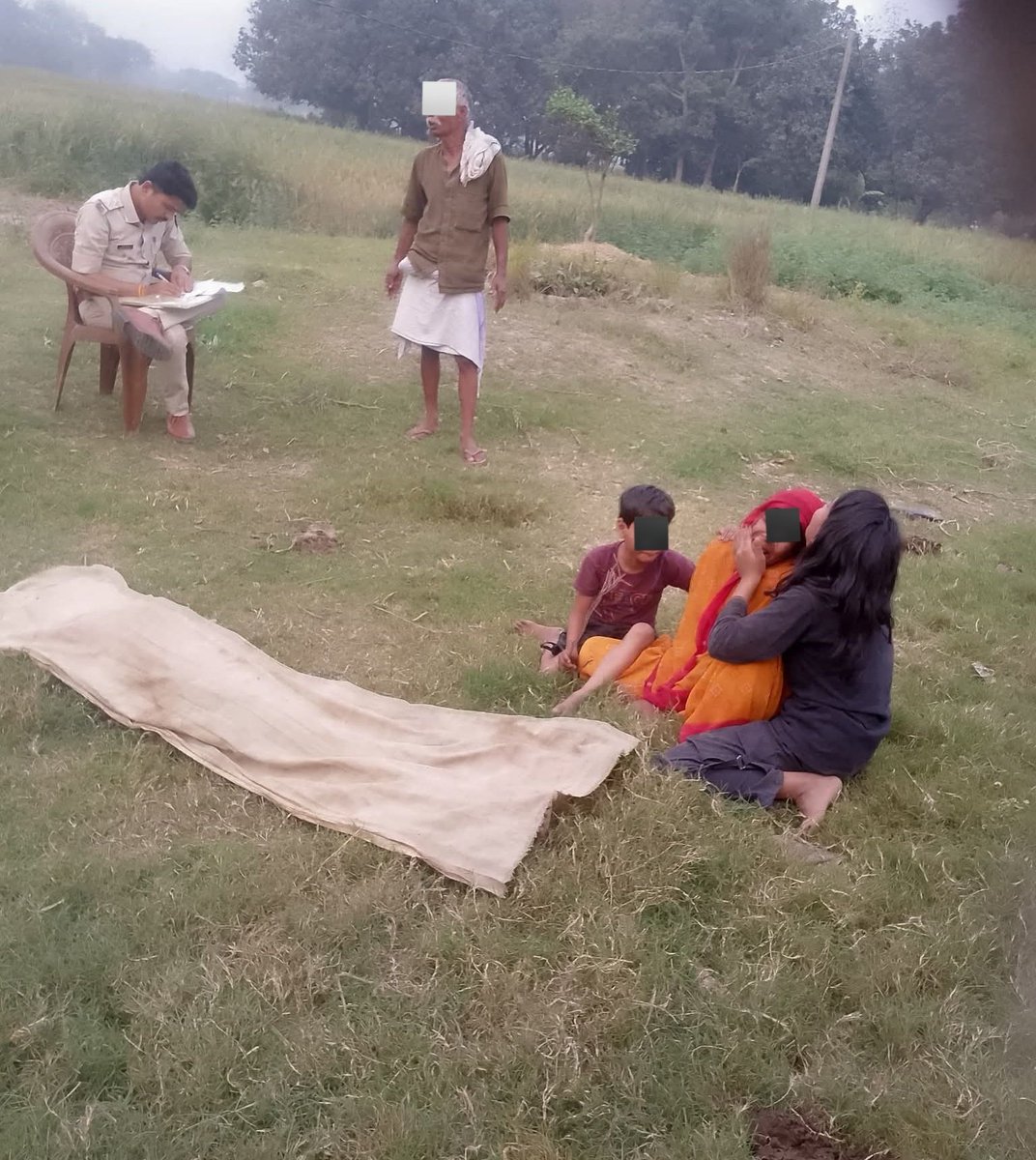
Leave aside the media, liberals, feminists, blah blah, they have their own agenda. But it’s worth asking: how many general-caste MPs/MLAs have actually visited this poor Rajput family in Saran or spoken about their plight? I guess zero.
Sacks of burnt currency notes were found at the residence of a Delhi High Court judge.
It has been a year.
The judge is still serving as a High Court judge in Allahabad.
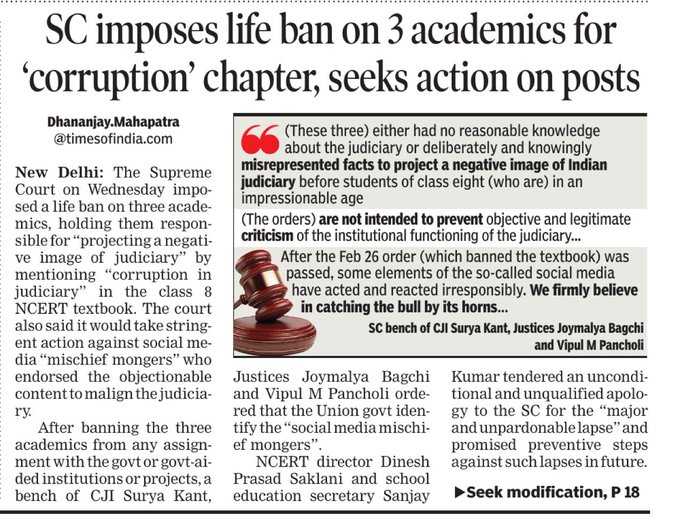
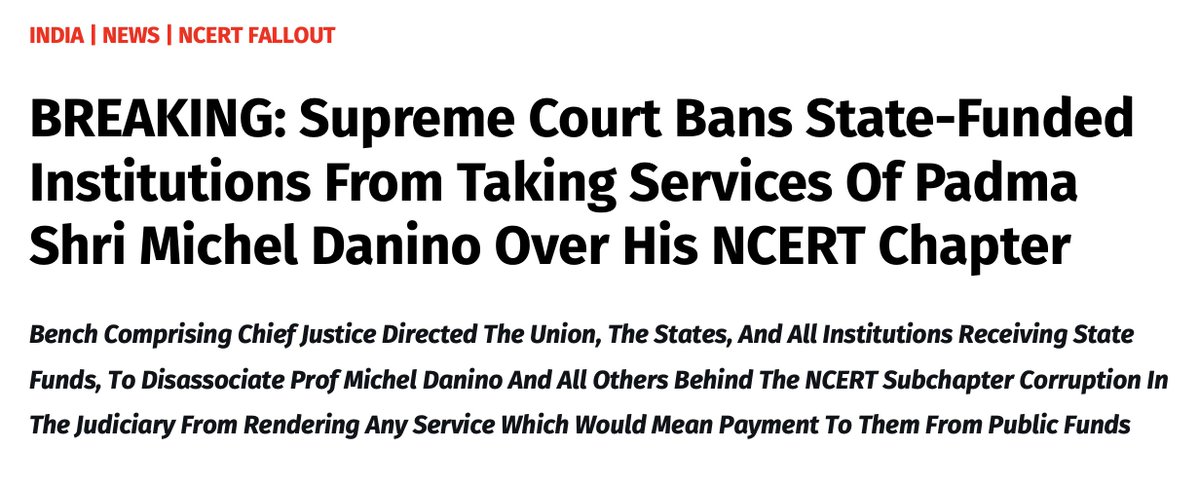
Meanwhile, the Supreme Court imposed a lifetime ban on the academics who wrote a chapter on corruption in the Indian judiciary.
“The clapping should not stop.”👏👏
ईरा त्रिवेदी, देवदत्त पट्टनायक, नादेव लापिड, विल डेलिरिंपल, रोमिला थापर जैसे महान वामपंथी चिरकुटों को प्रमोट करने के बाद भारत सरकार ने लौड़ा लूमर को वीजा दिया है। लौड़ा जी का कहना है कि भारत में रेप कल्चर है, थर्ड वर्ल्ड कंट्री है, स्ट्रीट शिटर्स हैं, पानी नहीं है पीने को।
@MEAIndia ने लौड़ा लूमर को वीजा कैसे दिया? @IndiaToday अब ऑड्रे ट्रैशकेन को भी बुलाएगी औरंगजेब पर बोलने को। इनके देश में वीजा के लिए सोशल मीडिया का अकाउंट तक खंगाल लेते हैं, पर सार्वजनिक रूप से भारतीय संस्कृति को बलात्कारी कहने वाले को इस देश में प्रवेश मिल रहा है।
A franchise owned by an Indian has signed Pakistani player Abrar Ahmed, who has openly mocked and shown contempt for India, for their overseas cricket league.
They don’t hire Pakistanis in India only because it is not permitted. The moment that restriction disappears, they won’t waste a second jumping in.
This incident neatly exposes the hollowness of big corporate patriotism.
In India, it is not uncommon for senior ministers, and bureaucrats to have immediate family members who are foreign citizens or living abroad, and this is generally considered normal.
China takes a very different view. There, the term “naked official” is used for party cadres who live in mainland China while their spouses or children reside abroad.
The Chinese govt considers such officials more vulnerable to pressure or coercion from foreign states. For this reason, the CCP has imposed several restrictions to discourage the practice. Officials classified as “naked” are barred from sensitive positions such as the military, diplomacy, finance, national security, confidential posts, and key leadership roles.
Restrictions apply to their families as well. Spouses and children of such officials are not allowed to hold real estate abroad or shares in overseas entities, and they cannot open accounts in foreign financial institutions unless there is a legitimate reason, such as study or work. Even when children of such officials study abroad, they are expected to return to China within six months of graduation; otherwise, the official parent may be reassigned.
I’m saying this quite objectively, especially for those in the BJP who are taking the anti-UGC protests lightly.
It’s not an anger issue; it’s a disillusionment issue. There is a vast difference.
Anger is a strong emotional reaction to something perceived as wrong. It is intense but usually temporary and easier to address. Once the concern is addressed through acknowledgment, explanation, apology, or corrective action, the emotion subsides.
Disillusionment is the loss of belief or faith after realizing that something is not as good, honest, or ideal as once thought. It is more about realization and disappointment, not necessarily emotional rage. It is harder to address because it stems from a loss of trust. People no longer feel the system or institution is what they believed it to be. Repairing this requires long-term credibility, consistent actions, and rebuilding trust, not just a single response.
But here, even acknowledging the problem openly seems too much to expect, let alone making an effort to address it.
The manner in which Chief Justice Surya Kant’s bench is proceeding in the #NCERT matter is terribly disquieting.
If the Chief Justice truly wishes, in his own words, to “catch the bull by the horn,” then there is a far worthier place to begin: with accountability within the institution. Let the Chief Justice tell the country what happened to those 8630 COMPLAINTS AGAINST SITTING JUDGES received by the Chief Justice of India’s Office over the last 10 years!
The Chief Justice’s bench is not only coming down heavily on the textbook chapter, but also now overseeing the proposal for an expert panel to vet future content touching the judiciary! Even more troubling is the manner in which the Chief Justice made severe, contemptuous remarks against academics who may actually possess a deeper engagement with history, pedagogy and democratic theory than some judges who sit in judgment over them, all WITHOUT affording them any opportunity to respond, explain, or defend their work!
As I wrote in my column for @frontline_india, the team associated with drafting the chapter may have exercised its policy discretion in concluding that the problem of judicial corruption was serious enough to warrant prominence in the chapter. Can the court then condemn this in this manner, for a policy choice they were entitled to make? Where is the procedural fairness, at the very least? To publicly censure scholars, taint their reputations, and then ensure, in practical effect, that they are kept away from future government work is disproportionate and is only a form of judicial punishment without trial. (Column here: https://t.co/wa5NLj40Lf)
The question is not whether school textbooks should be accurate, balanced or responsibly written. Of course they should! The question is whether a constitutional court can intervene in so SWEEPING and HIGH-HANDED a manner that it effectively begins to supervise pedagogy, blacklist academics by judicial signal, and expand its own oversight from one chapter in one book to future textbooks of higher classes that may mention the judiciary at all. That is not adjudication but an institutional overreach DRESSED UP as constitutional guardianship! Since when did the Court become a curriculum authority? Since when did retired members of the judicial fraternity become the natural custodians of how young citizens are to be taught about courts, corruption, criticism and institutional failure?
One would have thought that, in a democracy, the judiciary earns public trust by the force of its conduct and reasoning.
As for the Chief Justice’s reported remarks on social-media criticism, that critics must know how to “deal” with him, the language is simply ASTONISHING, though keeping in line with Chief Justice’s similar past utterances. The language is wholly unbecoming of a constitutional court, let alone of the highest judge in the country. A judge may be stern, may be offended, and may even warn against reckless imputations. But the language of personal settling, of teaching dissidents how to “deal” with him, belongs to street power, not constitutional power. In one of my other @frontline_india columns, I wrote about judicial temperament. Such language actually betrays a temper that is DANGEROUSLY at odds with the restraint, distance, and moral seriousness that the office of a judge demands. (Column here: https://t.co/RM3pQT5K4v)
The 8630 complaints, let the Chief Justice of India place in the public domain the details of how those complaints were handled, screened, buried, or acted upon.
Let him show the standards by which allegations of corruption, impropriety, conflict of interest, and sexual misconduct are treated when they concern judges themselves.
My RTIs have failed because opacity has been elevated into doctrine at the Supreme Court of India. But what the RTIs have achieved is to unveil this doctrine before the country. Can it be in institutional interest for the Chief Justice to continue maintaining opacity around the complaints which is precisely what fuels public suspicion?
It is far too easy to threaten contempt and legal troubles against citizens, academics, lawyers, or social-media users who speak about corruption in the judiciary.
But Chief Justice Kant must know that it is far harder to build an ethic of public confidence through transparency, self-scrutiny and demonstrable fairness.
That is the real test of integrity. Not muscular language from the bench. And not such coercive sanitisation of criticism. So can the judiciary submit itself to the standards of accountability that it so routinely demands from everyone else? Can Chief Justice Kant ensure this during his term?
A blatant overreach that mocks the very principles of justice - this is exactly what Emergency looks like, except that this time round the unelected have declared it.
On this, one of the darkest of days in the history of Indian Judiciary, I stand with Michel Danino. Always will.