Bill Wilson -- The co-founder of Midwest Permaculture inspired our imaginations to create Butler Permaculture Design, and to live the principles and ethics of permaculture.
The shape of your pollinator garden matters more than its size.
Most native bees have small foraging ranges. Peer-reviewed research on solitary bees found female flight distances of just 73 to 121 meters from the nest. A small bee born in your neighbor's yard might not reliably reach a flower patch in the middle of your yard if there's a length of mowed grass between them.
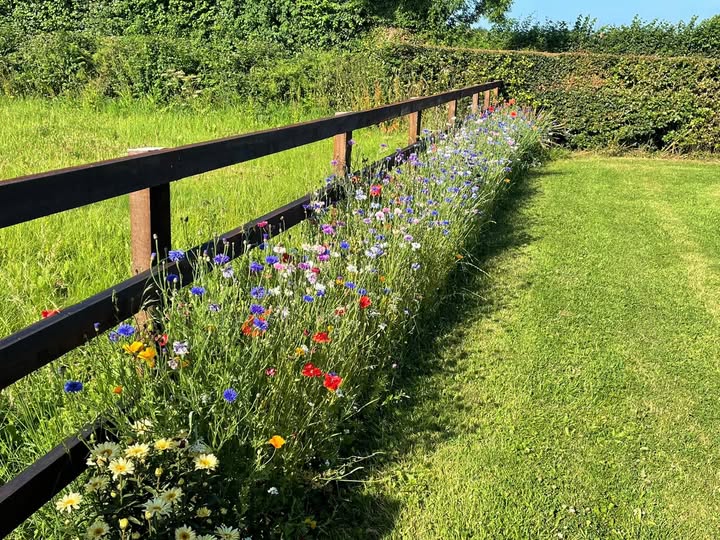
What works is linear pollinator habitat. A strip along a fence line, a corridor along the driveway, or a narrow band of natives running the full length of the property is best.
A 2018 study in the journal Ecography found that the length of linear semi-natural habitat was the single strongest predictor of wild bee species richness and connectivity in agricultural landscapes. Bees track edges.
A 2-foot-wide strip running 50 feet does more ecological work than a 10x10 island in the middle of the lawn. The strip gives pollinators a route to follow, something that guides their movement across the landscape.
The effect multiplies when your neighbors do the same. A strip along your fence meets a strip along theirs, and so on.
This guy's chickens kept getting targeted by hawks, so he started feeding local crows. Now he has an army of crows that patrols his property and chases the hawks away.
These houses are in Norway, covered in moss, the heat never leaves, the cold only because it doesn't enter. This engineering was carried out by the ancient Viking inhabitants.
@ARIKAHENRY We need to integrate selfishness with selflessness in order to be a good villager. Ask yourself, 'How may I serve my interest and benefit the village at the same time?'