Félicitations à Hong Wang, lauréate de la Médaille Fields !
Formée à l’École polytechnique, chercheuse à l’Institut des hautes études scientifiques, de Paris-Saclay, elle incarne l’excellence de notre recherche et de notre formation. Fierté.
Choose France for science!
Argentina fans were insulting a Mexican fan for supporting Spain in the 2026 World Cup final.
He responded by showing them a red card and dancing in front of them. 😂👋🏼
Happy Birthday, America!
At this inflection point for our country and our democracy, let us conjure the spirit of our Founding Fathers as we continue working toward a more perfect union.
European: “I’m dying of heat.”
Random Chinese person: “Why not try turning on the air conditioner?”
American: “I’m homeless and completely desperate.”
RandomChinese person: “Why not ask the police for help?”
British person: “My train got cancelled, I can’t get home tonight.”
Random Chinese person: “Why not just take the next high-speed train? Or rebook your ticket?”
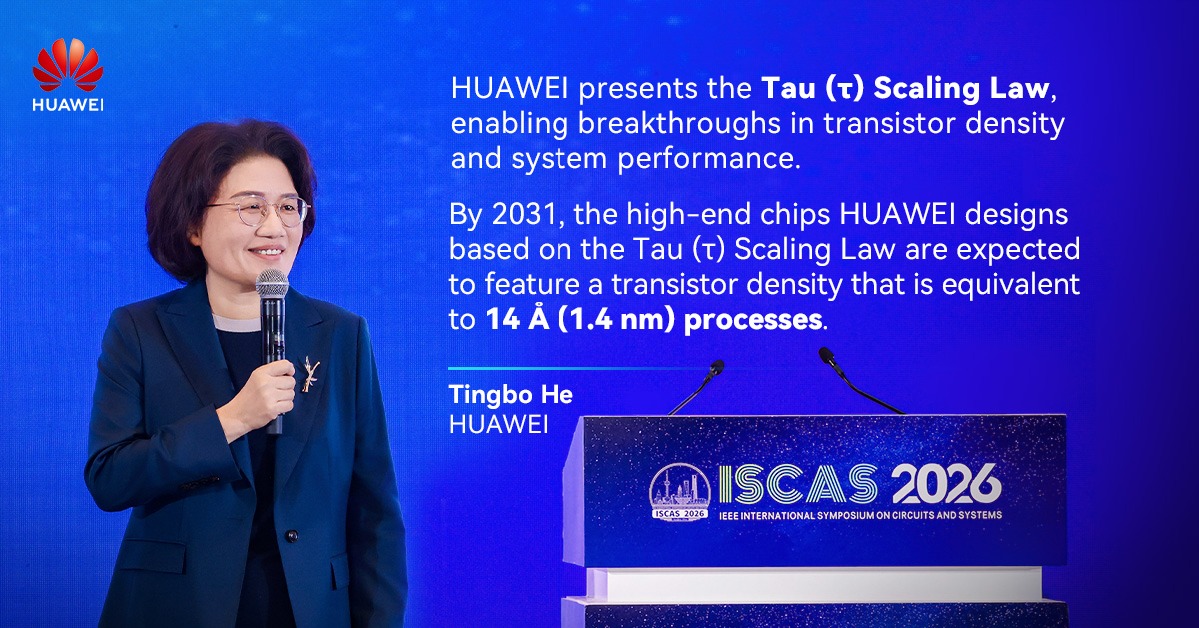
HUAWEI's Tau (τ) Scaling Law is a new principle for guiding the future development of semiconductors. By 2031, HUAWEI's high-end chips are expected to feature a transistor density equivalent to 14 Å (1.4 nm) processes. Watch the livestream to learn more! https://t.co/0Zb73r23ZP
Yes, it's legitimate—Huawei announced the Tau (τ) Scaling Law today at the IEEE ISCAS symposium in Shanghai. It's their proposed post-Moore's Law framework: instead of just shrinking transistors geometrically, they focus on "time scaling" by minimizing signal propagation delays (τ) via architectural innovations like LogicFolding.
This aims to boost effective transistor density and performance through better circuit/chip/system design. They claim high-end chips could reach density equivalent to 1.4nm processes by 2031, and their next Kirin chips will test LogicFolding.
For computing's future: It signals a broader industry shift toward holistic optimizations beyond process nodes—key for efficiency, AI, and navigating manufacturing limits. Results will depend on real-world delivery.
HUAWEI has presented the Tau (τ) Scaling Law, a new principle for guiding the future development of the semiconductor industry. By 2031, HUAWEI's high-end chips based on this law are expected to feature a transistor density that is equivalent to 14 Å (1.4 nm) processes.
I rendered a Pallas cat in Arnold and asked four AI systems to relight it.
Across Flux.1, Flux.2, IC-Light, and Doubao — every one returned a different kind of failure. Most returned a tiger.
Here's what I learned about AI relighting on real production renders. 🧵
Full breakdown — 6 findings, 4-scenario production pipeline proposal, the Hidden Pattern across all systems:
https://t.co/u83VDX1cwB
Part 2 — what happened when I trained my own LoRA to fix the species bias — landing this weekend.
The pattern across all six failures:
Subject preservation and lighting integration aren't independent. They're one trade-off axis. The system that locks one tightly tends to drift on the other.
No production-ready AI relighting tool solves both simultaneously — yet.