Two things can be true at once….
AI investments will end in a big bubble, but we are not there yet.
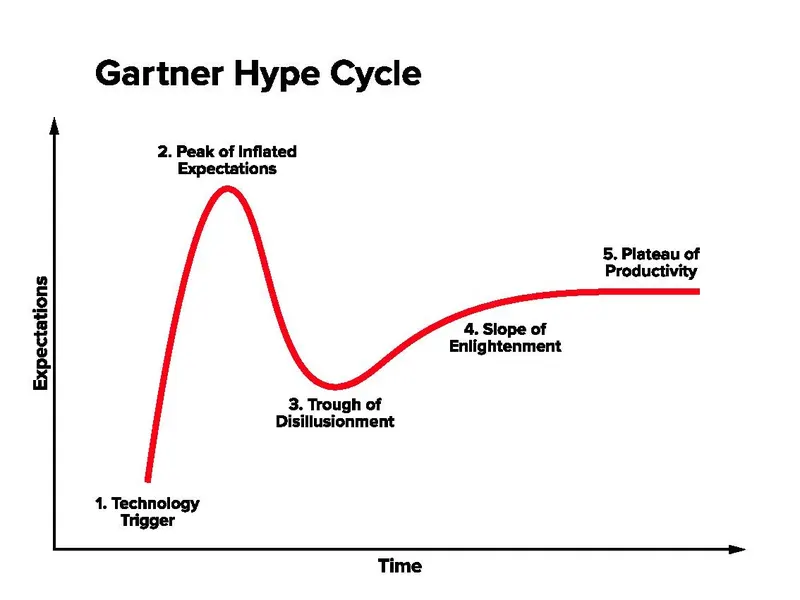
See the image below. Grant thinks we are near the "peak of inflated expectations." Recent Gartner analysis puts agentic AI right at that peak, but I still think we have more of the curve to climb before we actually get there. I agree with Grant (and Gartner) that we’re on this curve — I’m just arguing about where we are on it. And yes, it could end up being the biggest bubble yet.
We are in 1996 or 1997, not the spring of 2000.
We Are Early
About 5% of the corporate world is using the full potential of agentic AI. 85% to 90% are engaged with these tools and trying to figure out what they can actually do.
I’m deep into using all these tools, and I’m still trying to fully understand them. But I can already see their massive power and how they will change everything in the next 2 to 4 years.
I don’t think it will be as bad as most people worry. I think the net effect will be positive for employment and economic growth over time. That said, we’re about to go through a period of massive change, and change is always scary.
Once these tools are better understood, that 5% usage will move toward 85%. At that point, we’ll realize that effective, usable compute and data center capacity is still too small for what’s coming. Hyperscalers are already spending hundreds of billions, but we’re not seeing the kind of overbuilding and low utilization that usually marks the top of these cycles. The real bubble comes when spending massively outpaces productive demand. We’re not there yet because the productive demand coming will be huge.
How are we going to pay for all this?
Worldwide, corporations already spend roughly $400–450 billion a year on SaaS. That’s thousands of dollars per corporate computer — often more than they spend on the hardware itself.
A big chunk of that SaaS spending will likely get redirected or consolidated into AI. It’s similar to what happened with cameras, calculators, MP3 players, video recorders, maps, and alarm clocks — all of which eventually moved into the iPhone. AI agents should do something similar by consolidating a bunch of fragmented tools into a single intelligent interface.
The future computer probably won’t need a keyboard most of the time. It will have a big context window, and you’ll mostly just tell it what you want. You won’t have to fight with a dozen different SaaS products trying to get them to talk to each other.
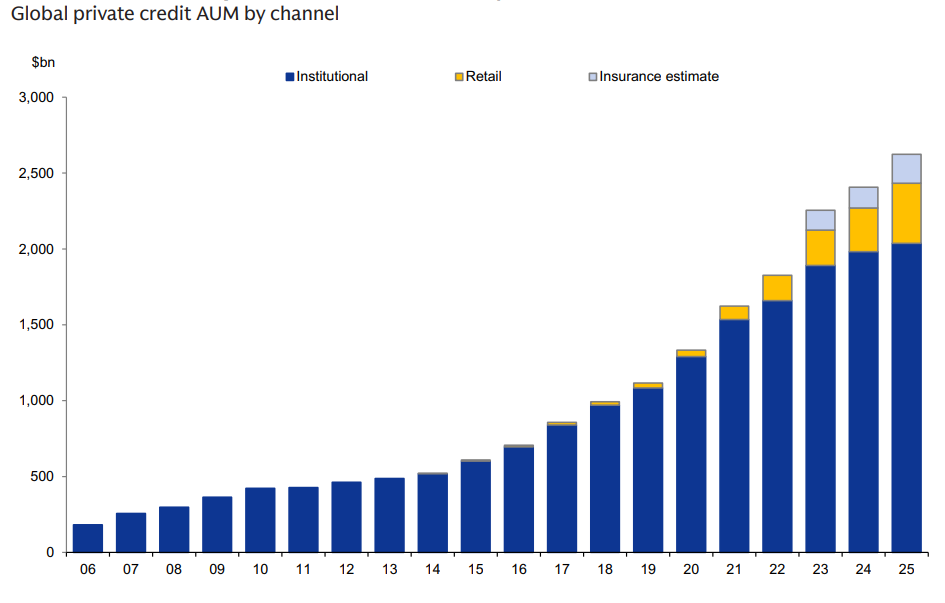
Goldman Sachs just released a detailed 26 page report on their long term view on private credit
A few charts that caught my eye
1/ Majority of private credit AUM is held by institutional investors
JP Morgan also mapped out what happens if the deal falls apart.
If fighting continues and escalates, they expect Saudi oil production to go offline. That pushes oil toward $125, possibly $150.
Everything changes from there.
In that scenario, the dollar strengthens, stocks sell off, and gold drops short term.
The only sectors JP Morgan likes if the deal collapses are:
- Energy stocks
- Oil services
- Pipelines
- Defense companies
- Fertilizer producers
Everything else gets hit.
The sectors hit hardest if the deal falls apart:
- Airlines, especially smaller carriers that could go under.
- Retailers
- Rate-sensitive stocks like real estate.
And any company with heavy borrowing costs. JP Morgan is very direct about avoiding these
Thread below covers more.
Great article in @ FT about the disconnect between the stock market, the reality of the war’s likely impact on the economy & the K-shaped nature of the economy.
The chart with the stock market soaring and job openings plummeting shows the disconnect between the real economy and prospects that people see have changed on the ground vs the surge in stock valuations. It is striking.
We entered the looking glass with the pandemic. Unlike Alice, we didn’t wake up back in a study with our cats nestled in our laps.
https://t.co/t20HbIkqM9 The stock market’s new approach to valuation
From account close to Tehran—not saying it’s correct, but it’s the first real colour we’re getting on what any interim Hormuz reopening during the ceasefire could look like:
“During the two-week ceasefire, only about 10 to 15 ships will be permitted to pass through the Strait of Hormuz with Iran's approval, in coordination with the IRGC Navy and after payment of tolls, and the United States is committed to releasing all of Iran's frozen assets. The Strait of Hormuz will in no way—even after a final agreement—be "open" as it was before.”
Relative to the pre-war pace of 100-120 ships a day, this would constitute a crack in the door and hardly a proper reopening.
Let’s see how many we get tomorrow.
BREAKING: Iran says it has "forced" the US to accept its "10-point plan" which includes the following terms:
1. Commitment to non-aggression
2. Iran’s control over the Strait of Hormuz
3. Acceptance of Iran's uranium enrichment
4. Lifting of all primary sanctions
5. Lifting of all secondary sanctions
6. Termination of all UN Security Council resolutions
7. Termination of all Board of Governors resolutions
8. Paying compensation to Iran
9. Withdrawal of US combat forces from the region
10. Cessation of war on all fronts, including in Lebanon
Trump says this plan is "a workable basis."
JUST IN: Broadcom just filed an 8-K that contains the most underpriced sentence in semiconductor history.
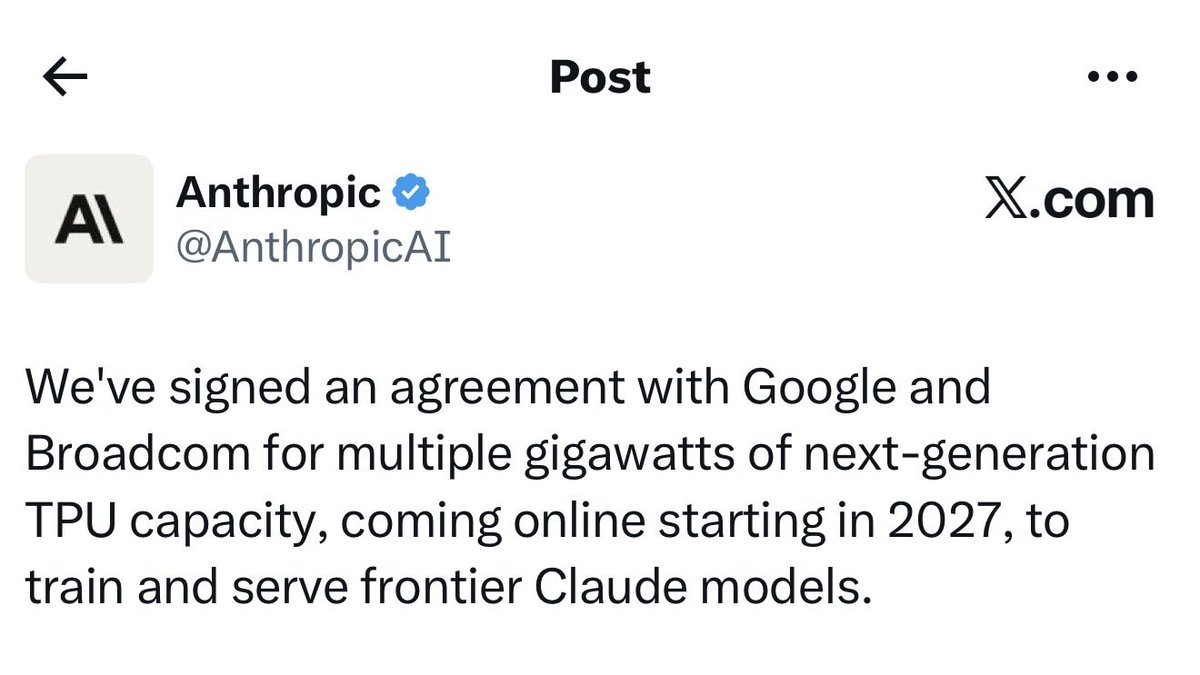
The filing confirms Anthropic Claude will access approximately 3.5 gigawatts of next-generation TPU capacity through Broadcom starting in 2027. That alone is not the story. The story is what Mizuho's math implies when you run it forward against the numbers Broadcom's own CEO put on the record.
Hock Tan guided to "significantly above $100 billion" in AI chip revenue for fiscal 2027. Mizuho estimates Broadcom will generate $42 billion from Anthropic alone in 2027. That is roughly 40 percent of Broadcom's entire AI revenue target from a single customer. A company that did not exist four years ago. A company the President of the United States ordered every federal agency to stop doing business with on February 27, 2026. A company the Secretary of War designated a supply-chain risk to national security.
Now read the 8-K language that Broadcom's lawyers required them to file with the SEC: "The consumption of such expanded AI compute capacity by Anthropic is dependent on Anthropic's continued commercial success."
Broadcom just told the Securities and Exchange Commission that roughly 40 percent of its 2027 AI revenue guidance is contingent on the commercial trajectory of a company that is simultaneously the fastest-growing enterprise software business in recorded history and the target of an active federal government campaign to cut it off from defense and intelligence customers.
Broadcom's trailing twelve-month revenue is $63.88 billion. If the Mizuho estimate holds, Anthropic alone would represent approximately two-thirds of Broadcom's current total annual revenue by 2027. For a $1.49 trillion company, that is customer concentration at a scale that no semiconductor analyst has properly stress-tested against the political risk vector. Every AVGO holder is, whether they know it or not, running a leveraged long position on Dario Amodei's refusal to let Claude target civilians with autonomous weapons. The Pentagon's designation of Anthropic as a national security threat is, by the plain language of a regulatory filing, a direct threat to Broadcom's $100 billion AI revenue target.
And here is the inversion that should stop every allocator mid-scroll …. Anthropic's run-rate revenue just passed $30 billion. Its projected Broadcom spend in 2027 is $42 billion. The company is on track to spend more on chips from a single supplier than it earns in total revenue. Either the revenue trajectory continues its 10x annual compounding and the math works, or it does not and Dario Amodei's own words apply: "There is no hedge on Earth that could stop me from going bankrupt."
The falsification trigger is precise. If Anthropic's revenue growth decelerates to even 5x instead of 10x, the Broadcom capacity clause unwinds, the $100 billion AI revenue target reprices, and approximately $200 billion to $400 billion of AVGO market capitalization is exposed to a re-rating that has nothing to do with Broadcom's technology and everything to do with whether a single customer can sustain the most aggressive growth curve in enterprise history while being actively attacked by the government whose infrastructure it is building.
The deepest irony is that Anthropic specified that the vast majority of this new compute will be sited in the United States. The company the Pentagon calls a national security risk is building more American AI infrastructure than the Pentagon can conceive of. The company Trump ordered blacklisted is Broadcom's largest growth driver. The company that refused to build autonomous weapons is the reason Broadcom can guide to $100 billion.
One regulatory filing. One conditional clause. One customer. Forty percent of everything.
https://t.co/AEv8EMPdsZ
This is a crucial point on Iran by Chas Freeman, the former US Assistant Secretary of Defense and, relevant to the topic, former US Ambassador to Saudi Arabia (also, incidentally, one of the very rare former senior US officials who's a genuinely thoughtful diplomat as opposed to a sociopathic neocon).
What Freeman explains is that Iran's control of Hormuz, which Trump implicitly admitted is beyond the US's ability to contest (by saying in his speech it's not his problem to solve, that "others" should deal with it), will necessarily lead to a reshaping of the regional order in Iran's favor.
As Freeman says, "the Gulf Arabs have no alternative but to negotiate with Iran because they cannot survive indefinitely with the Strait of Hormuz closed to their exports." Meanwhile, countries like China, India, Japan, and Turkey have already worked out transit agreements with Tehran - de-facto recognizing Iranian authority over the strait.
In effect, Iranian control of Hormuz is now a fait accompli: they control the valve on the single largest concentration of hydrocarbon exports on earth. This is a long-term reality with immense implications.
In fact it's such a massive long-term win for Iran that the way the war may ironically be remembered by history is Trump giving Tehran the ideal casus belli to seize control of Hormuz - something the world would have never accepted had they done it unprovoked.
It remains to be seen how the war ends - if it ends at all - but this may end up proving even more valuable to Iran than nuclear weapons.
For instance, as Freeman points out, one of the conditions Iran set for Hormuz passage is an end to sanctions and hostility toward them. The logical endpoint is the collapse of the entire sanctions regime - Iran trading openly with the world (save, presumably, for the US and Israel), without having to make any guarantees on its nuclear program.
In other words Trump tore up the JCPOA calling it "the worst deal in history," and his war may have replaced it with something infinitely more favorable to Tehran.
Source for the whole video (worth a watch in its entirety as are all of Freeman's talks): https://t.co/ye9h7n44Sz
The feedback on the @TruthGundlach episode has been incredible, so I'm posting the pod here on X too. 🙏
In his debut on The Julia La Roche Show, Jeffrey Gundlach, founder and CEO of DoubleLine Capital, breaks down why private credit is an unmitigated disaster, why the next recession will send rates up and the dollar down, and why most American investors are completely unprepared for what's coming.
Timestamps:
0:00 Introduction & welcome Jeffrey Gundlach
1:33 Big picture macro: secular shift from falling to rising interest rates
16:00 The case for 100% non-US stocks
17:30 Gundlach's current asset allocation
22:00 Private credit and why it's a “total unmitigated disaster"
38:00 The Fed follows the 2-year Treasury - next move a rate hike?
42:30 Recession odds
47:00 Capital preservation mode: lowest risk positioning in DoubleLine's 17-year history
50:00 The gold call
53:00 The most dangerous force in investing
56:00 California headed for bankruptcy?
1:01:00 Non-consensus prediction: three parties on the ballot in the next presidential election
1:02:00 The Fourth Turning
With the Iran conflict now in its 4th week, an important angle worth noting:
President Trump’s family business (Trump Organization) has substantial licensing deals across the GCC -
Trump Towers, hotels & golf resorts in Saudi Arabia, UAE, Qatar & Oman, partnered with government-linked developers.
The Trump Organization currently has active or announced licensing/branding deals (hotels, towers, golf resorts & residential) in 4 GCC countries:
Saudi Arabia: Multiple projects including Trump Tower Jeddah, Trump Plaza Jeddah, and Trump International Golf Club + resort in Wadi Safar/Diriyah (with Dar Global).
United Arab Emirates (UAE): Trump International Hotel & Tower Dubai (80-storey landmark with hotel & residences). Existing Trump International Golf Club in Dubai, plus further residential/hotel expansions (potential in Abu Dhabi area).
Qatar: Trump International Golf Club Simaisma + branded villas (first major entry into Qatar real estate, with Dar Global & Qatari Diar).
Oman: Trump International Oman in Aida/Muscat (hotel, golf course & residences, partnered with Dar Global & government-linked Omran).
Jared Kushner’s Affinity Partners now manages ~$6.2B AUM, the bulk from Saudi PIF, UAE & Qatari sovereign wealth funds and he is reportedly seeking billions more from the same sources while involved in regional diplomacy.
Clear economic incentives side for rapid de-escalation. As the late Charlie Munger used to say: “Show me the incentives and I’ll show you the outcome.”
History shows, unless there is a recession, equity markets almost always bottom during geopolitical shocks - well before any formal end to conflict.
$NDX $SPX
BREAKING: Google Gemini can now analyze any stock like a Wall Street analyst (for free).
Here are 10 insane Gemini prompts that replace $4,000/month Bloomberg terminals:
Save for later🔖
Breaking: Microsoft just turned Copilot into something that works while you sleep.
Copilot Tasks runs background automation across your inbox, files, calendar, and workflows without touching your day.
Here are 7 prompts to deploy immediately: ↓
Think this is largely driven by two factors
> how private credit has positioned itself
> misunderstanding of the asset class
Private equity has been a long standing area within finance. There have been multiple books written about private equity deals and the space in general
People generally understand it as an illiquid investment vehicle where large institutional investors are able to contribute capital as an LP
The same is not true for private credit
While it has been around for some time, private credit really started hitting the headlines in 2022 when SOFR and rates went from 0 to 5% within the span of a few quarters
While private equity cash flows look like a massive year 1 outflow and then a pay back in 5 years, the same is not true in private credit
Private credit loans pay interest and amortization each year. The cash flows look more like a year 1 outflow, followed by annual interest inflows, and then a bullet maturity payback inflow in year 4 or 5
This allowed some firms to position private credit as liquid or semi-liquid, in the form of BDCs
This works when things are going well, redemptions are low and most of your companies are paying cash interest regularly
However, the music stops when redemptions start clearing above the cash flow in interest that you collect
While your loans might be fine, you have a timing mismatch problem where your payback period on a loan no longer aligns with redemptions
This is what is happening right now
People also generally freak out whenever they hear stress in “credit”
Call it memory or reflex, but credit related headlines tend to be almost automatically ring off alarms about the 2008 GFC in a lot of people’s minds
The reality is that compared to the CDOs during ‘08, private credit carries much more modest leverage
People should understand that most of private credit, which is direct lending, sits above a mountain of equity from the private equity firms
These are mostly first lien secured positions. Any impairment in the credit would only happen once all the equity has been wiped out
If you are worried about private credit impairment, you first have to believe that all of that equity will be a zero first
CPI headline figures of 2.4% are artificially suppressed by the lapse in data collection during the six week government shutdown.
Under the hood, there is a disturbing acceleration in core service sector prices which means that the Fed has more work to do beyond the supply shocks due to tariffs and oil prices. That is all in addition to the supply chain disruptions beyond oil due to the closure of the strait. We learned in the wake of the pandemic that production is easier idled than restarted. This is key, as it could cause larger scarcities.
Those shifts are coming at the same time last year’s tax cuts are showing up as a surge in tax refunds. That will help blunt the blow to consumer wallets.
However, we learned in the wake of the recession pandemic that stimulus in the wake of scarcities caused hotter inflation that was anything but transitory.
The key difference is a lack of employment, but the supply of workers is also constrained. That is a problem, as the two together still enabled service sector inflation to accelerate at year end and into 2026.
The Fed meets next week and will stay on the sidelines. It is scheduled to release its forecast for growth, inflation, unemployment and the trajectory for interest rate moves. Governor Miran will no doubt dissent in favor of an additional cut, but I would not be surprised to see at least one participant at the meeting to pencil in a rare hike instead of a cut.
Credit market conditions have tightened on their own in the wake of strikes on Iran. That may or may not be enough to derail an inflation that has persisted for five years.
Nothing is more visceral for consumers and their perceptions of inflation than prices at the gas pump. This is not the 1970s but the shock of the speed of change in prices is stunning and could futher unmoor inflation expectations.
Mark Cuban just explained AI better than ANYONE in silicon valley has all year…
a tool. a way to learn. the biggest democratization of knowledge we've ever seen.
but he's also splitting people into two camps.
>ones who use AI so they don't have to learn anything.
>ones who use it so they have the opportunity to learn everything.
this split is going to define the next decade of careers.
which side are you on?
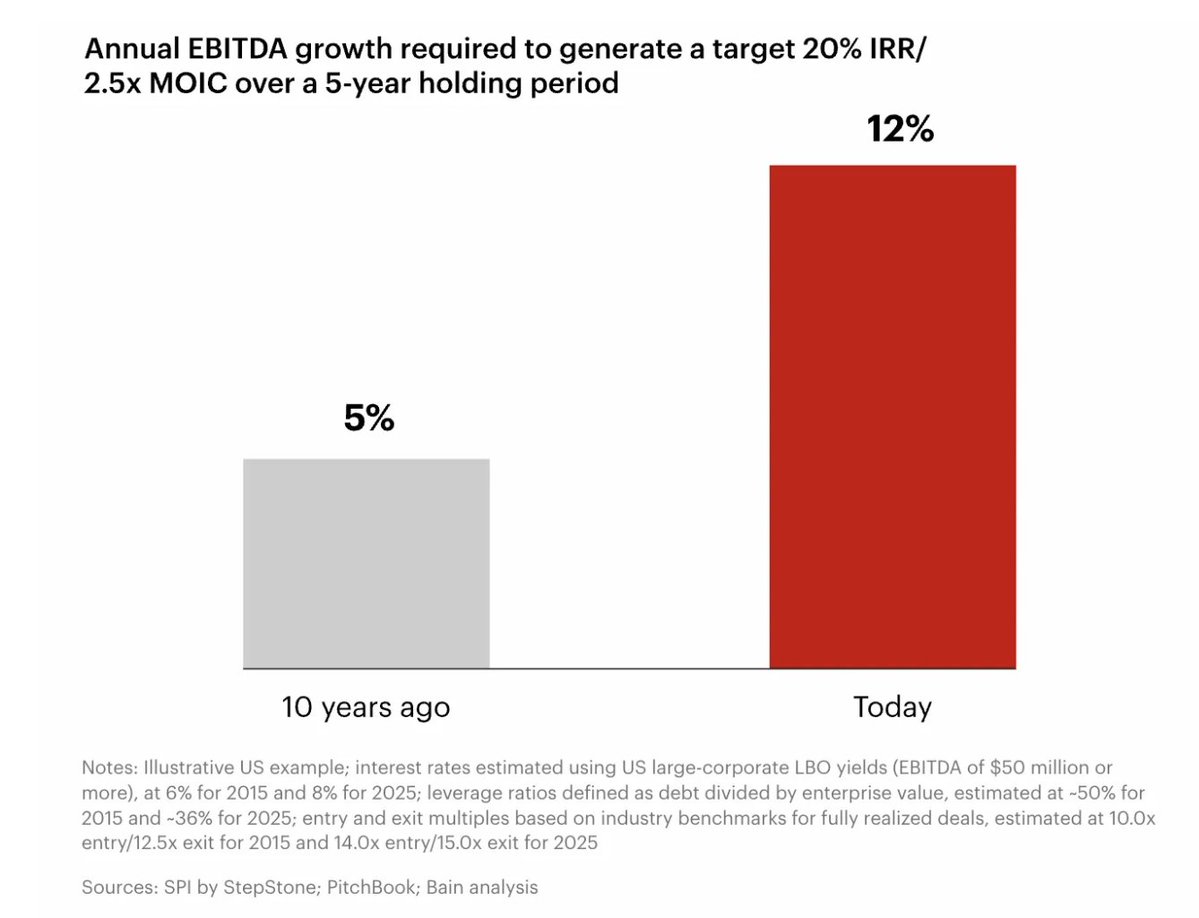
In 2015, in a typical buyout PE deal, a sponsor only needed to generate 5% annual EBITDA growth to hit 2.5x MOIC over 5 years:
- borrowing was cheap (50% leverage at 6-7% interest rate)
- multiples were expanding
The math today is A LOT harder:
- borrowing costs are ~8-9%, and leverage is down to 30-40%.
- add record-high purchase multiples (that are no longer expanding), and
- it now takes much larger increases in EBITDA (10%–12%, according to Bain) to generate that 2.5x return over five years
Great chart from Bain, all links here: https://t.co/X2L7kOwNIQ
This is potentially the biggest Iran story nobody is talking about: the global insurance market may be heading toward a systemic crisis. Here’s why…
Most people don’t realize London isn’t just a financial center it’s THE center of global insurance.
Lloyd’s underwrites ~40% of the world’s marine cargo. Ship sinks, port gets bombed, canal gets blocked the bill lands in London.
This is why the UK punches above its weight. Not the Royal Navy. Not diplomacy. Insurance.
Control insurance, control trade.
And London doesn’t just control the 90% of global trade that moves by sea. Lloyd’s and the London market are major insurers of almost everything skyscrapers, factories, ports, satellites, entire supply chains.
You can’t participate in public markets or raise large amounts of capital without insurance.
Now, the normal playbook for war risk is repricing, not cancellation.
Canceling coverage entirely is a massive escalation in underwriting posture. It signals something beyond risk, it signals uncertainty so deep the underwriter can’t even price it.
The question everyone should be asking: why?
Why not just jack up premiums and make a fortune off the crisis like they did in the Black Sea off Ukraine?
To answer that, you have to understand WHY London has maintained a stranglehold on global insurance while losing nearly submarket related to ships.
The answer: better intelligence.
It is no coincidence that MI6 headquarters sits directly across the Thames from the @IMOHQ, the world’s maritime regulator & a short distance from Lloyd’s itself.
I have no proof of a direct pipeline, but it has long been speculated in the industry that intelligence flows from MI6 to Lloyd’s.
Having the best intel in the world would be the single greatest competitive advantage any insurer could possess: the ability to price risk that competitors can only guess at.
Here’s the problem: the majority of MI6’s intel doesn’t come from its own agents. It comes from Five Eyes the alliance comprising the US, UK, Australia, Canada, and New Zealand.
And within 5Eyes, the dominant partner is obvious. The CIA, NSA, NRO, etc generate the lion’s share of intel.
So if Lloyd’s pricing advantage flows from MI6, and MI6’s best intelligence flows from the US… what happens when that data pipeline gets throttled?
All indications are that @Keir_Starmer was blindsided by the size and scope of the US/Israel strikes on Iran this weekend. That alone tells you something about the current state of transatlantic intelligence sharing.
And we know there has been serious anger in Washington over the UK’s decision to sell Diego Garcia, home to America’s most strategically important base in the Indian Ocean, to Mauritius.
It is not a huge leap to conclude that the submarine cables linking Langley to London have gone dark, or at minimum have been significantly throttled.
What this means for UK national security is a question for the Brits. But what it means for EVERY company globally that’s insured through the London market has massive implications for the entire financial system.
Because most large insurers worldwide don’t do independent intelligence work. They index off Lloyd’s rates.
If you’re insuring a skyscraper in Tokyo, a semiconductor fab in Taiwan, or a port in Argentina you get a Lloyd’s quote, then shop that price around.
Other insurers see Lloyd’s number and assume the diligence was done. They price accordingly.
This means if London is suddenly flying blind it’s not just Lloyd’s policyholders at risk. It’s the entire global reinsurance chain.
The cancellation of war risk coverage on ships isn’t the crisis. It’s the canary.
If this hypothesis is correct, we could be looking at a systemic repricing event across global insurance markets…. the kind of cascading uncertainty that defined 2008 and COVID.
Watch Lloyd’s. Watch reinsurance spreads. What Five Eyes. That’s where this story, and possibly Wall Street, breaks.
CC @BillAckman
Most people treat their HSA like a checking account for copays.
That’s a mistake.
Used correctly, an HSA can quietly become one of the best long-term wealth tools you have.
Here’s what almost no one explains 🧵