2026 Hyperliquid Q1 Report
Today, we're excited to release Hyperliquid's 2026 Q1 Report.
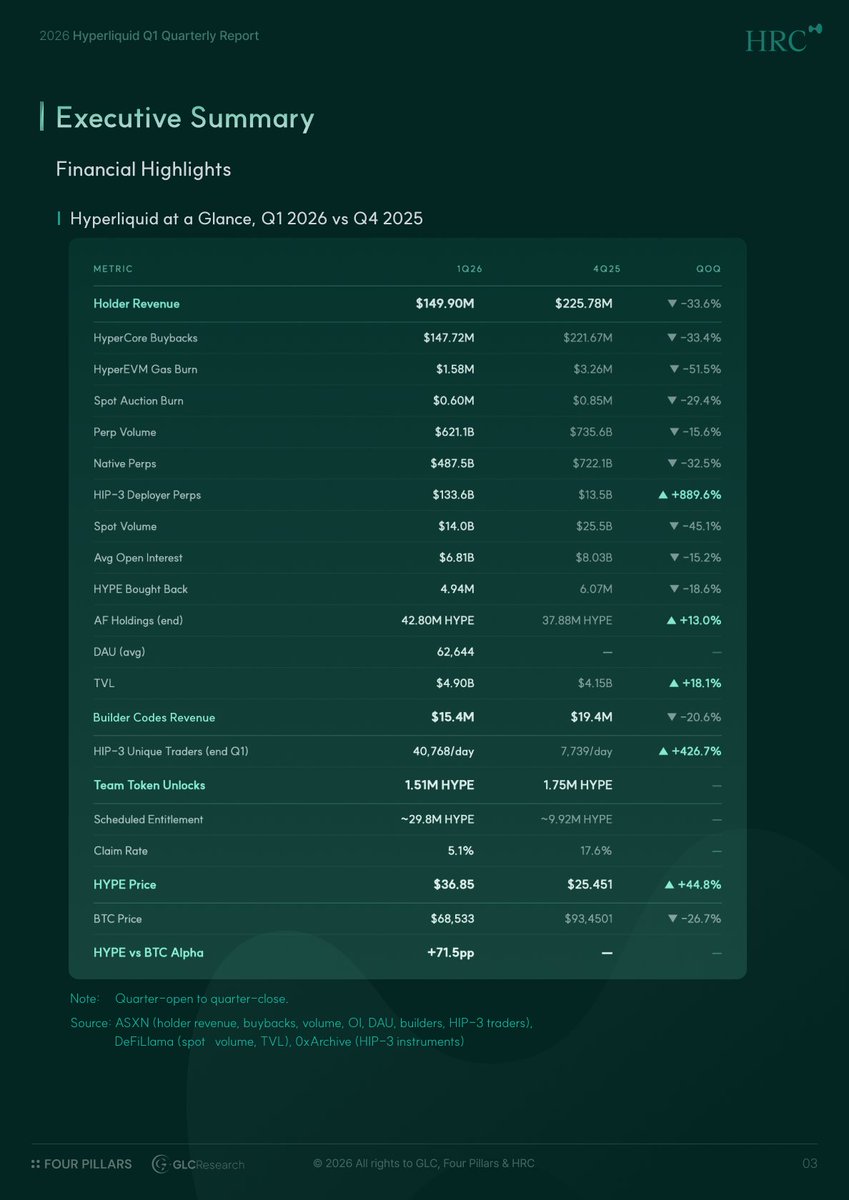
While Q1 stands as one of crypto’s most challenging quarters since 2018, Hyperliquid emerged stronger. As markets fell sharply, the protocol continued to gain traction, with HYPE returning +44.2% and entering the top 10.
More importantly, the quarter brought Hyperliquid closer to the “House of All Finance” vision, from institutional recognition through S&P Dow Jones to emerging as a price discovery venue for oil and other assets.
Enjoy the read. Some excerpts below, with the link to the full PDF.
Hyperliquid.
Introducing SEDA Outcomes, an ultra-low latency endpoint purpose-built for HIP4 markets.
Outcomes is already live, powering leading deployers:
@Outcomexyz@Perpsdotfun@StratiumX@HyperOddX
apple products are sold out. infinite demand for inference, rate limits everywhere. anthropic & openai growing at ridiculous pace. nvidia & google at all time highs. record meta earnings.
we are now more supply constrained than demand constrained. i suspect we’ll see inflationary pressure again very soon.
fundamentally, technology is the economy, & the economy is technology.
I want to share my thoughts on hyperliquid’s latest priority fees update. I think it’s going to significantly change the market structure there going forwards longer term.
A lot of the best market makers on HL - Alber Blanc, Pinely etc. are latency edge guys. They’ve already invested significant resources into trying to simulate what the next TOB is going to look like from pre-validated transactions, like by emitting raw mempool transactions from the node or by reverse engineering the binary to listen to the gossip data. Infra like this is all useless now, because you can literally just pay for it. There's a Dutch auction for the slot, you send your IP with your bid, and if you win, the IP gets whitelisted and prioritised, so the gossip data comes 10ms before everyone else.
The change to order priority fees is also interesting - you pay up to 8 bps to reduce the latency of your order. They say it’s empirically 45ms of latency reduced per bp paid, so max of 360ms faster - I haven’t tested this. Under the new system, if a maker cancels their order, that still gets processed first, but for the remaining executable orders, whoever paid more is matched first. Currently it looks like there aren’t that many people bidding for the market data, and even fewer (if any) bidding for the order priority. I think this is because Hyperliquid already implements a speedbump on taker orders which is roughly 250ms but can spike up to half a second so it’s already harder to take - the block time is ~70ms so this is ~4+ blocks as it is, and makers have plenty of time to cancel their liquidity.
These fees are paid in HYPE and burned. This isn’t really new - when protocols see trading firms making money they often want to extract more of a cut. Arbitrum did a similar thing with the timeboost auctions, and I’d say this was pretty successful, in that roughly 20-30% of the latency sensitive dex flow moved onto timeboost, and volumes didn’t meaningfully change. We’re sitting at around a year since they shipped this, and timeboost brought in around $7mn in revenue in this time. This is on (roughly) $300bn in volume, so with Hyperliquid at approx. 10x this, I can see the bull case for them to move to this kind of model.
Objectively, I think it’s a smarter version of Lighter’s design - Jeff basically just waited to see what Lighter’s business model would look like, improved it, shipped it to testnet on April 10th, and rolled it out to mainnet within a week. I don’t think any firm has had time to think about the game theory of how to bid yet and optimise this, but it should basically completely collapse the gap between the top MMs.
Disclaimers - I’m long some HYPE and haven’t sold LIT airdrop (yet).
Look guys, it's actually really straightforward, a bunch of people staked their ETH on the Ethereum blockchain to earn yield, except they didn't want their capital to be locked up, so they actually staked with a liquid staking protocol called Lido who provided them a liquid staking receipt token called stETH, except they decided to juice their yield further by depositing their stETH receipt tokens into a restaking protocol called Eigenlayer, except they didn't want to lock up their capital, so they actually restaked with a liquid restaking protocol called KelpDAO who provided them with a liquid restaking receipt token called rsETH, except they decided to juice their yield further by depositing their rsETH tokens into a lending protocol called Aave so that they could open a leveraged looping position that borrows ETH against the rsETH collateral and restakes the ETH into rsETH which is then deposited as collateral, except it turns out rsETH used a cross-chain bridge called LayerZero that was hacked by north koreans causing rsETH to become undercollateralized and now these looping positions are stuck and unprofitable, and everyone is pointing fingers at each other, and also DeFi is a very serious industry
Prev Hyperliquid Offramp Flow:
1. Settle your trade to stables
2. Transfer your stables from spot → perps balance
3. Withdraw to Arbitrum, wait ~5 minutes
4. Use a gasless swap or transfer ETH to your wallet
5. Send your stablecoins to a centralized exchange
6. Navigate landmines of 40-100bps fee swap options
7. Find the hidden withdraw button
8. Avoid another landmine of 150-350bps instant withdrawal fees
New Offramp Flow w/ USDHdotcom:
1. Input your bank (or brokerage)'s Wire / ACH instructions
2. Save persistent HyperEVM deposit address (Rabby Contact)
3. Send USDH to your persistent deposit address, receive USD straight to your bank. No fees, no slippage.
Don't go back to your (C)EX 😼
Gold trades at different prices in Shanghai and London.
The spread tells you more about capital flows and central bank policy than most macro indicators.
Derivatives aren't a Wall Street product. They're the purest form of a market. A leveraged view on anything. The real world trades thousands of markets across dozens of regions. That gap is where we're building @Scape_Exchange
Crypto built 24/7 permissionless markets. Commodities are the largest derivative markets on earth.
That convergence is just getting started.
Powered by @HyperliquidX
Thanks for the thought-provoking piece.
My main critique is that you are overemphasizing flashy but low probability events like “left-handed bacteria,” while merely giving lip service to the risk of extreme economic concentration of power, which is very real and materializing as we speak.
Anthropic is reportedly raising funds at a $350B valuation, and the wealth created thus far has been concentrated into a few hundred (perhaps more like dozens) high net worth individuals / institutions. It’s looking increasingly likely to me that none of the leading AI labs will IPO until they reach valuations in the trillions, at which point retail investors will finally be able to get shares. In order for retail to get a 100x return on these investments, which was achievable for Apple, Microsoft, Amazon, and Google, the valuations of the AI labs will need to reach hundreds of trillions of dollars, meaning it’s likely too late for a more equitable redistribution of wealth.
Simply put, you are currently exacerbating the problem. The consequences of this are that voters may take matters into their own hands and push for either or both 1) more aggressive / nonsensical forms of redistribution — the CA Founders’ Tax is just the beginning or 2) a drastic knee-capping of the AI industry in America, which make the CCP dominance scenario more likely.
The solution is to enable retail ownership now, increasing the number of Americans with economic exposure to Anthropic and other AI labs from hundreds of people to millions.
The wait is over. The Solodit API is now live.
Get instant access to 50,000 smart contract vulnerabilities. Free. No application required.
Here’s what you need to know 🧵