❗️Important update❗️Our research group has a new Twitter account @UCL_SBB which will now be our main channel announcing publications, project launches, upcoming events and more.
PLEASE NOTE: this account will remain live but we will no longer be tweeting from here
We're thrilled to share with you our research report summarising our findings from the COVID-19 Social Study. Download a copy of the report below & don't forget to sign up to our webinar in October hosted by @NuffieldFound! 👇
@Daisy_Fancourt@UCL_BSH
https://t.co/fUkQ59cYvS
During the pandemic, increases in physical activity were associated with:
😴 improved sleep
🍎 better nutrition
🍺 more alcohol consumption
🛋 increased sedentary time
in our latest study of 52,784 @C19socialstudy participants.
@UCL_BSH@UCL_IEHC
https://t.co/iJV22DypNq
Hot off the press! Liam Wright, @andrewp_steptoe and @Daisy_Fancourt explore how compliance with COVID-19 guidelines varied throughout the pandemic and what factors were associated with declining compliance.
https://t.co/OVxP5m3LRy
Exciting event opportunity 📣 On 4th October we'll be holding a webinar on the findings and impacts of the pivotal COVID-19 Social Study led by @Daisy_Fancourt & Prof James Banks. All welcome, sign up below 👇
@UCL_BSH@UCL_IEHC@UCLPopHealthSci@uclnews
https://t.co/dKFTh7EE3s
Hot off the press! What is the association between urban greenspace coverage & the growth trajectories of anxiety symptoms? Read more on this relationship during the pandemic here👇👇
@FeifeiBu @Karen_MakHW @andrewp_steptoe @benedictwheeler @Daisy_Fancourt
https://t.co/gGO4B94VEJ
"I am really impressed at how we have managed to collaborate together. The fact that you and I are talking and that the COVID-MINDS Network exists is a credit to us."
@Tamsin_J_Ford's insights on the MH crisis of young ppl & how researchers can respond
https://t.co/AWd9RVj818
Our team @a_r_mckinlay@DrElisePaul1 & @Karen_MakHW give a presentation of the COVID Social Study at the #DHPConf.
Topics discussed include mental health throughout the pandemic, arts engagement, physical health, community and ways in which we coped.
If you're interested in learning about how dance can support the wellbeing of young people living with anxiety do sign up to this webinar. Follow the link to sign up & discuss the Dance/Connect research project led by UCL in partnership with Dance Base. 👇
https://t.co/u7nceKMnLb
NEW: How did spending time outside impact our mental health during lockdown?
Sarah Stock, @FeifeiBu, @Daisy_Fancourt & @Karen_MakHW conduct a longitudinal analysis to identify moderators that influenced this relationship such as neighbourhood "walkability"
https://t.co/jwg5eSpVUO
New article! Our team explore the socio-structural inequalities that have disproportionately effected people who inject drugs. @tommayucl @DawesJo@Daisy_Fancourt & Dr Alex Burton highlight the need for additional support to address these vulnerabilities
https://t.co/sANS55CrGO
New publication! We explore changes to perceived socioeconomic & psychosocial adversities during COVID-19 for cultural workers. Some really interesting findings in relation to changing valuing processes & relational priorities @tommayucl @Daisy_Fancourt https://t.co/CYu7SD8vcl
Does racial/ethnic discrimination predict future COVID vaccine refusal?
@DrElisePaul1@Daisy_Fancourt and @MohammadRazai conduct a longitudinal study to to learn whether trust in the government and the health system have a role to play in vaccine uptake.
https://t.co/j0EPp0hDOQ
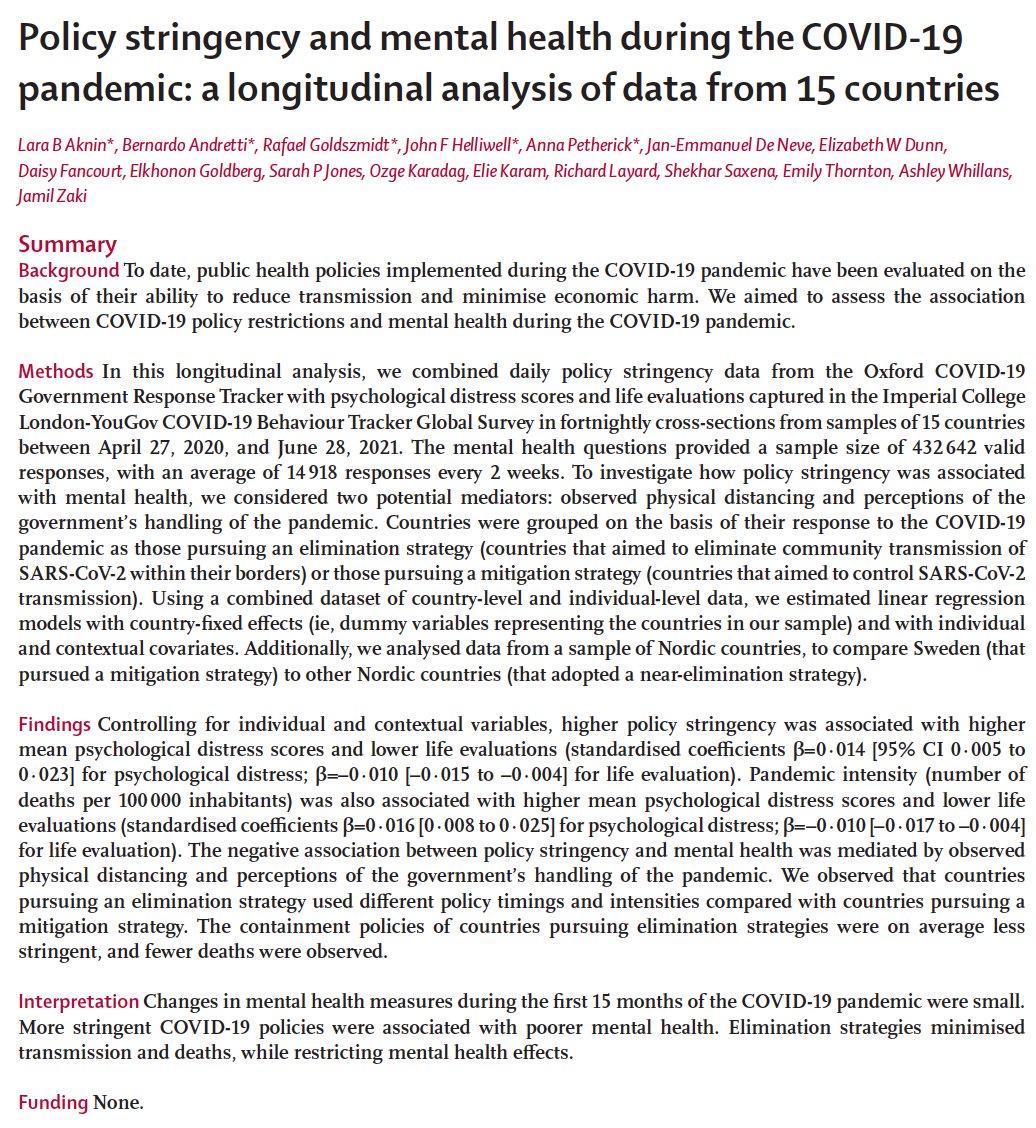
NEW PAPER in @TheLancetPH : Public health policies implemented during COVID-19 have been evaluated primarily on their ability to reduce transmission and minimise economic harm. But how are COVID-19 restrictions associated with short-term mental health? 🧵
https://t.co/J4g4Wpapog
More people are now more worried about their finances (38%), than catching Covid-19 (33%), according to the latest UCL @C19socialstudy findings led by Dr @Daisy_Fancourt@UCL_IEHC@UCL_BSH https://t.co/r2OWIEKQy1
Our study using data from @C19socialstudy is now in Psychological Medicine @CambUP_Psych. It looks at longitudinal changes in days of not leaving the house/garden and how they were related to depressive and anxiety symptoms.
https://t.co/iYsHrFz6eN