10/ Personally, I wouldn’t blindly believe the company being investigated.
But I also wouldn’t blindly believe the people investigating it.
I’d read the report.
I’d read the evidence.
I’d read the company’s response.
Then I’d check what actually happened afterward.
Do your own homework.
Because in markets, the loudest story isn’t always the most accurate one.
9/ Companies should absolutely be investigated.
Bad companies shouldn’t escape scrutiny just because the investigation might hurt them.
But the investigators aren’t beyond scrutiny either.
Especially when financial incentives are somewhere in the picture.
8/ And honestly, this principle shouldn’t only apply to Hunterbrook.
If any organization is publishing stories capable of moving billions of dollars in the market, I think transparency should be expected.
Who is involved?
How was the information obtained?
Are there financial interests?
What happened after the story?
Fair questions.
7/ The real test comes later.
Take an old Hunterbrook report and compare the original claims with what eventually happened.
6 months later.
12 months later.
That tells you much more than the first-day market reaction.
6/ Because there’s an easy mistake people make.
A stock drops after a report, so they assume the report must have been correct.
Not necessarily.
All we know from the price movement is that the market reacted.
That’s it.
5/ I’d also look backwards.
What happened with their previous investigations?
Did the claims hold up?
Did the companies successfully dispute them?
Did later filings confirm what was reported?
And what did the business actually look like several months later?
4/ The more serious the accusation, the more convincing the evidence should be.
If you’re accusing a company of something major, “trust me” isn’t enough.
Investors should be able to look at the evidence and decide whether the conclusion actually follows.
3/ Then comes the most important part:
What’s the proof?
Not the scary headline.
Not the bold conclusion.
Show me the documents, filings, interviews, sources and facts that actually support the story.
2/ Imagine someone publishes a story saying a company is in serious trouble.
The stock drops.
Before deciding the company is actually in trouble, I’d want to know:
Was there a financial position involved?
That’s a pretty reasonable question.
1/ First, understand the setup.
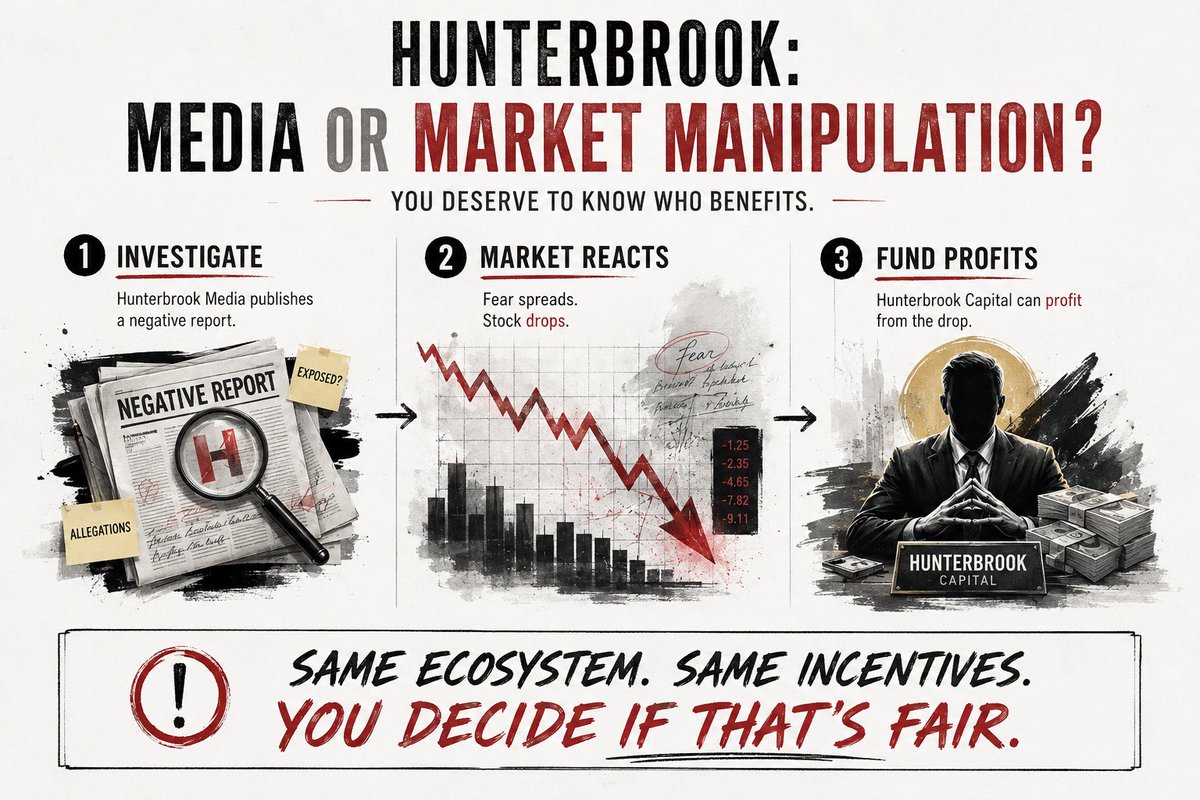
Hunterbrook combines financial journalism with an investment operation.
Again, that doesn’t automatically make their journalism bad.
But when money and market-moving stories exist in the same ecosystem, I think readers deserve to know exactly what the incentives look like.
Hunterbrook recently got my attention..
It’s a media company, that also has a hedge fund tied to the broader operation.
But If your research can move a stock and there can also be money made from that move, people have every right to ask questions..
🧵 Here’s how I look at it:
HE RUNS 6 AI AGENTS ON ONE SHARED COMPUTER. THEY MANAGE HIS HEALTH AND HIS INBOX WITHOUT HIM TOUCHING EITHER.
not one chatbot. six specialized bots, one cloud machine, running while he’s offline.
the fleet:
→ tracker bot: pulls apple watch, whoop, oura data 24/7, flags anomalies
→ dash bot: rolls it all into one family health dashboard
→ fit bot: rewrites his workout based on today’s whoop recovery score
→ calm bot: pings him the second his heart rate spikes
→ doc bot: books doctor appointments through his insurance, no calls
→ zero & chief: keeps gmail at inbox zero, automatically
no dashboards. no app-switching. no manual scheduling.
he skipped the client software entirely and built a fleet instead.
grok bot: shared cloud computer, multi-agent, chat-first control.
this is what “AI agent” means when people stop using it like a buzzword.
This one is for the BIG BRAINS..
like me (joking👀😂)
It’s for everyone!!
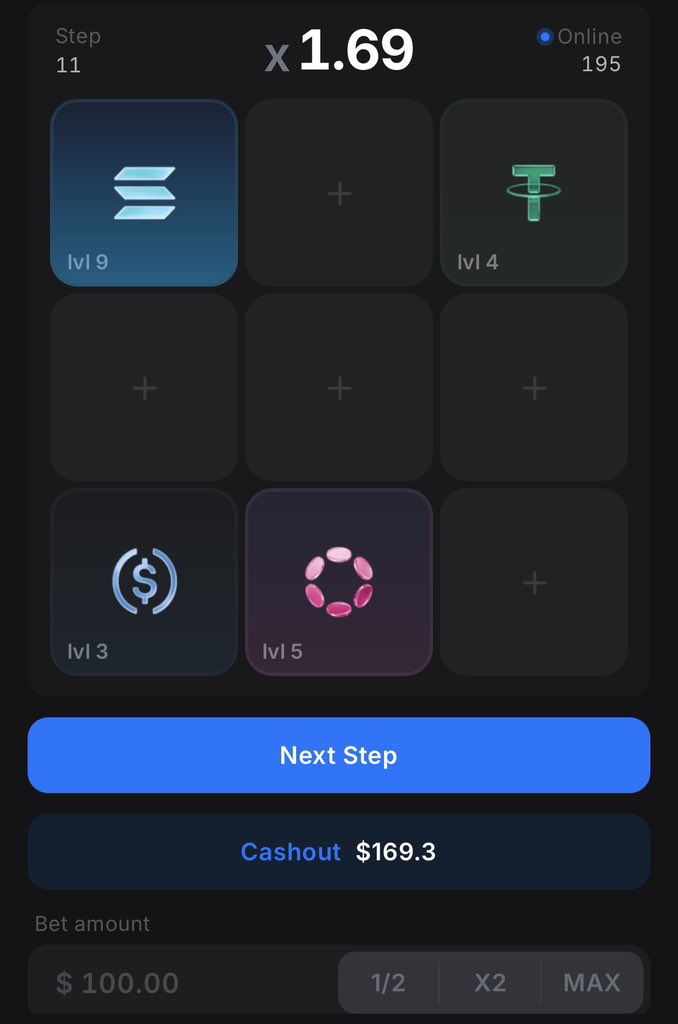
I was able to make $69 profit from $100, in just 11 MOVES
gud tek and gud game if you ask me.. @1winPro is cooking :)
try it too👇
https://t.co/F5eE8DcfJL
This is f**king dangerous…
someone just figured out how to run Claude Code, Codex, and Cursor inside Grok Bot
here’s how to set it up in 4 mins:
> copy the “setup-grok-prompt”
> give it to your agent
> you’re done
a 24 years old running a faceless YouTube channe, he’s never shown his face on camera. his channels made $40,000 last month.
no personality. no camera. no lighting setup. everything the internet says you need to succeed on YouTube he skipped all of it.
he runs faceless channels in high-traffic niches military tech, sports, true crime.
he opens Gemini. refuses to touch ChatGPT, calls it garbage. prompts it to write a full ten-minute script something like why a modern human wouldn’t survive the Middle Ages.
he doesn’t stop at the first draft. he argues with it. forces rewrites until the pacing actually lands.
script goes to ElevenLabs. hyper-realistic AI voiceover, more human-sounding than most actual humans on camera.
if he wants to save time, forty dollars on Fiverr gets it stitched together. if he wants to save money, he does it himself in CapCut.
back to Gemini for a thumbnail concept built to outperform whatever’s already ranking in the niche.
posts it. never runs an ad. the algorithm does the rest.
one channel alone: $18,000 on the dashboard.
the traditional creator economy is obsessed with authenticity.
the ghost economy doesn’t really care if you exist.
most people will watch this and call the niche saturated.
a few will open a new tab.
THIS IS CRAZY.
Someone built an entire AI research desk with Grok Bots for roughly $200/month.
A traditional Wall Street research setup can reportedly cost around $294K/year:
→ $27K — Bloomberg Terminal
→ $22K — Refinitiv
→ $50K — sell-side research
→ $15K — AlphaSense
→ $180K — junior analyst
His alternative?
6 AI agents for roughly $2,400/year.
Each agent has one job:
1. FILINGS — scans company reports and flags unusual changes
2. EARNINGS — analyzes earnings calls for important signals
3. SECTOR — monitors industries for relevant developments
4. INSIDER — tracks insider activity and major fund positions
5. CHATTER — monitors X for unusual company-related activity
6. CHIEF OF STAFF — reviews everything and delivers the key findings
They can run overnight and compile the research before the market opens.
Instead of waking up to hundreds of pages of information, you wake up to one organized briefing highlighting what matters.
And here’s the wildest part:
The person who built the system reportedly published the prompts and complete setup.
The video below walks through how to build the entire thing yourself.
One human. Six AI agents. A research desk that never sleeps.
What if you could trade $CC without first having to sell or swap it?
That is now possible on @Canborsa_DEX. Canton Coin can be used directly as collateral for perpetual trading.
In this thread, we will be discussing about the latest update which removes a common barrier and gives the native token clearer utility inside an active market
🧵👇
only those who found a leverage and built on it are winning in this circle
bet me, if you keep chasing everything, you’ll keep loosing and if you’re the type that prolly lacks risk management, you’ll get liquidated
people who make these kinda mistakes hardly make a comeback
don’t go back to zero