It’s great to see the open-source @CADLabs_org radCAD modelling and simulation framework being built upon and extended by @tokenomiapro and @woocash_eth for Simulation as a Service (unfortunately, SaaS is already taken…)!
It was a pleasure spending the day at the @EthCC token engineering track, presenting about our experience building high-performance simulations of Web3 protocols using radCAD. Thanks, @akrtws, @Kaidlyne_Neukam, and the rest of the @tokengineering team, for a superb event!
I’m looking forward to be representing @CADLabs_org and presenting during EthCC on the topic of “building simulations that scale”. Thanks to @tokengineering and @akrtws for organising the token engineering track!
Last chance to join our CADLabs Token Engineering 101 Workshop! 🚀 This Thursday, 4th of April, at 16:30 GMT. An introductory workshop to core concepts in token engineering: complexity science, mechanism design, and building simulation models in Web3 🛠️
16/16: 💬 What do you think will lead the next wave of NFT lending? Liquid instrument tokenization, the diverse world of long-tail assets, re-discovering debt market dynamics on-chain, or something else altogether? We’re keen to hear your thoughts!
10/16: ⚖️ The @rwa_xyz Guest Post Primer discusses the Pincer Movement Thesis: Re-legdering of non web3-native assets will start at both ends of the liquidity spectrum, and move towards mid-liquidity markets in the longer run.
15/16: 🔮 Looking Ahead: The journey of NFT lending is one in which there is potential for greater liquidity in markets for long-tail assets and unprecedented diversification and aggregation of yield-bearing assets and instruments on secure financial infrastructure.
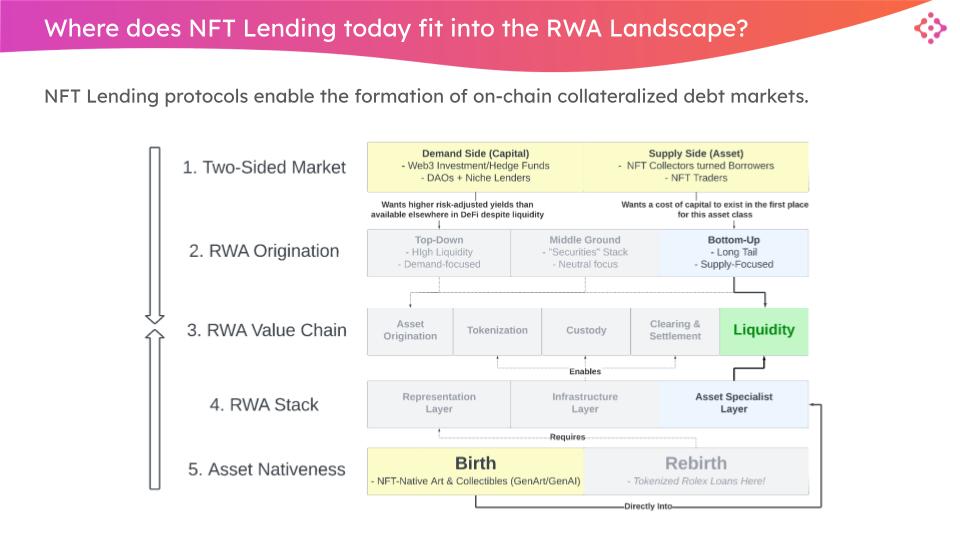
9/16: 🌉 Bridging Gaps: The future of NFT lending lies in vertical integration with "re-birth" asset originators, bringing diverse assets on-chain. But which asset class will find its market fit first?
8/16: 🏗️ Role in the RWA Stack: NFT lending protocols are “infrastrucutralists”, protocol types (mainly p2p and p2pool) have emerged focusing on the crucial layers of clearing/settlement and liquidity.
7/16: 🔄 Supply & Demand: The demand side (capital providers) want higher risk-adjusted yield than elsewhere in DeFi, even in light of liquidity constraints. The supply side (asset providers) want a cost of capital to exist for their assets in the first place (ie: a borrow rate).
6/16: 🔒Assets: Loan primitives in NFT lending are themselves "birth" assets, backed by the intrinsic value of collateral used. This market is fueled by niche lenders with specialized domain knowledge. Loans taken out against rebirth RWAs can be seen as a hybrid primitive.
5/16: 🔄 NFT lending protocols are shaping fully on-chain collateralized debt markets, the majority of outstanding debt on these protocols is on "birth" assets like on-chain native Art & Collectibles. Let’s see how the flowchart introduced last week is adapted here:
3/16: 🌍 Within the NFT Financialization space, NFT lending markets stand out as the key consumer use case outside of spot markets for NFTs (@opensea , @blur_io). We’ll focus on these today.