Filtration reduces PM in wildfire smoke, air pollution, & airborne infectious disease (RSV, influenza, COVID-19, and norovirus). It should be a no-brainer to filter air before you breathe it. Air pollution is the 2nd most deadly health risk worldwide.
https://t.co/8VbeVdeW5e
Join us on October 24th as our co-director, Kimberly Prather, will be speaking at @americanacad about our research on how ocean and river pollution affects air quality in South Bay.
Sign up at https://t.co/slDti3FYLy #enviroscience#tijuanariver#crossborderpollution
Did you spot our electric van around this week? 👀🚐
We’re cruising Southern San Diego with state-of-the-art air sampling equipment with our partners from UT Austin. Our goal is to map smells and pollution, giving us a clear picture of what’s in the air you breathe. +
Exciting alert!! My first co-authorship from grad school has been published!! Check out our new article in Atmospheric Chemistry and Physics: “Effects of Wind Speed on Size-Dependent Morphology and Composition of Sea Spray Aerosols”
https://t.co/ZEB6NBw9pF
A 99-second overview of our @CAICECCI research by @Scripps_Ocean comms. So proud of our team that made this possible!! The plan is to get these results in climate and air quality models by working with Max Planck Institute for Chemie in a wonderful new collaboration!!
...and growth. These results can be used to improve the parametrization of SMA in climate models and their predictive power of future Earth scenarios.
https://t.co/aW4zTwKrZI
New paper from our group! 🎉
Secondary marine aerosols (SMA) have been shown to significantly contribute to the marine atmosphere by affecting the formation and lifespan of clouds. Prior research has focused on single VOC studies, leading to a gap in understanding SMA. +
In this work we look at how mixtures of marine relevant gases impact SMA formation by analyzing the aerosol yields and composition. We found that mixtures of VOCs impacted the production of sulfate and methanesulfonic acid, two species that play a key role in aerosol formation...
🌊 Step into the lab to see how scientists are using a unique instrument, SOARS, to understand how human activities are changing the chemistry of the ocean and atmosphere. Scripps Oceanography PhD student & @CAICECCI member @RLeibensperger3 shares more ⬇️
https://t.co/15zP2r06n1
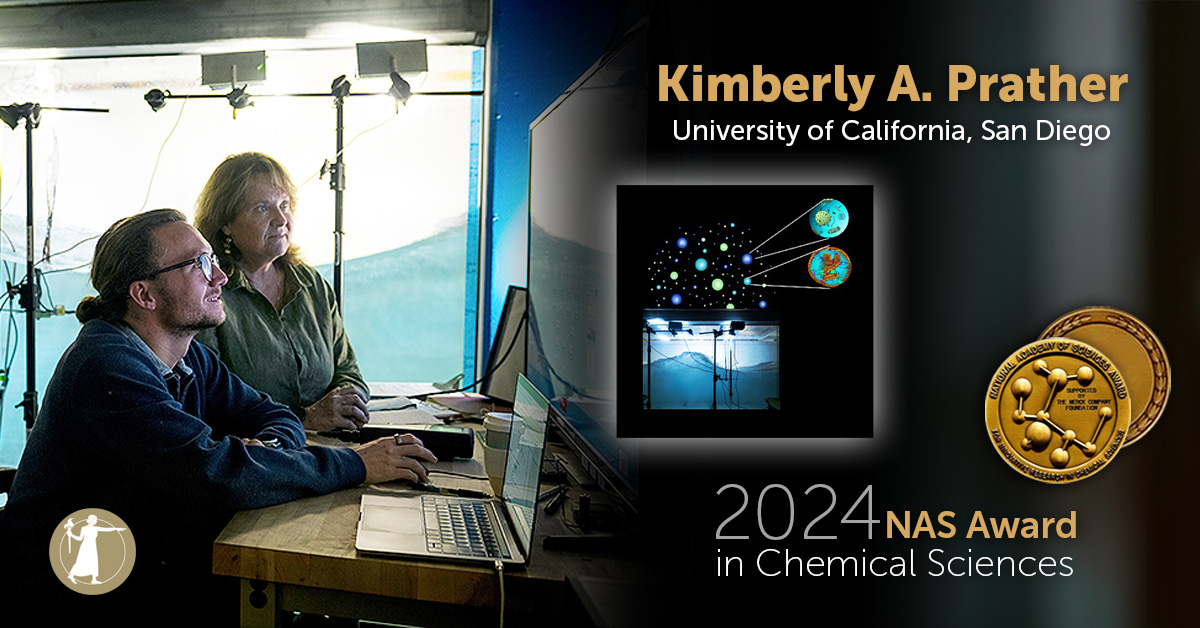
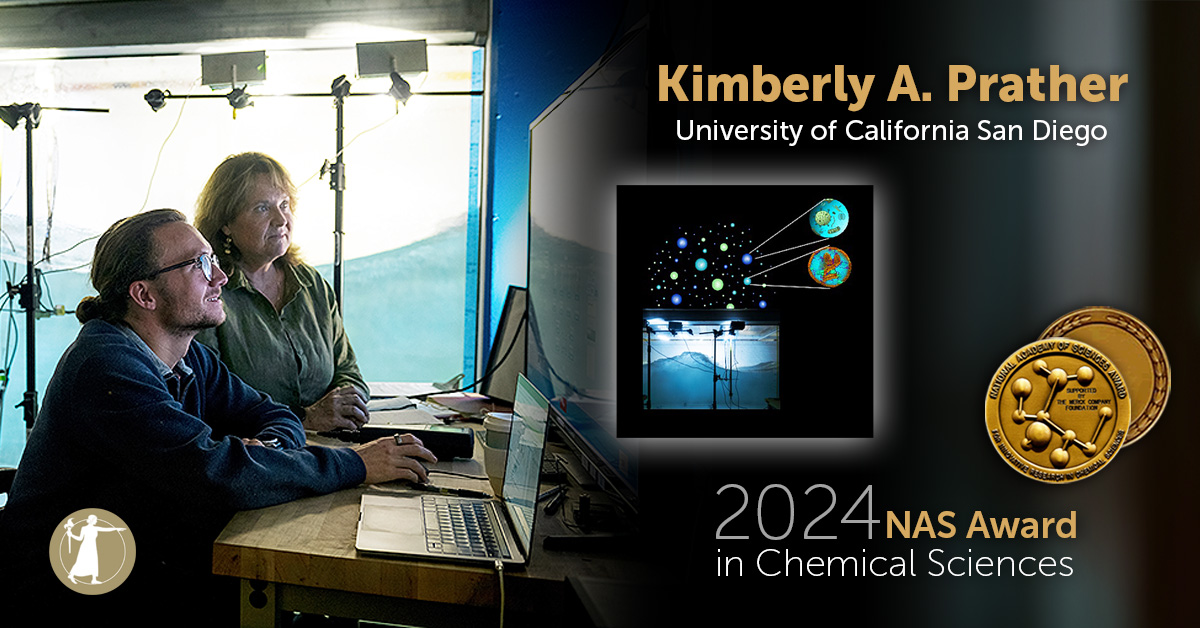
Congratulations to NAE and #NASmember Kimberly A. Prather of @UCSD, winner of the 2024 NAS Award in Chemical Sciences for her pioneering research on aerosols! Learn more about her discoveries: https://t.co/ZZPjHp1GO5 #NASaward#chemistry
@kprather88@theNASciences She has been a member of the National Academy of Sciences since 2020 and this award recognizes her work as a pioneer and leading scientist, helping us understand how different types of aerosols, including bioaerosols, interact with the atmosphere and the human body.
Extending a very warm welcome to the newest Phase 2 NSF Center for Chemical Innovation, The NSF Center for the Mechanical Control of Chemistry (CMCC)! Learn more about their awesome science here: https://t.co/5wZJNDd8qd
@NSF@NSF_CMCC#NSFfunded
Our newest @CAICECCI publication modeling how chemical complexity of SSA impacts climate-led by @abbydommer and @RommieAmaro
Revealing the Impacts of Chemical Complexity on Submicrometer Sea Spray Aerosol Morphology
https://t.co/FAUrvoGMhz
A study from Matthew Pendergraft, @kprather88@UCSanDiego & colleagues shows sea spray can transport sewage-contaminated waters inland, exposing those living kilometers from the beach.
Comments by Crystal Weagle @DalhousieU. Story by @caffeinatedkrys
https://t.co/LaZz3DYnnS