📉 El futur que no arriba: per què s’ha frenat el progrés?
El control managerial i la demografia de substitució ens arrosseguen cap a un món d’estancament i mediocritat.
Llegiu-lo a 👉https://t.co/vWxpujATMM
#Progrés#Innovació#CatalunyaTechBiz
Giving everyone a personalized AI tutor would massively increase inequality because smart kids could race ahead at their own speed. This would be a great thing. There is nothing inherently good about equality, and attempts to achieve it are almost always destructive.
El salari mitjà ha pujat un 3,8%, la inflació ha estat del 2,6% i la càrrega fiscal per no deflactar l’IRPF ha pujat un 1,5%.
3,8% – 2,6% – 1,5% = –0,3%.
En termes reals, som un 0,3% més pobres.
La pujada de sou se l’ha quedat el Govern, no el treballador.
He calculado dos cosas más:
A la izquierda, la tasa de agresiones sexuales por cada 100.000 habitantes. Cataluña, igual que en números absolutos, está totalmente desacoplada del resto de CCAA.
Si en números absolutos la segunda es Madrid y la tercera Andalucía (lógico por la población) en números relativos País Vasco tiene la segunda posición, seguida de un triple empate entre C. Valenciana, Baleares y Navarra. Madrid empatada con Canarias en 6ª posición.
A la derecha, la tasa de incremento de agresiones 2020-2025. Cataluña tercera, con un aumento del 146%, superada por Extremadura (+174%) y Cantabria (+157,6%).
The leftoid position is now, without exaggeration: "diversity is our strength and there's nothing wrong with Muslim migrants, but Israel is using them to punish us"
Un treballador amb un salari brut de 30.000 euros anuals ha pagat 2.608 euros de sobrecost des de 2021 per no #deflactar els trams de l'IRPF, pàrametres base, mínims exempts, reduccions, mínims personals, familiars i deduccions a l'IPC.
Ja l'any 2022 ens vam reunir amb la Secretària d’Hisenda @mespasa1 i la Directora General de Tributs i Jocs, @natalia_caba, per presentar el nostre informe: “Combatre l’impacte fiscal de la inflació. Una proposta per deflactar l’IRPF a Catalunya”
Dins l'acord d'investidura PSC-ERC signat el 7 d'agost de 2024, hi diu, textualment: «No implementar propostes de deflactació de l'IRPF».
Ens agradaria confirmar si ha canviat la seva posició @Esquerra_ERC?
Sneako is a good example of a common phenomenon: the racial alien who grows up enjoying a great standard of living in the West, has no reason to feel anything for Whites but gratitude and should be an ideal case of "integration," yet still ends up making resentment of their hosts the core of their worldview.
Sneako grew up to a middle-class family in Connecticut and attended a private school paid for by his immigrant parents, yet he larps as a black New Yorker. He adopted Malcolm X and Andrew Tate as his idols because they were more self-assured mulatto men who seemed to assert an identity outside White cultural norms, and even converted to Islam to imitate them. He has since made his entire justification for his religion that it is the most universal and anti-racist creed, because he is absolutely obsessed with "White supremacy."
He gradually went from red pill slop content to brown clown leftism because the one constant incentive he couldn't resist was the racial justice angle, which like most Muslim immigrants in the West trumps any of the other social values his religion might prescribe.
But like many brown clowns who adopt the language of leftism to articulate their hatred, the mask always eventually comes off and it becomes clear the driving force is his resentment of White civilization and cope for his feelings of inferiority and deracination.
Interestingly if you look at the profile of Islamic terrorists in the West, many are second-generation immigrants who came from middle-class families and lived pretty liberal, degenerate lifestyles before a sudden dramatic conversion – and they are typically driven by the same resentment.
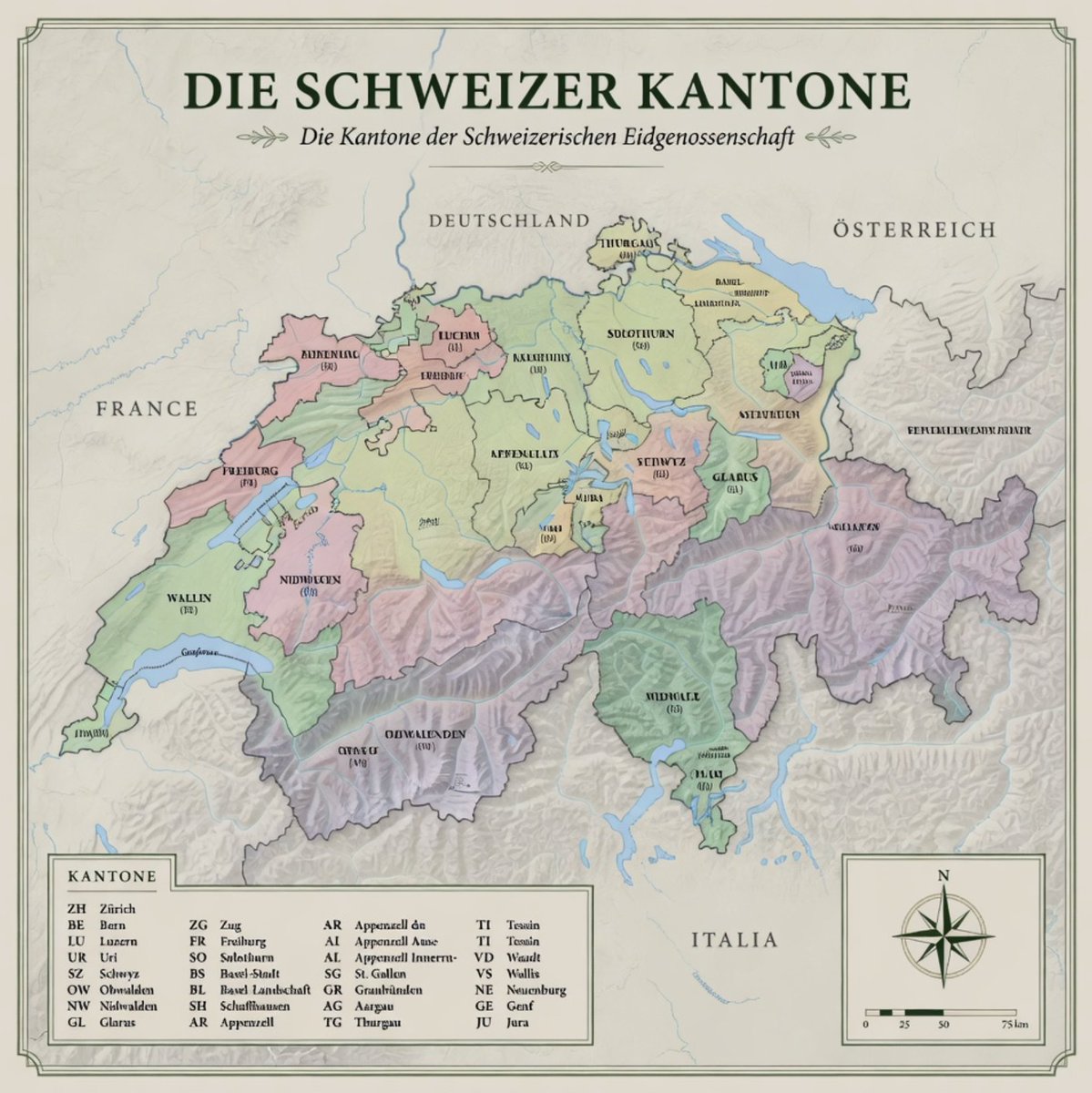
Switzerland has 26 cantons, each with its own constitution, tax rates, and laws, and the result is one of the wealthiest, most stable countries on earth. That is not a coincidence.
You want to understand why Swiss GDP per capita sits around $92,000 while the EU average hovers near $37,000? Start here. Cantons compete for residents and businesses the same way firms compete for customers. Zug kept its corporate tax rate at roughly 11.9%, attracted commodity traders and crypto firms, and watched its population and tax revenues grow. Cantons that taxed aggressively lost mobile capital and productive citizens to neighbors with lighter burdens. This is Tiebout competition working in real life, not a textbook diagram.
The federal government in Bern handles defense, monetary policy, and some foreign affairs. Everything else defaults downward. Cantons set income taxes. Communes set property levies. Citizens in Appenzell Innerrhoden voted on local laws by a show of hands in the Landsgemeinde, an open-air assembly, until 1990 for most matters. The feedback loop between decision-makers and the people paying for those decisions stays tight. That tightness disciplines spending in ways no central auditor ever will.
Free market thinkers have stressed this for generations: political units must be small enough that exit is credible. When the cost of leaving a bad jurisdiction drops, politicians face real consequences for bad policy. Switzerland kept that cost low by design. A business or family in Basel-Stadt dissatisfied with cantonal policy drives forty minutes to Baselland. No visa. No language barrier. No bureaucratic labyrinth. Just a move.
The EU spent decades building the opposite architecture, consolidating regulatory power in Brussels and eliminating the jurisdictional diversity that forces governments to stay honest. Switzerland refused to join. Its per-capita wealth, its low public debt, and its functional civil society arrived because the Swiss preserved the one institutional feature every centralized state destroys first: the credible right to leave.
Que el partit únic hagi d’actuar cada vegada més obertament com a partit únic és conseqüència de l’erosió de la seva posició. Tanmateix això no significa que els seus mecanismes siguin menys efectius
In an increasingly multicultural society, declining trust and demographic competition drive people to organize into ethnos blocs that outcoordinate atomized individuals and turn politics into a struggle over resources and state power. As those blocs harden, the state increasingly governs the resulting instability through authoritarian, technocratic means, making the future ethnos below and technocracy above.
Blank-slate universalism was never a durable operating system. It was an ideological luxury sustained by states already bound by a dominant historical ethnos, inherited norms, and deep reserves of common trust. Multiculturalism consumes that inheritance while denying it was ever necessary. As ethnic heterogeneity rises, generalized trust erodes, civic solidarity thins, and people sort into blocs that supply identity, protection, and reciprocal obligation. As universal institutions lose credibility, obligation retreats to groups whose members can reward loyalty and punish defection. The common society recedes; the in-group becomes the decisive political unit.
Ethnos blocs possess dense networks, internal discipline, and the power to coordinate turnout, institutional pressure, and social sanctions. Atomized individuals cannot match that unity. They are fragmented, cross-pressured, and easily outorganized. Public choice accelerates the process. Each bloc captures concentrated benefits while dispersing costs across everyone else. The state adapts by distributing appointments, exemptions, selective enforcement, and legitimacy through recognized groups. Appear as a bloc or forfeit the seat.
Heterogeneity reorganizes political life around group competition. Elections become demographic contests. Appointments become ethnic allocations. Policy transfers status and resources among blocs. Political defeat becomes collective dispossession; institutional control becomes group security. Ethnicity becomes the currency of collective power. Individualists must accept political irrelevance or become a counter-bloc. Once every population must form a bloc to survive politically, the creedal order has died.
Lee Kuan Yew understood the regime consequence. A deeply plural society cannot be governed by sentimental assumptions of spontaneous cohesion and procedural neutrality. When communal blocs compete through the state, it must manage them from above through housing policy, administrative allocation, surveillance, and speech controls. In the contemporary West, this machinery is increasingly digital: data collection, algorithmic monitoring, platform control, and behavioral regulation.
Multiculturalism hardens ethnos below while building technocratic authoritarianism above. The less a population can govern itself through common trust, the more coercion the state needs to hold it together. In an increasingly multicultural society, the future is ethnos, and the government of ethnos is technocracy.
The debate over who should rule the AI frontier is Mare Clausum vs. Mare Liberum all over again. Even Anthropic got its own Treaty of Tordesillas from the Pope. But just as 500 years ago, the dream of universal empire is being met with a pro-sovereignty reaction
@pmarca The people who want everyone to live off of handouts from a central bureaucracy do not really care whether we get the fever-dream utopian AI or the actually existing real technology, because their goal is for everyone to live off of handouts from a central bureaucracy.
I feel like expounding on a reply I made to this, specifically the part about self-replicating machines. It's a patently ridiculous idea if you even begin to think about how modern hardware is actually built and where the physical materials are sourced. Every part of a computer has its own supply chain, the raw materials needed to make them and the tools required to extract and make things each have their own supply chains, recursively and so on.
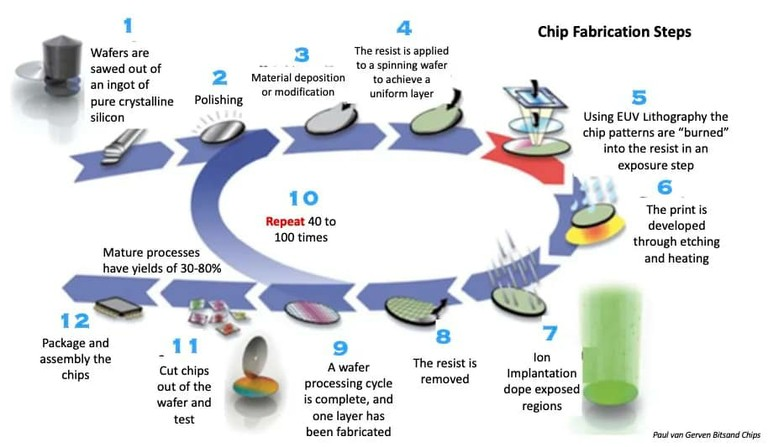
Microchips are built upon a substrate of high-purity monocrystalline silicon. Obtaining it is done through an energy-intensive reduction process from sand which then has to be cut into ingots and wafers with microscopic precision. It has to be scrubbed of organic residues with industrial solvents, engraved through EUV photolithography and chemical etching, doped with other elements to modify semiconductor properties, sliced into smaller dies, and this is all done in a clean room well before being worked and packaged into a finished usable product.
Every tool at each step of this process is complex and expensive to manufacture. Other inputs like germanium, gallium, antimony, arsenic, bismuth, boron, phosphorus, nitric and hydrofluoric acid, etc all have to be extracted, refined, and purified at scale. The EUV lithography machine requires helium as a coolant in order to operate. All this is just for the wafer. Materials like copper, gold, silver, tantalum and neodymium have to be used for wiring, electrical contacts, capacitors and permanent magnets as well.
The full list of things that are needed to make the most important component which enables AI (embodied or otherwise) to even be possible is exceedingly exhaustive, far more than can be described in a single post. Then there are the memory chips, disc drives, heat sinks, capacitors, resistors, diodes, timing circuits, transformers. An embodied machine would also require precision servomotors, batteries, optics, accelerometers. It goes on and on and on.
In short everything and its grandma - literally - has a supply chain. Most of the critical supply chains are not confined to one country or region of the world, they cross oceans, continents, international borders, and even war zones.
Which is to say, all of the industrial processes required to produce a machine "theoretically" capable of self-replication are themselves maximally complicated, fragile, and geographically dispersed. Even if such capability were loosely defined as "an AI-controlled factory that could churn out more robots," it is literally physically impossible to consolidate all of the capabilities and competencies required to assemble each component and their respective subcomponents into a single location, let alone gather and extract the raw materials required and find the energy to power it all.
Hence machine self-replication as a whole is also physically impossible. "AI takeover" is also impossible, except in the astronomically unlikely scenario that the entire world more or less unanimously consents to the building of an AI system (or system of systems) capable of impartially managing the entire globe.
Another, more tangential implication is that the collective industrial base which supports the entire "AI economy" is extremely tenuous, fragile, and unlikely to withstand any large-scale societal upheaval on a global scale (which it might play a substantial role in exacerbating).
This is why I call the technosingularity the Nerd Rapture. At its core it's a religious impulse, one that doesn't really survive contact with material reality if you consider what comprises the industrial-technological foundations upon which it depends.
Two countries split from the same colonial body in 1965. One picked economic freedom. The other picked handouts and racial spoils. You already know how this ended.
Singapore had no oil, no farmland, no hinterland. Just a swamp and a port. Lee Kuan Yew looked at that and trusted trade, low taxes, and hard money. Central planners hate what he did.
Malaysia went the other way. In 1971 Kuala Lumpur launched the New Economic Policy, a state program handing quotas, contracts, and university seats to ethnic Malays. Politicians decided who got what. A commissar fantasy dressed in liberal language.
Now let's look at the numbers. In 1965 both places sat around $500 per capita. Today Singapore clears $84,000. Malaysia sits near $13,000. Same climate, same starting line, one sixth the result.
The Singapore dollar holds its value because the Monetary Authority of Singapore manages it against a currency basket and refuses to print its way out of trouble. The ringgit has lost roughly two thirds of its value against the Singapore dollar since 1981.
You cannot subsidize your way to wealth. You cannot redistribute what you never let people produce. Every ringgit funneled through a quota is a ringgit some bureaucrat spent on his own vision instead of a customer's.
Malaysia bet on planners deciding outcomes. Singapore bet on people deciding for themselves. The gap between $84,000 and $13,000 is your answer.
El periodisme compromès no és el que fa activisme polític per qui et paga. El periodisme compromès no es posa de perfil davant els casos de corrupció de l'esquerra. El periodisme compromès no cobra milers d'euros públics ens subvencions. Sou vosaltres els garants de la desinformació
Des de la indústria hem estat testimonis dels esforços per fer-ho possible: enganys amb els Next Generation, impossibilitat d'obtenir permisos d'obres, política energètica nefasta, estigmatització social (discursos residuals com CUP i Comuns són centrals), fiscalitat verda...
❌Els 'especuladors' a Catalunya
Generalitat 10.731 pisos,
Caixabank 5.064,
l'Ajuntament de Barcelona 4.809,
Cerberus 2.877
Blackstone 2.493
Dels 5 primers grans tenidors, el 60% en mans de la Generalitat i l'Ajuntament de Barcelona
La mayor talasocracia mediterránea medieval no fue Venecia ni el Imperio Otomano. Fue la Corona de Aragón.
Entre 1229 y 1442, la unión dinástica de Aragón y Barcelona, sumada después a Valencia y Mallorca, construyó un dominio marítimo que arrancaba en las Baleares y llegaba a Atenas. Jaime I conquistó Mallorca en 1229 y Valencia en 1238. Pedro III tomó Sicilia en 1282 tras las Vísperas Sicilianas. Roger de Lauria batió a la flota angevina en el golfo de Nápoles en 1284. Jaime II invadió Cerdeña en 1323. La Compañía Catalana, los mercenarios al mando de Roger de Flor, entró al servicio de Bizancio en 1303 con 6.500 hombres, derrotó a los selyúcidas en Anatolia, y tras el asesinato de su capitán por los bizantinos en 1305 desencadenó la Venganza Catalana, conquistó el ducado franco de Atenas en la batalla del Cefiso y gobernó Atenas y Neopatria como ducados aragoneses durante setenta y siete años. Alfonso V el Magnánimo entró en Nápoles en 1442. En el siglo XIV, las cuatro barras ondeaban desde Mahón hasta el Pireo.
La hegemonía fue también jurídica. El Llibre del Consolat de Mar, compilado en Barcelona entre 1320 y 1370 a partir de las costumbres marítimas mediterráneas, se convirtió en el código de derecho marítimo de referencia desde Marsella hasta Alejandría, adoptado por puertos venecianos, genoveses, pisanos, marselleses y mesinos. Los consulados catalanes funcionaban en Alejandría, Damasco, Constantinopla, Túnez, Bugía, Pera y Rodas. Las Atarazanas Reales de Barcelona, iniciadas por Pedro III en 1283, podían armar treinta galeras en simultáneo, capacidad que ningún astillero cristiano del Mediterráneo igualaba.
Si comparamos con Venecia, la Serenísima duró más, mil años de Stato da Mar entre el siglo IX y 1797. Su monopolio del comercio especiero con Egipto y su red de bases en el Egeo (Negroponte, Creta, Chipre) son insuperables en duración. Pero su extensión espacial simultánea fue menor. En el cuarto del siglo XIV, Venecia controlaba el Adriático y enclaves egeos. La Corona de Aragón controlaba al mismo tiempo el arco completo del Mediterráneo occidental, las dos grandes islas (Sicilia y Cerdeña), Malta, las Baleares y los ducados griegos. Ningún otro poder cristiano medieval cubrió ese arco geográfico.
En comparación con los otomanos, la hegemonía mediterránea otomana es posterior. Su flota imperial se construye desde Selim I y Solimán, entre 1517 y 1571 (batalla de Lepanto). Es una talasocracia de la Edad Moderna, no medieval. Y no es una talasocracia en sentido estricto sino un imperio terrestre conuna flota proyectada, no un Estado vertebrado por el mar.
La definición de talasocracia exige tres componentes: dominio naval militar, red comercial sostenida y proyección política a través del mar y la Corona de Aragón los reunió todos. Roger de Lauria nunca perdió una batalla naval. Los almogávares con su grito Desperta ferro entraron en la cuenca egea por la puerta de atrás de Bizancio. El Consolat de Mar regulaba contratos de fletamento desde Mallorca hasta Constantinopla. Pedro IV el Ceremonioso firmaba como rey de Aragón, Valencia, Mallorca, Cerdeña, Sicilia, conde de Barcelona y duque de Atenas y Neopatria.
Bernat Desclot, en su Crònica del rey Pedro III escrita hacia 1285, pone en boca de Roger de Lauria la frase que resume el siglo: "no creo que pez alguno intente alzarse sobre el mar si no lleva un escudo con la enseña del rey de Aragón en la cola para mostrar el salvoconducto."
Bibliografía recomendada:
– David Abulafia, The Western Mediterranean Kingdoms 1200-1500. The Struggle for Dominion, Longman, Londres, 1997.
– María Teresa Ferrer i Mallol, La Corona Catalano-Aragonesa i el seu entorn mediterrani a la baixa Edat Mitjana, CSIC, Barcelona, 2005.