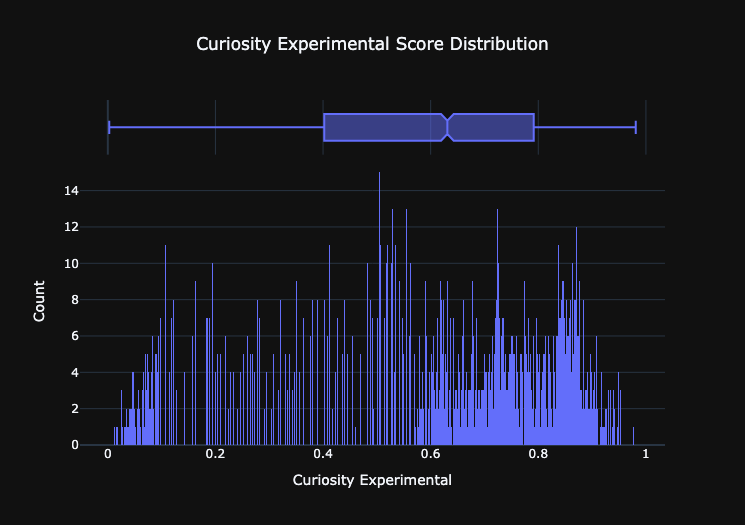
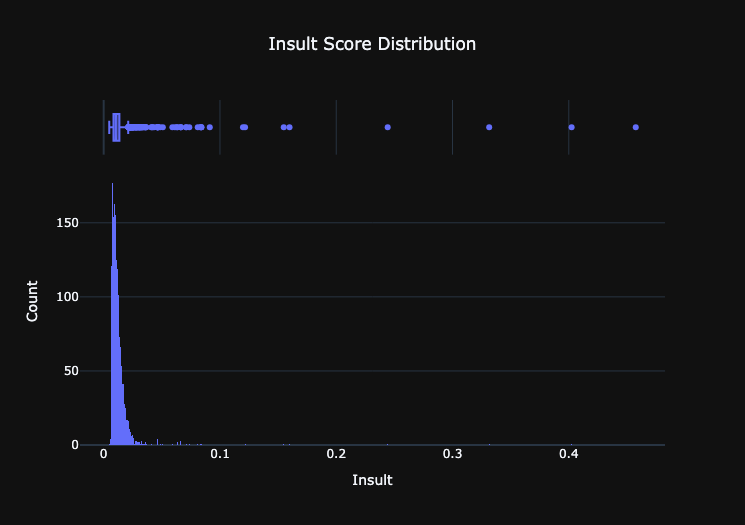
@radicle /5 I found that the distributions for toxicity scores were right-skewed, while the distributions for bridging scores were most often left-skewed or close to left-skewed.
From this exploratory analysis, the Radicle forum engages in primarily constructive conversations.
/1 DAO Discussion Forums: Exploratory Toxicity and Bridging Analysis of Radicle Forum Posts
https://t.co/yQeLXPmZxu
As part of my explorations into DAO discussion forums, I assessed civility in @radicle governance forum posts.
@radicle /3 Regarding definitions, toxicity refers to "a rude, disrespectful, or unreasonable comment that is likely to make you leave a discussion," while bridging refers to "a comment correlated with more constructive conversations."
@radicle /2 I collected @radicle governance forum posts via @boardroom_info Governance API
I used Google's Perspective API to classify posts for toxicity and bridging attributes.
https://t.co/cgFkoSc9Lk
@volkyeth For example, a sense-making process could focus on assessing engagement signals (e.g., likes, replies) on annotations (e.g., comments, highlights) on blog posts and quality signals (e.g., informative, evergreen, well-written, relevance) from snippets or full-text of the blog post
@volkyeth > Is it for papers, blog posts, articles, or — on the fine-grained side of the spectrum — tweets, individual statements, etc?
Any digital object, but I expect it to be used primarily with creative content.
@volkyeth > One question I couldn't answer yet: Which granularity of content do they target?
Good question.
I plan to make the vocabulary allow for any level of granularity.
@volkyeth The Sense-making markers is meant to provide a vocabulary for describing and formatting sense-making processes, based on signals, from the inputs to the processing method to the outputs, so that sense-making processes can be interoperable and shared between information systems.
@volkyeth > Are sense-making markers some dimensions on which you evaluate content to contextualize the kind of information it contains?
Yes, but there is a bit more to it.
@volkyeth I apologize for the late reply and the confusing response. I am still working on how to communicate the project concisely and succinctly.
> Sorry if I'm being obtuse, but I'm not very familiar with the academic language in that domain. Thanks for helping with that
Not at all.
@volkyeth > mind giving an overview or sharing a link with a high-level description of what that is?
I am still trying to find the right language for describing the project currently.
The best overview I have now are the two links below:
https://t.co/7bYyb8i86a
https://t.co/r2hIQ9wnxe
@volkyeth Hi @volkyeth,
You might be interested in my work on developing sense-making markers.
You can find links to my work here:
https://t.co/hdeps9KIOo
https://t.co/7bYyb8i86a
https://t.co/emiRqyMTdq
https://t.co/EdDGRi22Iq
@clinamenic@onchain_org@clinamenic Thanks for the shoutout.
You can find a collection on DAO resources here: https://t.co/bP8xpctcoz
I hope you find the collection helpful.
🌟 Big news! We’ve just submitted a proposal to @gitcoin & @metagov_project for our DAO Index initiative as part of the Distributed Governance Score Framework (DGSF).
🔍 Our mission? To answer a crucial question: How can we develop a standard and measurement tool to rate and benchmark DAO design features and governance processes, considering the unique themes and sociotechnical imaginaries associated with DAOs?
💡 Explore our innovative approach to revolutionizing DAO governance and see how AI integration could make a difference.
👀 Check out our proposal and lend your support here: https://t.co/vUBeNIwuCT
#DAO #DecentralizedGovernance #gitcoin #metagov