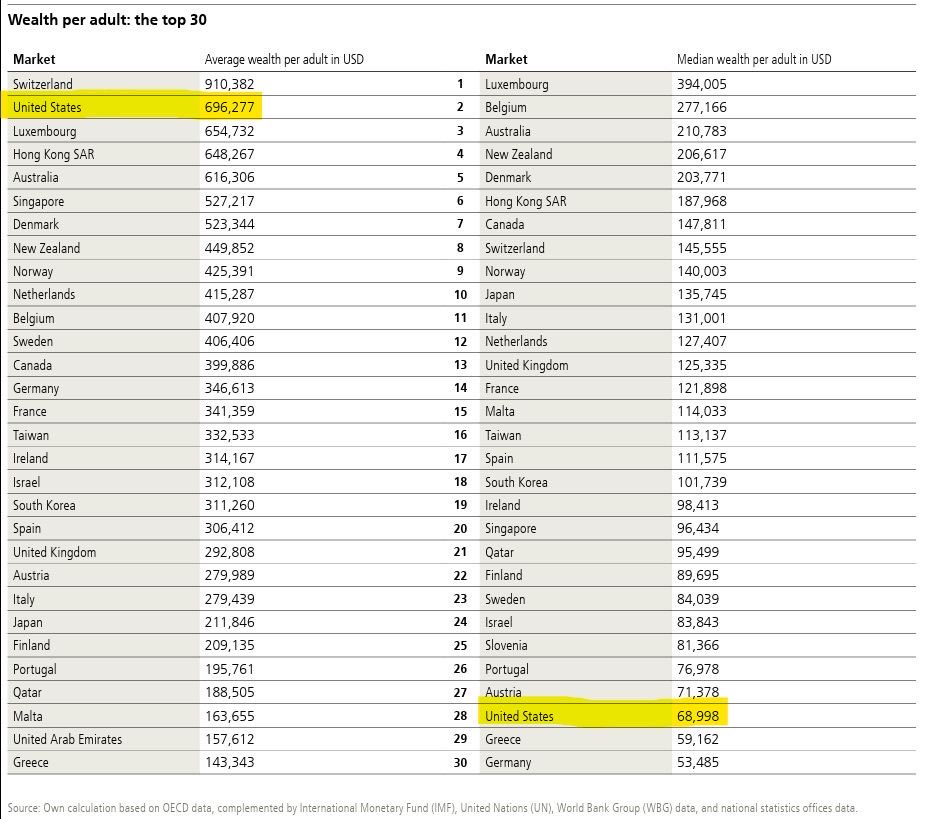
The US loves to boast about how wealthy it is, but its wealth is concentrated in the hands of a few oligarchs.
US oligarchs are so insanely rich that they make average wealth seem very high.
But *median* wealth in the US is lower than in Slovenia & Portugal, and half of Italy's
Specific British people ended slavery, not the British in general, and that was against the sustained opposition of the British establishment, over a campaign that lasted 50 years.
The first organised abolitionist group in Britain was founded by Quakers in 1783. Quakers; religious Nonconformists, barred from public office and the universities by the Test Acts, regarded by the establishment as eccentric dissenters. They were joined by evangelical Anglicans from the Clapham Sect, whom Parliament mockingly called "the Saints", by Methodists, and by former enslaved people; Olaudah Equiano and Ottobah Cugoano, who wrote and campaigned for their own liberation. The Committee for the Abolition of the Slave Trade was founded in 1787. 9 of its 12 founding members were Quakers. Its members were called proponents of "a mad, wild, fanatical scheme of enthusiasts" on the floor of Parliament.
They were the woke radical looney leftists of their time. And the establishment treated them exactly the way every establishment treats its radicals.
In 1791, the first abolition bill was defeated in the House of Commons, 163 votes to 88. Nearly twice as many MPs voted to preserve the slave trade as voted to end it.
In 1792, petitions carrying approximately 400,000 signatures were sent to Parliament, most signed by people who could not vote. These were not passive victims; they were active political agents who chose to sign, boycott, and organise despite having no representation. The Commons voted for gradual abolition. The House of Lords blocked it. In the same session, Henry Dundas, the Home Secretary, inserted the word "gradual" into the abolition motion; a procedural manoeuvre that historians of slavery, including Seymour Drescher, regard as a deliberate delaying tactic executed in collaboration with the West India interest. The following year brought war with France, and the political climate turned hostile to any reform. Between Dundas's obstruction, the war, and the continuing power of the London Society of West India Planters and Merchants; described in the scholarship as "the most powerful pro-slavery lobbying group in the British Atlantic world"; abolition was delayed for a further 15 years.
During those years, between 1791 and 1807, British ships made approximately 1,340 voyages in the decade to 1800 alone, landing nearly 400,000 enslaved Africans, and carried a further 266,000 between 1801 and 1807. Over 600,000 people were transported into slavery while Parliament deliberated.
The Slave Trade Act was finally passed in 1807. It abolished the trade. It did not abolish slavery. Over 800,000 people remained enslaved in the British Caribbean.
The "Proud of Us" post cites the Royal Navy's West Africa Squadron, which intercepted slave ships after 1808, as evidence of collective national virtue. The Squadron was real, its sailors' sacrifice was real, and the approximately 150,000 people it freed were real. But the Squadron did not materialise from national consensus. When it was established in 1808, the Admiralty assigned it 2 outdated ships. Anti-slavery patrol was, in the Navy's own operational priorities, initially a low priority behind the Napoleonic Wars. It took years of continued abolitionist pressure to increase its resources. Even at its peak in the 1840s and 1850s, with up to 36 vessels and 4,000 men, the Squadron captured approximately 6% of transatlantic slave ships. An estimated 3.2 million people were still taken from West Africa between 1808 and 1863, while the Squadron operated. The approximately 1,600 sailors who died on that patrol, mostly of disease, deserve to be remembered. But they were there because abolitionists fought to put them there, not because Britain spontaneously decided to act. The Squadron belongs to the people who campaigned for it, not to a national "we".
The abolitionists then had to campaign for another 26 years before the Slavery Abolition Act was passed in 1833; 50 years after the Quakers first organised.
Now to the £20 million.
The "Proud of Us" post frames this as "your family helped buy 800,000 people their freedom". This is a rewriting of what actually happened.
The £20 million, approximately 40% of the Treasury's annual spending, was paid to approximately 3,000 slave-owning families as compensation for the loss of their "property". The biggest single payout went to James Blair, an MP, who received £83,530 (equivalent to approximately £65 million today) for the 1,598 people he enslaved in British Guyana. Half the total compensation went to absentee landlords living in Britain who had never set foot on a plantation.
The enslaved people received nothing. Not a penny. Not an acre. Historic England is unambiguous: "The enslaved received nothing".
Worse: the 1833 Act did not even free most of the enslaved immediately. Children under 6 were freed. Everyone else was reclassified as an "apprentice" and required to continue working for their former owners, unpaid, for up to 6 years. Full freedom did not come until 1838, and only after further campaigning forced Parliament to end the apprenticeship system early.
The British public did not "buy 800,000 people their freedom". The British public was taxed to compensate the people who had enslaved them, while the people who had been enslaved got nothing and were forced to keep working.
The post says "history got rewritten once, in living memory, by no one who was ever named". History did not get rewritten. What happened is that people started reading the primary sources. The UCL Legacies of British Slave-Ownership database, built from the Slave Compensation Commission's own records, names every slave-owning family that received a payout. The parliamentary debates are in Hansard. The ship logs are in the National Archives.
Nobody rewrote the story. The story was always there. The establishment preferred that nobody read it.
There is no "we" in this history. There were abolitionists and there were slave owners, and for 50 years the slave owners had the majority of Parliament, the backing of the West India lobby, the support of the Home Secretary, and the protection of the House of Lords. The abolitionists were Quakers, Methodists, evangelicals, former enslaved people, working-class petition signers who could not vote, and women who formed their own societies in 1825 because the men had been, in their own words, "too slow and cautious".
They were the radicals. They were the dissenters. They were the people the establishment of the day despised.
Claiming their struggle as "ours" while opposing everything they stood for is not patriotism. It is appropriation.
Sources:
1791 and 1792 parliamentary votes, petition figures, and the 15-year legislative timeline:
https://t.co/Dg5Jep8hjZ
The abolition campaign 1787-1807, including the 1791 defeat and petition drives:
https://t.co/aTfqY6zGV9
Henry Dundas and the deliberate delay of abolition (Dr Stephen Mullen, University of Glasgow):
https://t.co/YcQ3oHs84A
The West India Interest and the parliamentary defence of slavery 1823-1833 (Dr Michael Taylor):
https://t.co/hc3Fu6VOub
The Glasgow-West India interest and pro-slavery lobbying (peer-reviewed, Taylor & Francis):
https://t.co/D8zJGp4adO
Royal Navy West Africa Squadron, 6% capture rate, 3.2 million still transported:
https://t.co/EHcDK9tJCu
West Africa Squadron operations, cost (1-2% of government expenditure), nearly 200,000 freed:
https://t.co/AYUqnrgiZZ
The £20 million compensation, Bank of England administration of payments:
https://t.co/a1LYCXLkL9
"The enslaved received nothing" and the UCL Legacies of British Slave-Ownership database:
https://t.co/2JZVCYL5WB
The Slave Compensation Act 1837, 40,000+ awards to slave owners, annuity payments until 2015:
https://t.co/8EO7r4ZGAK
The West Indian colonies and emancipation, including the apprenticeship system (UK Parliament):
https://t.co/MUshPKrooO
Women's anti-slavery societies and the "too slow and cautious" assessment:
https://t.co/ZdYq256xz7
"A mad, wild, fanatical scheme of enthusiasts" and the parliamentary opposition:
https://t.co/GNMfuYxV9M
James Blair MP, £83,530 for 1,598 enslaved people, and the UCL database findings:
https://t.co/msXgGQFZTJ
@GoBlueTherapy@ggreenwald Is Tucker an elected official you dumbfuck?Why don't you compare Tucker with something relavent like all the Zionist funded media.
@Bobb_Dobbs@AslanEgia@ericleenet@ggreenwald What a dumbass. You just pulled those numbers out of your ass
https://t.co/D7bLvW1bCU
People like you are why people think Americans are stupid.
@WengerWoke@davidjackson911@mtracey Sure, totally agree but there's an argument that letting people say 'don't know' let's them mask their true beliefs. But either way, only about 15% recognise that it's a totally horrendous idea. As a foreigner, that does make me more concerned about the Republicans...
@davidjackson911@mtracey Most polls are bullshit but practically the same number disagree with military action in both polls. Doesn't really help your case.
@ma1ybe Fake and made up for clicks.
Your friend was in medical school but didn't have the money to cross state lines to get the morning after pill. Lolz.
Bullshit feminist ambulance chaser denigrating all the genuine rape victims.
And not even one percent of abortions are for rape.
@harukaawake Well of course, you don't even learn about how your nation killed 30 million civilians for no reason in WWII so you're too ignorant to feel bad about it. Anyway, you sound like an Indian.