📢 We are delighted to announce that the CCICED 2026 Annual General Meeting is tentatively scheduled for September 27-29 in Beijing, China. Save the date!
In advance of the AGM, a site visit to North China’s Shanxi Province will be organized exclusively for CCICED Members and Special Advisors, offering a valuable opportunity to gain deeper insights into China's sustainable development practices on the ground.
China has released a plan to advance the green and low-carbon transformation of its industrial sector for the 15th Five-Year Plan (2026-30) period, setting a target of peaking carbon dioxide emissions from industry by 2030.
The plan also aims to significantly increase the use of green energy in industry and further strengthen the competitiveness of green and low-carbon sectors.
https://t.co/UXoVbmpBp4
China published its national climate change response plan for the 15th Five-Year Plan (2026-30) period on July 30, aiming to cut carbon dioxide emissions per unit of GDP by 17% from 2025 levels by 2030 and identifying the period as critical for achieving the nation's carbon peak.
https://t.co/DXNVHTdt79
China is transforming wastewater treatment from an energy-intensive burden into a carbon-negative resource hub, offering a replicable Chinese model for global environmental governance. https://t.co/PYY5uXZHSl
This approach also supports domestic energy security, carbon neutrality and the circular economy. Read the full commentary to discover how China is turning waste into valuable resources.
According to the recently issued plan for building a #BeautifulChina during the 15th Five-Year Plan period (2026-30), China aims to achieve an overall improvement in ecological and environmental quality by 2030,
It also aims to make significant progress toward building a Beautiful China, with green production and lifestyles largely established and the carbon peak target reached on schedule. #GreenTransition https://t.co/iXZm7M1eS5
On July 6-7, #CCICED's High-Level Task Force (HLTF) met in Geneva in Switzerland to review progress and advance the draft synthesis report on China's Environment and Development Outlook.
The HLTF Working Group co-leads presented their key findings across its four areas: Environmental governance and the three planetary crises, shifting development paradigms in the #greentransition, China's mutual engagement with the world in sustainable development, and reforming institutions and governance systems.
HLTF experts discussed the draft report in depth, helping to refine its analysis and agree on next steps ahead of its presentation at the #CCICED2026AGM. To gather further perspectives, the Chinese delegation met with @IISD_news and other organizations in Geneva before joining a roundtable with European civil society representatives in Brussels.
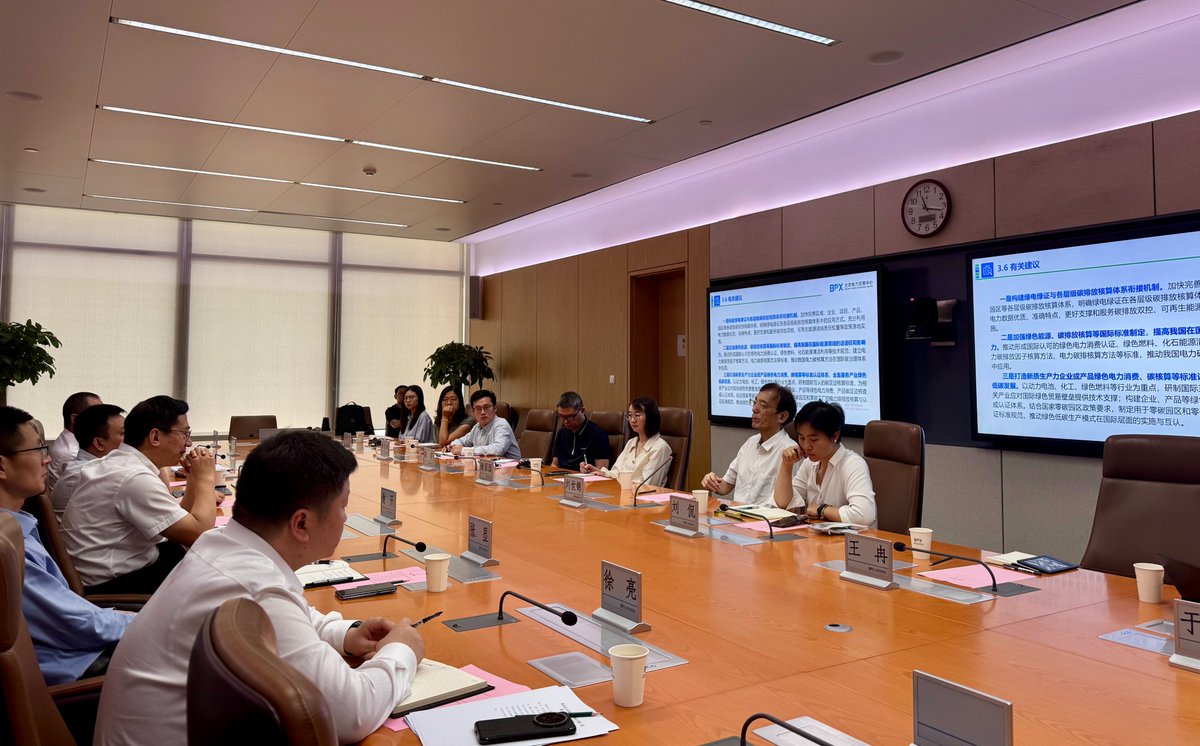
Relevant business heads of the Beijing Power Exchange Center received the research team and conducted in-depth exchanges. At the meeting, the center shared the progress made in the construction of China's national unified power market, systematically sorted out the current practices in the green electricity market, with a focus on the exploration of multi-year PPA transactions and matching and traceability of hourly green electricity transactions.
The two sides also explored ways to strengthen coordination among green electricity, green certificates and the carbon market, aiming to explore collaborative innovation and their integrated development. #CarbonMarket #GreenElectricity #GreenCertificates
𝗖𝗖𝗜𝗖𝗘𝗗 𝗥𝗲𝘀𝗲𝗮𝗿𝗰𝗵 𝗧𝗲𝗮𝗺 𝗖𝗼𝗻𝗱𝘂𝗰𝘁𝘀 𝗙𝗶𝗲𝗹𝗱 𝗩𝗶𝘀𝗶𝘁 𝗮𝘁 𝗕𝗲𝗶𝗷𝗶𝗻𝗴 𝗣𝗼𝘄𝗲𝗿 𝗘𝘅𝗰𝗵𝗮𝗻𝗴𝗲 𝗖𝗲𝗻𝘁𝗲𝗿 𝘁𝗼 𝗘𝘅𝗽𝗹𝗼𝗿𝗲 𝗖𝗼𝗹𝗹𝗮𝗯𝗼𝗿𝗮𝘁𝗶𝘃𝗲 𝗜𝗻𝗻𝗼𝘃𝗮𝘁𝗶𝗼𝗻 𝗣𝗮𝘁𝗵𝘀 𝗳𝗼𝗿 𝗖𝗮𝗿𝗯𝗼𝗻 𝗠𝗮𝗿𝗸𝗲𝘁, 𝗚𝗿𝗲𝗲𝗻 𝗘𝗹𝗲𝗰𝘁𝗿𝗶𝗰𝗶𝘁𝘆 𝗮𝗻𝗱 𝗚𝗿𝗲𝗲𝗻 𝗖𝗲𝗿𝘁𝗶𝗳𝗶𝗰𝗮𝘁𝗲𝘀
On July 14, CCICED’s research team for the scoping study on carbon market expansion and innovation carried out an on-site research at the Beijing Power Exchange Center.
Led by Liu Shijin, Chinese Chief Advisor of CCICED and Head of the research team, the delegation included staff members from the CCICED Secretariat and relevant experts.
China's Circular Economy Development 15th Five-Year Plan reflects key policy recommendations from the #CCICED — highlighting the impact of its policy research. The plan includes stronger circular economy governance, enhanced recycling systems, and EPR measures, while targeting a 16% increase in major resource productivity and an 8-trillion-yuan ($1.18 trillion) recycling industry by the end of the plan period. #CircularEconomy #GreenDevelopment
China's 15th Five-Year Plan (2026-2030) calls for accelerating the country's #greentransition across the board, building a Beautiful China and promoting green and low-carbon transformation in key areas.
For multinationals, China's green transition is speeding right up, bringing them clearer policy direction and expanded industrial space. https://t.co/2Vv9e0Zno3
China passed the Ecological and Environmental Code in March, covering climate action, nature protection and pollution control. It lays a strong legal foundation for the nation's push toward green and low-carbon development. This is not just good for the environment; it's smart governance, says Dimitri de Boer, @ClientEarth's China Director and CCICED Special Advisor.
Learn more about his insights on what China's new environmental code means at https://t.co/Ma1yysvCBv
Cooper played a key role in the KMGBF process, serving as the Secretary of the Convention on Biological Diversity at #COP15 and guiding the complex international negotiations that led to its finalization. Beyond #KMGBF progress, the interview covers:
🗨️The significance of China's bid for the BBNJ (High Seas Treaty) secretariat and its role in reinforcing the global biodiversity framework.
🗨️How CCICED’S next five-year research phase can help manage efforts to align human well-being with environmental sustainability, including through advancing frameworks like the Gross Ecosystem Product.
🗨️Why future carbon efficiency and net-zero planning must account for the massive energy and water demands of rapid AI expansion.
🗨️The urgent scientific and policy need to de-link agricultural fertilizer production from fossil fuels to protect freshwater and coastal ecosystems.
Three years after the historic adoption of the Kunming-Montreal Global Biodiversity Framework (KMGBF), where does global implementation stand? In our latest interview, CCICED Special Advisor David Cooper breaks down the implementation momentum, geopolitical opportunities and challenges, and China's growing leadership role in international environmental diplomacy.
Read the full interview to explore the future of environmental multilateralism at
https://t.co/luJLTUEDtO
Below are some viewpoints shared by the experts:
☑️ AI is proving its value in early warning systems, renewable energy forecasting, grid optimization and infrastructure risk simulation.
☑️ AI's environmental footprint cannot be overlooked. Training and operating large language models consume massive volumes of electricity and water, with certain data centers consuming power equivalent to that of a medium-sized city.
☑️ Green AI is essential. Experts called for improvements in model efficiency, data center siting and cooling, solutions and the adoption of green evaluation metrics that incorporate carbon emissions indicators.
The message was clear that technology alone is not enough. Real climate resilience requires international policy coordination, cross-sector collaboration between energy and AI, and a shared commitment across generations.
A truly adaptive future is within reach, but only if we work together. #AIforClimate #ClimateAdaptation #AMNC26 #GreenAI #SustainableFuture
CCICED and the World Economic Forum co-hosted an accredited program on June 24 on the sidelines of the Annual Meeting of the New Champions in Dalian. The event was held under the theme of "AI and Climate Resilience: Enabling Adaptive Societies".
Over 50 participants from research institutes, businesses and universities joined the discussion. Experts agreed that climate change is entering a fast track towards an "overshoot" phase, making climate adaptation equally urgent to mitigation.
The CCICED 2026 Roundtable was held in Xiamen on May 25-26, bringing together senior experts in global environmental governance and youth representatives to share their insights on the "Sustainable Blue Future".
Themed on "Inspire the Next", the third episode of the CCICED Youth Dialogue dives deep into what skills young people need to bridge the gap between science and policy and to help shape the future.
The CCICED 2026 Roundtable was held in Xiamen on May 25-26, bringing together senior experts in global environmental governance and youth representatives to share their insights on the "Sustainable Blue Future".
Themed on "Inspire the Next", the second episode of the CCICED Youth Dialogue dives deep into multi-dimensional synergies of policy in action.
The CCICED 2026 Roundtable was held in Xiamen on May 25-26, bringing together senior experts in global environmental governance and youth representatives to share their insights on the "Sustainable Blue Future".
Themed on "Inspire the Next", the first episode of the CCICED Youth Dialogue dives deep into the role of global governance in the pursuit of equity and consensus.
The event was held in the context of the CCICED HLTF and aimed to complement the project's existing working groups by gathering broader strategic insights on the global implications of China’s green transformation and possible ways to enhance international cooperation. These insights will inform the HLTF’s final report, to be presented later this year at the #CCICED2026AGM. #GreenTransformation #InternationalCooperation
On April 27-28, CCICED Vice Chairperson Achim Steiner @ASteiner convened a high-level dialogue titled “China and the World at a Crossroads” at the Oxford Martin School @oxmartinschool, University of Oxford @UniofOxford. The event was co-organized with the International Institute for Sustainable Development @IISD_news.
CCICED’s SS team for Adaptation held a kick-off meeting in April, where they outlined a research framework aligned with China’s 2035 climate resilience goals.
The discussion emphasized the need to transition from reactive disaster management to proactive adaptation, while addressing the financing gap between climate mitigation and adaptation.