Produce more than you consume. Real food, sound money, self-reliance. Author of the Little Impressions picture books. Sonoran desert. Learn then guide.
Be a teacher, a guide, and an instructor.
Little Impressions is a home for picture books that help you do that. Kindness, honesty, patience, and a habit of producing more than you consume.
https://t.co/aUPV4H155M
A canning jar and a solar panel are the same idea, a hundred years apart. Catch what's plentiful today so your family has it tomorrow.
Old wisdom, new tools. Keeping your own Bitcoin keys belongs on that same shelf.
What old habit have you given a modern upgrade?
@SamaHoole Strong enough to win every fight and gentle enough to lose to the pups on purpose. That's the kind of strength worth raising young ones around.
The toughest wolf ever recorded in Yellowstone never lost a fight, never killed a beaten rival, and spent his evenings losing wrestling matches to puppies.
He had a number where a name should be. Wolf 21 was born in April 1995, in the first litter of the wolves brought back to Yellowstone after 70 years without them. A poacher shot his father the same week. The stepfather who raised him was wolf 8, the runt of his own litter, who once pinned a far bigger rival to the ground and then let him get up and leave. The young 21 was standing there watching.
He grew into the biggest wolf in the park. At two and a half he walked into the Druid Peak pack two days after its leader had been shot, was accepted on the spot, and ran it for the next six and a half years.
A ranger called Rick McIntyre watched him through a telescope almost every day of that reign. Twice he saw 21 take on six attacking wolves at once and scatter the lot. McIntyre said it was like watching a wolf do things a wolf cannot do.
He beat every male that ever challenged him and let every one of them walk away.
At home he was a different animal. He would let the pups jump him, go down on his back with his legs in the air, and lie there while something the size of a loaf of bread stood on his chest and celebrated. When there was a sickly pup the rest of the litter ignored, 21 went and sat with it.
Under him the Druids grew to 37 wolves, the largest pack anyone has ever documented.
His mate was wolf 42. They were together for the whole of it. In February 2004 a rival pack killed her, and 21 was seen on a ridge, howling for days. That June he left the pack, climbed alone to the high ground they had used together, and was found curled under a tree. He was nine, about twice what a Yellowstone wolf normally gets.
There is an entire industry selling men a course on how to be the alpha. The most dominant animal anyone has ever followed with a telescope let a twelve week old pin him every night, then went out and stood between his family and six wolves.
The strongest animal in the valley was the one with nothing to prove to a puppy.
@KenDBerryMD A herd can't be printed. It grows one calf at a time, over years, on land someone takes care of.
Want more beef on the table, make it easier to be the person raising it.
The family who lost the barn didn't owe anyone money. They owed the next family a day of work, and everyone knew it would be paid.
That's an old kind of wealth: hands you can count on, kids who grew up watching, and a whole road of people who know how to build.
A few generations back, when a barn burned on a country road, the help didn't wait to be asked.
By morning there were wagons in the yard. Men with saws, women with pots of stew, kids hauling nails in coffee cans. By sundown a new frame was standing.
Nobody called it charity.
A good life is built the same way: one ordinary morning at a time, pointed at a home you can stand on. Food, water, and power you had a hand in, and a family that knows how to create more than they take.
The day after the feast is a good teacher. Leftover turkey becomes broth. The quiet house becomes a chance to walk, to put things in order, to start again without rushing. Deep breath, look for the gratitude.
Using what you already have is one of the cleanest ways to produce more than you consume.
@SamaHoole Funny how the fix keeps turning out to be the old food that got pushed off the plate. Reading labels taught me to trust the short ingredient list over the clever one.
@MidwesternDoc Morning and evening sun is full of that same deep red end of the spectrum, and nobody can ban it. One more good reason to step outside before the lights come on.
A full house and a grateful evening are a strong defense against a flashy deal. The best purchase is often the one you never needed to make.
Money you keep is effort you get to point somewhere better. Kids who see that learn to buy on purpose, not on cue.
Tonight the dishes get put away, and tomorrow the whole country gets told to buy.
Before the sales start, take a slow lap through the house with the kids. Count the things you already own and actually use. Most families find they have more than enough.
Let them help make it, then let them wait for it. The crust, the filling, and the cooling each take their time, and the slice is better because of it.
Most good things work that way. You do your part, then you give it time to set.
A pie straight out of the oven has to sit before anyone cuts it. Every kid in the kitchen wants a slice right now, and every cook knows it falls apart if you rush it.
That hour on the counter is a lesson in patience you can actually smell.
Before the turkey today, write one thank-you note by hand.
It costs five minutes and a card.
It gives someone a reason to smile every time they find it in a drawer.
Gratitude you can hold keeps giving long after the meal is gone.
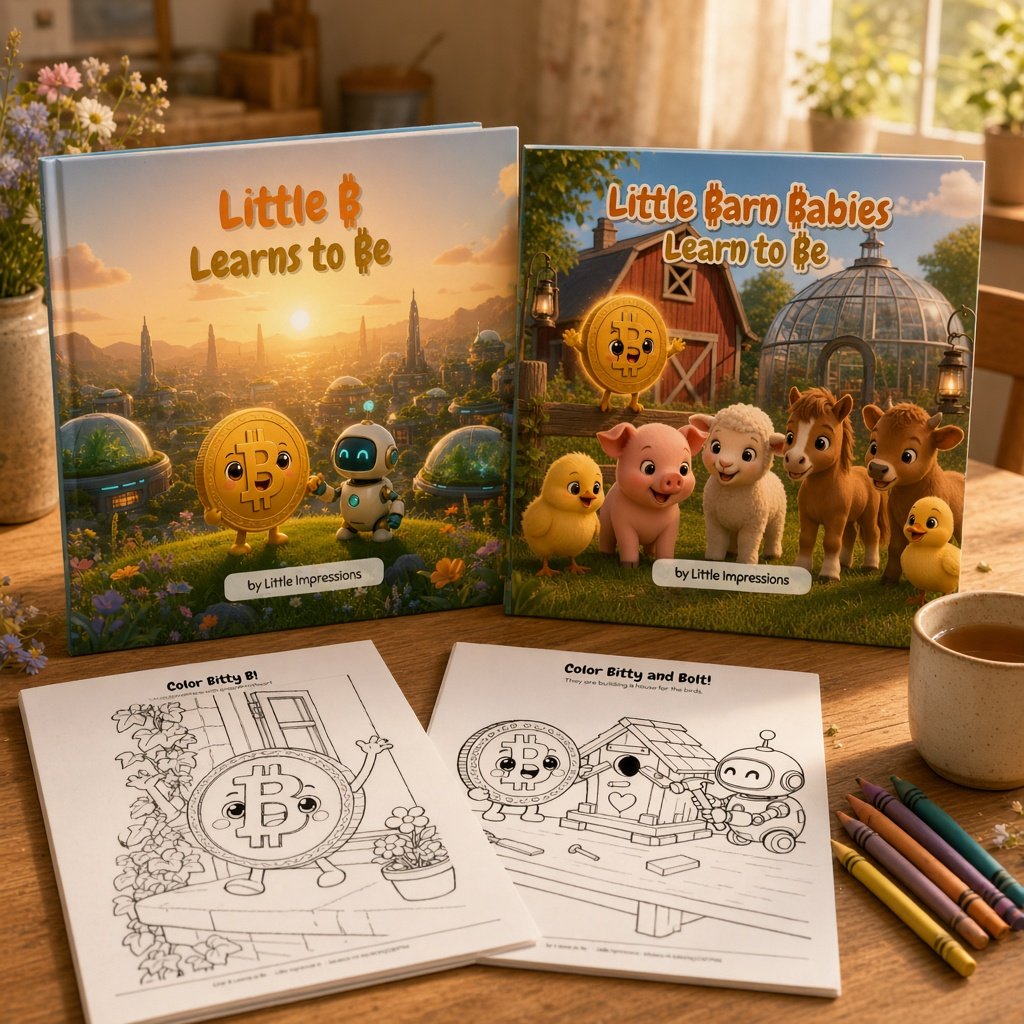
If you're looking for a gift that lasts longer than the wrapping, I wrote a children's book called Little B Learns to Be.
It's a short picture book for ages 3 to 7, about a small character in Brightvale learning to be productive, patient, kind, and brave.
@MidwesternDoc Reading labels taught me to ask one more question: how did this get from the field to the bottle? Butter, tallow, and olive oil have short answers, and short answers are usually a good sign. The shorter the better.
Water, food, and power all start somewhere before they reach the faucet, the plate, or the outlet. Knowing where is the first step to having a hand in it.
A family that understands what it uses is already learning how to make some of it.
Ask a kid where the light in the room comes from, and most will point at the switch. That's a fine place to start.
Then set a small solar light in the yard and let them check on it after dark. Power that came from the sun in your own yard feels different.