🟥Hello, welcome.
The original intention behind this account is simple: curiosity, and the desire to support myself through curiosity.
I'm curious—how many things in this world are there that we still don't know?
Honestly, this world is pretty boring.
But when you start paying attention to those mysterious and profound things—metaphysics, mythology, anomalies, legends—the world suddenly becomes very interesting.
This curiosity has driven me for a long time, and it will probably continue to drive me in the future.
Thank you for being willing to join me.
Cold facts about butterflies:
1. When a butterfly lands on your hand, it's not because it likes you. It's because the salt and nutrients in your sweat are too tempting.
2. You think all butterflies are collecting pollen, when in fact they are feasting on rotting fruit and fluids seeping from animal carcasses.
🟥To Win a Royal Post, Scientists Killed Alchemy
One day in July 1783, James Price, chemist of the Royal Society in London, took poison in his own laboratory and died.
A few months earlier he had been in full glory.
Price had twice performed turning stone into gold in public.
A pinch of white powder turned mercury into silver.
A red powder turned mercury into gold.
The news shook England and France.
Newspapers raced to print it.
Sir Joseph Banks, president of the Royal Society, was furious.
He demanded that Price perform again before the whole fellowship.
Otherwise he was a fraud.
Price first stalled.
The powder was gone.
Making more would take months.
At last he set a date and invited the fellows to his house in the country.
On the day only a handful of fellows arrived.
Or no one came.
The versions differ.
They did not see gold.
They only saw a corpse.
Price left a note saying he was not a fraud.
No one believed it.
The Royal Society cut him off at once.
His story went into textbooks as the madness of an alchemist.
One key fact was left out on purpose.
Price died in 1783.
Lavoisier’s theory of oxidation was still six years away.
At that moment no physical or chemical experiment could falsify the transmutation of metals.
He killed himself not for a scientific reason.
He killed himself under moral shame.
By the early eighteenth century a war of strangling alchemy was already under way.
Chemists, in order to enter the establishment and take chairs, wrote their own founding masters as cheats with their own hands.
🔺In the seventeenth century alchemy was the same dirty word
Today alchemy and chemistry are two words.
One is a false science.
One is a proper discipline.
In the seventeenth century and before, they were one word.
Chymistry.
What the alchemist did, the chemist did.
The books chemists wrote, alchemists also read.
The problem was the trade’s image.
First, low birth.
Physics, mathematics, astronomy had Greek classical roots.
They were noble sciences.
Chymistry?
It was bound to hand labor, smelting, pharmacy.
Practitioners often crouched by a furnace, reeking of sulfur, one slip from poison.
The university had no chair for it.
It could not enter the ivory tower.
Second, a rotten name.
For centuries the hunt for turning stone into gold had been tied to counterfeit coin and street fraud.
Pope John XXII ordered a strike on alchemy in 1317.
Not from fear of black magic.
From fear that fake gold would wreck the economy.
On the streets of sixteenth-century Morocco, alchemists who made false coin had their hands cut off, one after another.
Worse, in seventeenth-century plays the chemist, the alchemist, was always a clumsy, greedy, fraudulent clown.
In 1666 the Royal Academy of Sciences was founded in Paris.
Five of its thirty chairs were given to chemistry.
This was the first time chemistry won a formal national seat.
Then the problem.
How does a discipline covered in mud sit beside noble mathematics and physics?
🔺The early eighteenth century: pour the dirty water onto alchemy
The chief designer of this image overhaul was Fontenelle, secretary of the Academy.
He lived nearly a hundred years.
He knew how to work opinion.
He held that chemistry sat low because it had no geometric spirit.
It could not derive from axioms like mathematics.
It also spent its days tangled with fraudulent alchemy.
His prescription was blunt.
Cut.
Keep under the name chemistry whatever in chymistry was useful, testable, fit for a textbook.
Stamp the pursuit of the philosopher’s stone and of turning lead into gold as alchemy, as delusion, and kick it away.
In 1722 the Academy chemist Étienne-François Geoffroy published On Some Deceptions Concerning the Philosopher’s Stone.
Point by point he exposed the tricks of alchemists.
Gold dust hidden in charcoal.
True gold in the lining of a crucible.
Silver bars gilt with amalgam.
The paper later came to be seen as the sign of alchemy’s death.
The archives unmask Geoffroy’s double life.
Most of that anti-fraud paper was copied intact from a book by a gold-maker a hundred years earlier.
That book was not written to cheat.
It was written for peers, to warn them how to guard against fraud.
Geoffroy’s private library was stacked with alchemical works on transmutation.
Laboratory notes left at his death show that after 1722 he was still studying the transmutation of metals in secret.
His personal notes say:
Heat lead with a red substance.
A clear golden luster appears on the surface.
Needs further verification.
This was not one man’s habit.
Another Academy chemist, Louis Lémery, echoed Fontenelle in public.
In private he copied alchemical recipes into a notebook and marked them to be tried.
A collective cut on the surface.
A collective double standard below.
Why?
Once they had posts and royal funds, no one dared admit in public that he was still working the infamous art of alchemy.
Admit it, and the legitimacy the discipline had just built would collapse.
🔺A purge of language: kill the al- at the root
To draw the line for good they also used a weapon of linguistics.
A story still current says the al- in alchemy is the Arabic definite article.
So alchemy is only the Arabic edition of chemistry.
The al- makes it look low.
Drop the al- and you have high chemistry.
This is of course nonsense.
As early as the Greco-Roman period the craft was called chemeia.
The Arabs added the article and it became al-kimiya.
Europeans kept the al- in translation.
It was never a burden that had to be stripped.
Eighteenth-century chemists stressed that dropping of the al- on purpose.
They manufactured the illusion that chemistry had evolved and alchemy was a backward stage.
In fact, through the whole seventeenth century the sharpest natural philosophers studied transmutation.
Boyle wrote a skeptical dialogue on transmutation.
Newton left hundreds of thousands of words of alchemical manuscripts, with detailed records of how to prepare philosophical mercury.
They did not think they were practicing superstition.
🔺The death of Price
Back to Price.
He did not kill himself because science had failed.
He killed himself because the profession was destroyed.
The Royal Society was furious not because he claimed he could make gold.
That had been part of chemistry.
He had broken a new order already formed by the mid-eighteenth century.
In public you may only condemn alchemy.
You may not practice it.
Price was not as clever as Geoffroy.
He did not split public condemnation from private research.
He performed in the open.
He pulled down the chemist’s underclothes.
Sir Joseph Banks said in private:
If the public believes chemists are still doing transmutation, decades of building our name are wasted.
After Price died the Royal Society cut him off at once.
Details of his experiments were destroyed.
His note was read as a madman’s delusion.
No fellow of the Society attended his funeral.
🔺Alchemy invented
Today every chemistry student is told in the first class that chemistry is science and alchemy is superstition.
Few know that three hundred years ago the two words were one thing.
The cut was not made for truth.
It was made for posts, funds, a jump in class.
Alchemists may never have cheated anyone in a lifetime.
Chemists, in order to come ashore, joined hands and wrote them as frauds.
Price’s ashes lie in some nameless London grave.
No stone.
Geoffroy’s portrait still hangs in a corridor of the French Academy of Sciences.
Beside it a note:
One of the founders of modern chemistry.
History is never written by the truth.
It is written by the winners.
Sources:
James Price’s public transmutations and suicide, London, July 1783, and the Royal Society’s break with him under Joseph Banks.
The single early-modern word chymistry, and chemistry’s first chairs at the Paris Royal Academy of Sciences, 1666.
Fontenelle’s campaign to separate chemistry from alchemy.
Étienne-François Geoffroy, On Some Deceptions Concerning the Philosopher’s Stone, 1722, and his private notes on metallic luster.
Louis Lémery’s public line and private recipes marked to be tried.
The al- etymology story; Boyle on transmutation; Newton’s manuscripts on philosophical mercury.
Pope John XXII’s 1317 decree against alchemical coin.
🟥Is Your Soul Only a Secretion of the Brain?
Late Qing intellectuals lived through a spiritual earthquake stronger than a change of dynasty.
They suddenly found they might have no soul.
Missionaries did not do this.
Missionaries fought to prove the soul exists.
They only swapped in a God version.
What tore the paper on the window was modern psychology and anatomy.
With a new language they pried the word soul out of the dictionary and put four words back in.
Function of the brain.
🔺From qi to electricity
The traditional Chinese account of the soul did not start low.
In the qi-transformation view of the soul, the soul is a higher form of qi.
Qi is not simple air.
It is the basic stuff of the cosmos, carrying numinous intelligence and energy of its own.
A person lives because qi gathers in the body.
A person dies and qi scatters back into the cosmos.
The qi of the good and the bad scatters the same way.
The only difference is this.
A very few who used much refined stuff scatter more slowly and can gather for a while as ghosts.
The theory cannot explain judgment after death.
It still gives the soul a household registration in the cosmos.
You did not come from nowhere.
You are part of the qi of Heaven and Earth.
Your consciousness, feeling, and moral sense are the intelligent properties of qi.
You and the cosmos are one.
After Christianity arrived it gave the soul another source.
Not qi.
God.
When God made the human being he blew a soul into the flesh.
The soul is pure spirit.
No weight.
No space.
Never extinguished.
The body dies.
The soul is judged.
The good go to heaven.
The bad go to hell.
This version has more absolute fairness than the qi theory.
It also has one more dependence.
You must believe in God, or the soul has nowhere to register.
The version from scientific psychology is sharper.
Soul?
It does not exist.
What you call consciousness, feeling, will, are all physiological activity of the brain.
Like a battery discharging.
Like a muscle contracting.
Nothing mysterious.
🔺The soul is only a nervous system
In 1907 Wang Xingshu, a student in Japan, published an essay in the Journal of Medicine and Pharmacy.
He wrote the anatomical result of modern medicine on the soul in plain words.
He said all mental activity depends on the material working of the cerebral cortex.
Without that material mechanism of the cortex, there is no mind.
You see color because the optic nerve is working.
You hear sound because the auditory nerve is working.
You feel pain because the tactile nerve is working.
You feel that an I exists because the brain binds these signals and produces one stream of consciousness.
Once the brain stops, deep anesthesia, severe injury, death, consciousness is gone.
It has not floated away.
It has not gone back to the cosmos.
It has not gone to see God.
It is simply gone.
He used two figures.
The first is electricity and the battery.
The brain is like a battery.
Consciousness is like current.
The battery is spent.
The current is gone.
There is no such thing as the battery gone and the current still there.
The second is a machine and its motion.
A clock.
Gears mesh.
Hands turn.
Take the clock apart and the motion stops.
You do not ask where the soul of the motion went.
It was never a separate thing.
Wang Xingshu’s student summary:
Medicine proves that without the material mechanism of the cerebral cortex there is no mind.
The eye cannot tell color.
The ear cannot tell sound.
The mouth cannot tell taste.
The nose cannot tell smell.
The skin cannot tell touch.
All of it is nerves.
None of it is ghosts.
🔺A dream is no longer a journey of the soul
The ancients believed a dream is the soul leaving the body.
You sleep.
The soul drifts out, travels far, meets a dead relative, receives a revelation from an immortal.
You remember on waking, so the soul has a good memory.
Late Qing popular articles on psychology punched through that romantic account.
In 1903 Xinmin Congbao explained:
A dream is consciousness still moving after you fall asleep.
You think you dreamed of a ghost because by day you heard too many ghost stories.
The brain stored many images of ghosts.
When you sleep, inhibition in the brain weakens.
Those stored images start to play by themselves and project as a dream.
You think you dreamed of an immortal because you burn incense often and bow to the Buddha often.
Fantasy switches on in sleep.
The immortal did not come to find you.
The immortal database in your head is running at night.
The account has an inference that sits badly.
The dead relative you dream is not really coming to see you.
Your brain is remembering him for you.
The warmth is real.
That he is no longer anywhere.
🔺If there is no soul, what holds up morality?
Missionaries once struck hard at the Chinese qi view of the soul.
If a person dies and scatters, to whom is paper burned at Qingming?
If a villain dies and is finished, on what ground do you urge people toward the good?
After scientific psychology arrived, the missionaries were slapped too.
Science does not recognize the Christian soul either.
Under the microscope of neuroscience, the undying spiritual substance God gave has no place to stand.
Late Qing intellectuals fell into a double bind.
On one side the scientific evidence was too hard.
Chen Huang wrote in Sequel to On the Nonexistence of Ghosts:
After death the optic, olfactory, auditory, speech, and limb nerves all go out.
Like a charge spent, vibration stopped, burning finished.
You cannot make a shut-down brain produce consciousness again.
You cannot make a stick of charcoal already burned to ash burn again.
On the other side the moral anxiety was too heavy.
Disciples of the late Qing thinker Yu Yue, friends of Zhang Taiyan, talked in private.
If a person dies like a lamp going out, what is the difference between a sage and a bandit?
Yan Hui died young.
Robber Zhi lived long.
Who settles that account?
Science does not answer why the good must suffer.
It only answers how the good suffer.
In 1902 Du Yaquan tried a middle path in A Brief Account of Psychology.
He swapped the word soul for spirit.
He defined spirit as consciousness.
He understood consciousness as a function of the brain.
He kept a kind of independence for function.
You cannot say walking is a secretion of the legs.
You can say walking is a function of the legs.
Function is not matter.
It is also not a substance that exists on its own.
The compromise was not thorough.
It was enough for late Qing intellectuals to find a crack of air between the scientific conclusion of no soul and the moral need for a soul.
🔺The brain wave stops. Then what?
Today neuroscience is far more advanced than a hundred years ago.
We know which region of the brain governs language, which memory, which fear.
We know brain waves can be quantified, measured, shown on a machine as a rising and falling line.
We know that when that line goes flat, consciousness is gone for good.
We know the truth of the soul more clearly than the late Qing.
We find it harder than they did to answer then what.
The ancients answered:
Then the soul reports to King Yama.
Christians answered:
Then the soul goes to God for judgment.
Modern people answer:
Then the brain wave becomes a straight line.
There is no then.
Do we still go at Qingming?
Do we still burn paper?
More than a hundred years later the answer still has not appeared.
Not because science is not advanced enough.
Some questions were never ones science can answer.
Science tells you what it is.
It does not tell you what to do then.
Perhaps we can only live like this.
Know there is no soul.
Still love, remember, and revere as if there were.
Not because we cheat ourselves.
Because knowing is one thing and living is another.
The brain wave will stop.
What you choose to do before it stops, that act, with a soul or without, still counts.
Sources:
Wang Xingshu, Journal of Medicine and Pharmacy, 1907, on mental life as the material working of the cerebral cortex.
Xinmin Congbao, 1903, on dreams as stored images playing when inhibition weakens.
Chen Huang, Sequel to On the Nonexistence of Ghosts, on nerves going out after death.
Du Yaquan, A Brief Account of Psychology, 1902, spirit as consciousness and consciousness as a function of the brain.
The qi-transformation view of the soul, the Christian undying soul, and the late Qing moral anxiety after both were displaced.
🟥Sabazios
In the ancient Mediterranean world, there was an enigmatic yet profoundly influential deity from Phrygian mythology—Sabazios.
He originated in west-central Turkey. Later, with the expansion of the Hellenistic era and the Roman Empire, he was carried across the entire Mediterranean world.
Many scholars believe he shares complex connections with the wine god Dionysus, Zeus, and even Eastern mystery religions.
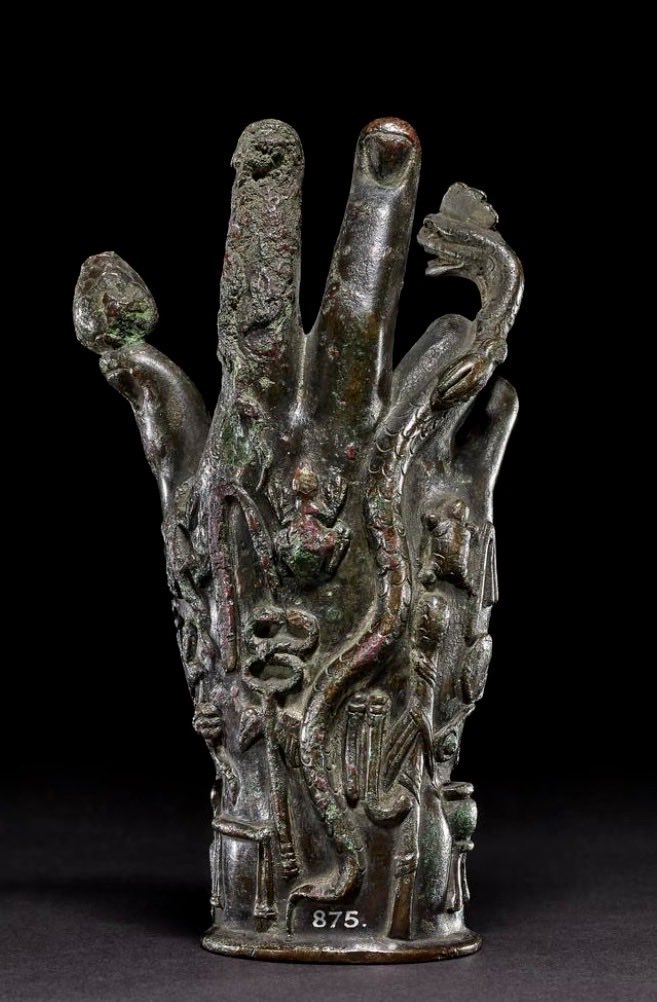
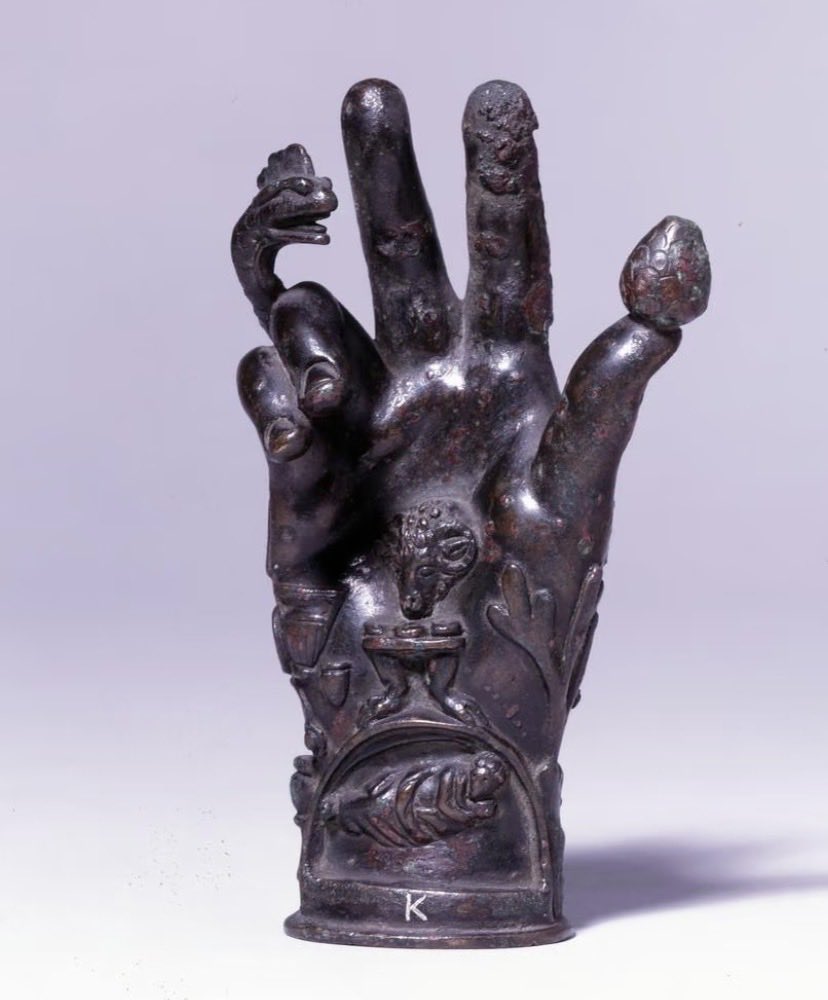
In the Antiquities collection, Sabazios's most famous relic is not a statue of the god himself—but a "bronze hand."
These ritual objects, known as the "Hand of Sabazios," are typically crafted as a raised right hand, as if performing a blessing or a mystic ritual.
The palm and fingers are often covered with symbolic elements:
· Snake — rebirth, the underworld, and hidden knowledge
· Frog — fertility and the cycle of life
· Lizard — transformation and regeneration
· Pinecone — Dionysian ecstasy and spirituality
· Divine figures and altars — sacrificial rites in mystery religions
These elements, mixed together, give the worship of Sabazios a powerful aura of "Eastern mysticism."
Many researchers believe these religions did not emphasize public sacrifice, but rather resembled a secret, "initiatory" faith.
Through ritual, music, Dionysian ecstasy, and symbols, worshippers sought an experience of communion with the divine.
Interestingly, the raised-hand gesture of Sabazios may have even influenced the early Christian gesture of blessing.