Finnish scientists trucked in real forest dirt and grass and laid it over the gravel at four daycare yards. They let the kids dig around in it for a month. The blood tests came back with changes the researchers hadn’t expected to see so fast or so clear.
The study ran at ten daycares in two Finnish cities with 75 kids aged three to five. Four of the yards got the forest treatment: about a tennis court worth of soil and grass laid over the gravel, plus planters and peat blocks the kids could dig and climb on. Three others stuck with their normal gravel yards. The last three were daycares where the kids were already visiting real forests every day.
After one month, the variety of bacteria living on the kids’ skin shot up, and the kind that helps train the skin’s immune defenses jumped the most. Their gut bacteria started to look like the gut bacteria of the forest-visiting kids. Their blood showed more of the immune cells whose job is to keep the body from freaking out at harmless stuff like pollen and peanuts, and overall inflammation dropped. The kids on the plain gravel yards showed none of this.
Childhood asthma in the US doubled between 1980 and 1995. Food allergies in kids jumped 50 percent between 1997 and 2011, then jumped another 50 percent between 2007 and 2021. And peanut allergies in one-year-olds tripled between 2001 and 2017.
The Finnish researchers think one of the reasons is simple: kids today don’t get dirty enough. 37 percent of American preschoolers now spend an hour or less outside on a normal weekday. Their immune systems are getting trained in environments stripped of the bacteria humans have always lived around.
Aki Sinkkonen, who led the study, put it in plain words: “It would be best if children could play in puddles and everyone could dig organic soil.” The Finnish government is now helping pay for daycares across the country to make the same changes.
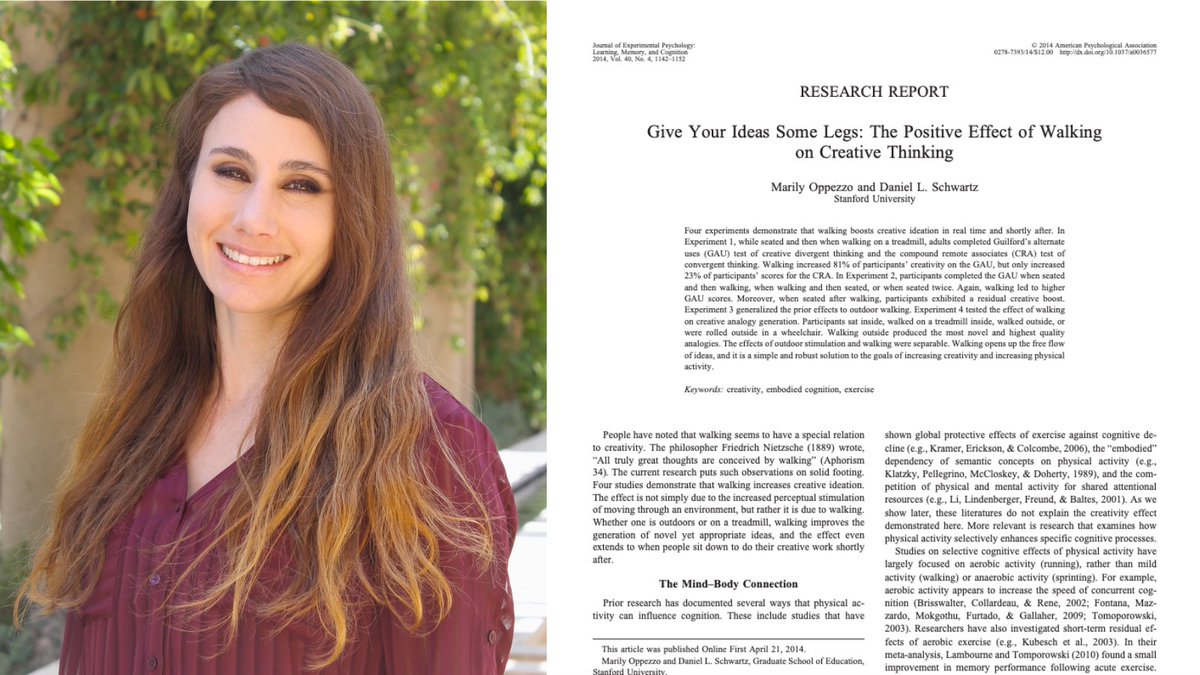
A Stanford psychologist spent 4 years proving that the simple act of walking generates 60% more creative ideas than sitting, and the experiment she designed to kill every alternative explanation is one of the most decisive findings in modern psychology.
Her name is Marily Oppezzo.
She got the idea for the study while walking with her advisor at Stanford to discuss her thesis topic, and the paper she eventually published in the Journal of Experimental Psychology in 2014 is sharp enough that it should have ended the seated meeting on the day it came out.
She ran 4 experiments on 176 people. Same person tested twice. Once sitting, once walking. The creativity tasks were the standard ones psychologists have used for decades to measure how good a brain is at generating novel useful ideas.
The result was almost too clean to publish.
81% of participants in the first experiment produced more creative ideas while walking than while sitting. In the second experiment, 88%. In the third, 100%. Every single person walked into a more creative version of themselves.
On average, people generated 60% more novel useful ideas the moment their legs started moving.
The skeptical question is the obvious one. Maybe it was the fresh air. Maybe it was the scenery passing by. Maybe it was the change of environment doing the work, not the walking itself.
Oppezzo killed every one of those explanations with one experimental decision.
She put people on a treadmill facing a blank wall. No scenery. No fresh air. No environmental change. Just legs moving in place while staring at white drywall. The 60% boost held.
Then she ran the experiment that closed the case completely. She took participants outside in two conditions. Half of them walked through a Stanford courtyard. The other half were pushed through the exact same courtyard in a wheelchair. Same outdoor stimulation. Same scenery passing at the same speed. The only difference was whether the legs were moving.
The walkers produced dramatically more novel high-quality ideas than the wheelchair group. The outdoors did almost nothing on its own. The walking did everything.
This is the part of the study that hit hardest when I read it the first time.
She also tested the opposite kind of thinking. Convergent thinking. The kind where there is one right answer and you have to narrow down to it.
Word puzzles where 3 words share a hidden fourth word that connects them. The seated participants did slightly better on these. Walkers got slightly worse.
Walking is not a general intelligence enhancer. It does one specific thing. It opens up the divergent search inside your brain. The part that generates options. The part that produces unexpected connections. The part that takes a problem and finds five ways into it instead of one.
When you need to converge on the single right answer, sit down. When you need to find the answer in the first place, get up.
The mechanism is now well understood. Walking selectively activates what neuroscientists call the default mode network, the system inside your brain that runs when you are not consciously focused on anything. The DMN is where mind-wandering happens. Where memories cross-reference each other. Where ideas that have been sitting in separate folders inside your head finally bump into each other.
When you sit at a desk and force yourself to concentrate, you suppress the DMN. When you walk at a natural pace, the executive part of your brain gets just busy enough handling the walking that the DMN comes online and starts doing the work that focus was blocking.
The most useful finding in the entire paper is the one almost nobody quotes.
The boost did not turn off the moment people stopped walking. Participants who walked first and then sat back down stayed elevated. Their next round of seated creativity work was still significantly better than people who had been sitting the whole time. The rest lingered for at least several minutes after the legs stopped moving.
You do not need to do creative work while walking. You need to walk before the creative work. The brain holds the state.
The history of this is the part that should haunt anyone who still does meetings in chairs.
Charles Darwin built a gravel loop behind his house in Kent called the Sandwalk and walked it 3 times a day for the rest of his life. The theory of evolution was developed one lap at a time on that path.
Nietzsche walked up to 10 hours a day during the years he wrote his most important books and openly said the work was conceived on his feet.
Beethoven composed for the morning and walked for 5 hours every afternoon with a pencil in his pocket for when something landed.
Kahneman said the best thinking of his Nobel Prize-winning career happened on leisurely walks with Amos Tversky. Steve Jobs refused to take important conversations sitting down. He held them on foot.
Every one of them was using the system Oppezzo would not measure until 2014. They just did not know what to call it.
The question worth sitting with is the one almost nobody asks.
Every meeting you have ever attended sitting around a table was a meeting held at a fraction of the brain power that was actually available to the people in the room. Every brainstorm that got stuck inside a conference room. Every problem you tried to solve at a desk and gave up on. Every idea you could not quite get to.
The intervention is the easiest one in modern science. No supplement. No app. No subscription. No training program. Just a pair of legs and 15 minutes.
The Stanford lab proved it. The philosophers knew it. The neuroscience explains it.
And almost everyone reading this is still trying to think their way out of problems sitting completely still.
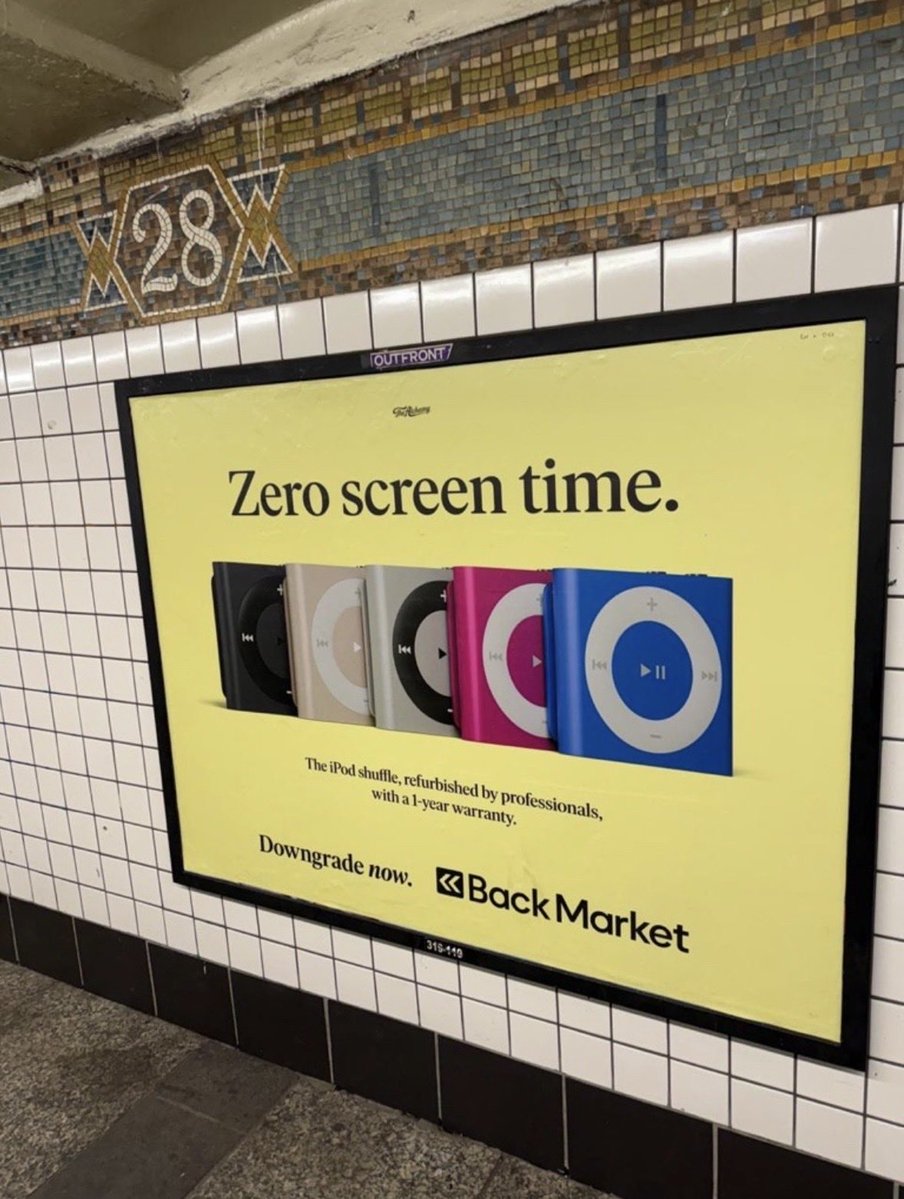
Spotted in the NYC subway. “Zero screen time.” An iPod Shuffle ad in 2026.
When we built the iPod, the goal was the technology disappeared and you could have your music wherever you were. 1,000 songs in your pocket.
Now we’re living through a moment where people are actively looking for ways to disconnect from the infinite feed, algos, and constant notifications. That doesn’t mean technology is bad. It means the best technology understands when to step back.
Not every problem needs another screen, another menu, or another layer of complexity. Constraints create freedom (read: @DavidEpstein new book Inside the Box). And often removing features creates a better product than adding them.
The future of technology shouldn’t just be more engagement. It should help us be more human.
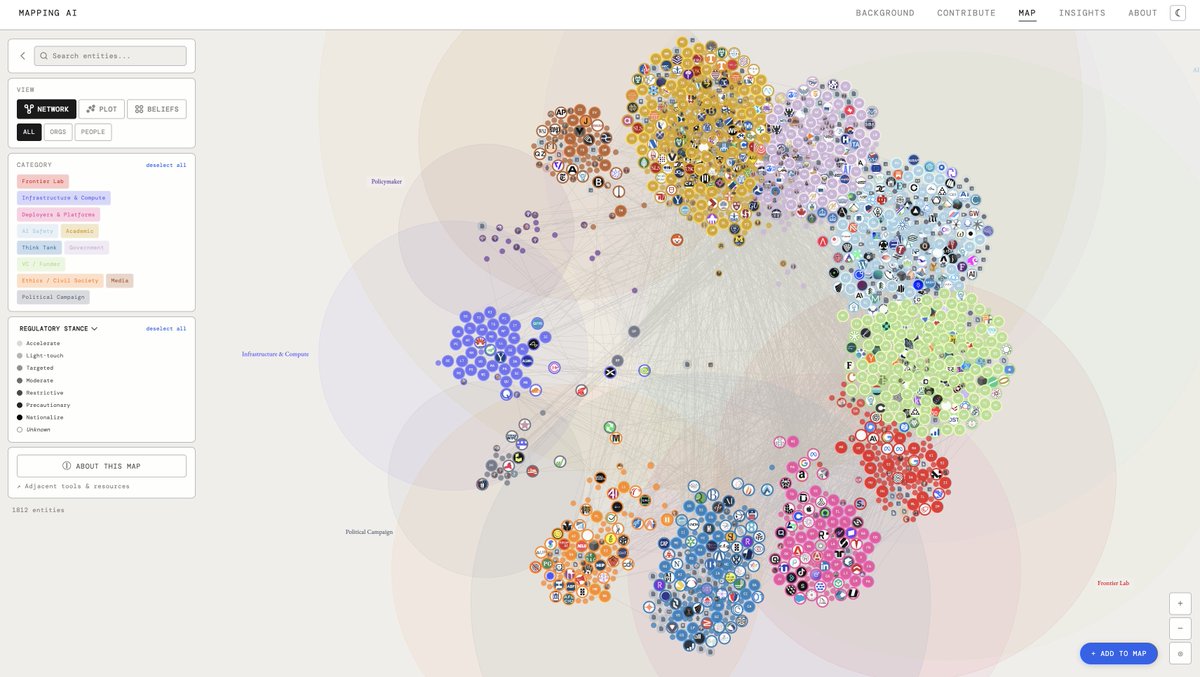
Who actually shapes AI policy in the U.S.?
We mapped 1,812 entities: 745 people, 918 organizations, 2,925 relationships. Frontier Labs, AI Safety orgs, Think Tanks, Government, VCs, and more.
https://t.co/6RDB1R0qNd
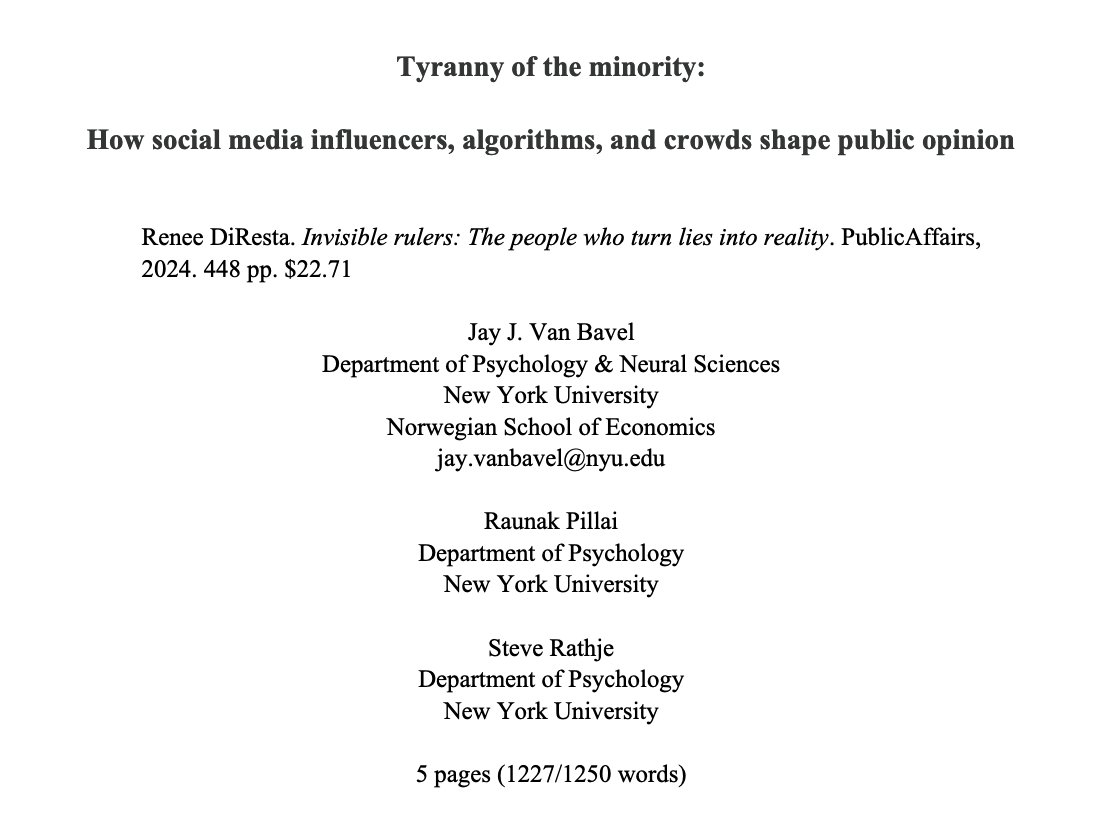
A small fraction of online actors now exerts outsized influence over what the public sees, believes, and argues about.
In a new short review paper, we trace how social media influencers can turn fringe claims into viral narratives—often by exploiting a feedback loop between influencers, algorithms, and crowds.
As such, the modern information environment enables a tyranny of the minority: extreme and coordinated voices dominate attention, distort perceived social norms, and create a “funhouse mirror” version of public opinion that makes fringe positions look common and conflict look inevitable.
We synthesize emerging evidence that a tiny number of highly active users drives a disproportionate share of misinformation and toxicity, and explain how platform incentives reward moralized, identity-salient, and emotionally charged content.
We conclude by outlining pragmatic responses—individual, institutional, and policy-level—and by highlighting how generative AI could either accelerate bespoke realities or help rebuild shared understanding, depending on how these systems are designed and governed. https://t.co/9oZRF8y8mL
We (@PillaiRaunak & @steverathje2) reviewed @noUpside's fantastic book "INVISIBLE RULERS" and connected it to the research we have been doing on this topic for the past decade.
Norway is reversing its mistaken 2016 decision to give every student an iPad, which damaged education immediately. Many countries are going back to books and handwriting. I hope many American schools will go back to analog next September, and let's see if that works for us too:
Destroying the @InternetArchive's @WayBackMachine would be the equivalent of the burning of the Library of Alexandria - one of the worst losses of knowledge in history.
Media giants are now threatening to do this.
We can't let this happen.
Pass it on.
A HARVARD psychologist says: “if you’ve achieved nothing by 25, you’ve avoided the most destructive illusion of youth”
> In 2021, a Harvard psychologist surprised a lecture hall with an unexpected statement:
“If you haven’t accomplished much by 25, you may have escaped one of youth’s biggest illusions.”
At first, the room laughed.
She wasn’t kidding.
> The illusion of early success.
In your early 20s, the brain seeks quick proof of worth ~status, attention, rapid achievements.
But psychologists warn that chasing recognition too soon can lock people into roles or paths they never consciously chose.
They decide too early… and spend years trying to undo it.
> The exploration phase.
Research on career development suggests that people who explore more before 30 often build stronger long-term directions.
Testing ideas.
Making mistakes in public.
Changing course.
At 25 it looks like confusion ….but by 35 it often turns into clarity.
People who feel “behind” in their mid-20s frequently gain something others miss:
Perspective.
Patience.
And a clearer sense of what truly matters to them.
That foundation often leads to better decisions later on.
At the end of the lecture, the psychologist left the students with one final thought:
“You’re not meant to have life fully figured out at 25.”
“You’re meant to discover who you’re not.”
A Harvard professor spent 40 years inside the human brain studying how language works. Wrote 9 books. Taught thousands of students.
And he still thinks most people have no idea why their writing fails.
Steven Pinker stood in front of a room and asked one question. Why is almost all writing academic, corporate, government, even most things you read online so painfully bad to get through?
The room expected him to say laziness. Lack of practice. Poor education.
He said none of those things.
He called it the Curse of Knowledge. And once he explained it, I couldn't unsee it anywhere.
Here's how it works. The moment you understand something deeply, something breaks inside you. You lose access to what it felt like before you knew it. The confusion you once had disappears so completely that you can no longer imagine anyone else feeling it. Your blind spots don't feel like blind spots anymore. They feel like obvious starting points.
He told a story about a molecular biologist presenting at a TED event in front of 400 people. Brilliant man. Spent years on his research. Walked on stage and immediately started speaking in technical language without ever once explaining what problem he was trying to solve or why a single person in that room should care about it. People glazed over within two minutes. He finished his talk having no idea what had just happened. He thought he'd done well.
That is the curse in its purest form. It doesn't announce itself. It disguises itself as competence.
Then Pinker said the thing that stopped me cold.
Bad writing is not about intelligence. It is not about effort. It is a failure of empathy. A writer who cannot imagine what it feels like to not know what they know will always lose their reader. Every time. No exceptions.
His solution was not a writing technique. It was a person.
He gave his drafts to his mother. She was educated, well-read, deeply intelligent. But she was not a cognitive scientist. She had no stake in his field. When she hit a sentence and her eyes slowed down, when she read a paragraph and looked up slightly confused, he didn't think she'd missed something. He went back and fixed the writing. Not her. The writing.
That reframe alone is worth more than most writing advice combined.
Then he moved to the thing almost every writer gets completely wrong.
Words are not the point. Words are just a vehicle. What your reader actually walks away with is not the sentence you wrote. It is the image, the feeling, the physical thing that sentence was supposed to create inside their mind. If no image forms, nothing was communicated. The words passed through and left nothing behind.
He asked his audience what a paradigm looks like. What a framework feels like. What color a concept is.
Total silence.
Because abstractions are invisible. They produce no picture, no texture, no sensation. They are placeholders that feel like meaning but deliver none.
The writers who survived two hundred years did it because they had no choice but to be concrete. There was no jargon to retreat into. So instead of writing about aggression they wrote about the spirit of the hawk tearing into flesh. The reader felt it before they understood it. That is the only writing that actually works.
The last thing he said was about brevity. And he defined it in a way I had never heard before.
Brevity is not a low word count. Brevity is the discipline of cutting every single word that asks something of your reader without giving something back. Every unnecessary word is a small tax. Enough small taxes and the reader stops paying.
He has carried three words with him for forty years. Omit needless words. He said that line does something almost no piece of advice manages to do. It demonstrates what it teaches. It is itself an example of the principle it describes.
The best writing he ever produced came under an 800-word limit an editor refused to negotiate. The pressure of that constraint cut everything that was hiding inside the extra space. It always worked. Without fail.
The Curse of Knowledge will not go away because you are aware of it. Awareness is not enough. The only move that actually works is finding someone outside your world, handing them what you wrote, and watching their face while they read it.
Not reading it for them. Watching them.
The moment their face shows even a flicker of confusion, you have found exactly where your writing failed.
That is the whole masterclass.
I know social media's toxic right now.
But I'm glad that Katie Brinkley's book paves a way to elevate discourse to get this medium unstuck. Her @funnelreboot episode is out now - head to link on show's page to catch it.
Sam Altman, Dario Amodei, Demis Hassabis, Elon Musk, and Mark Zuckerberg all face the same trap: if I don't move fast, a competitor will.
They're right. Which is exactly why the public — not any individual company — needs to set the rules.
I made the case in Fortune this week: https://t.co/yeHp3Jo2qf
A growing number of college professors say they are turning to oral exams, and combining a variety of old-fashioned and cutting-edge techniques, to help address a crisis in higher education. https://t.co/PE29GWYPMT
🚨 Do you understand what happened in the last 24 hours?
> Zuckerberg killed the Metaverse after burning $80 billion on cartoon avatars nobody used
> Sam Altman took $13 billion from Microsoft then sold OpenAI's cloud to Amazon for $50 billion.. Microsoft just found out they funded their own competition
> Anthropic made an AI that takes orders from your phone and does your work while you sleep..
> X dropped a dislike button AND a mute-entire-countries button in the same week..
> YouTube asking you to flag AI slop is just Google getting 2 billion people to train their next model for free
> 93% of US jobs can now be partly done by AI.. Same week companies started giving the weakest raises since 2008
> Apple started rejecting vibe-coded apps from the App Store
> xAI is paying Wall Street bankers $100/hour to teach Grok how to replace Wall Street bankers.. They're taking the money..
> A mystery AI model appeared on benchmarks beating everything.. Developers think DeepSeek is quietly testing their next weapon
> Bloomberg asked "Is the AI bubble about to burst" the same day Nvidia said the chip market will hit $1 trillion.. One of them is dead wrong..
> The UK government backed down on AI copyright after artists revolted.. First government to flinch
> The Fed said rate hikes are back on the table and blamed AI data centers for making inflation worse
And it's only Wednesday. See you tomorrow. It'll be worse.
If you're not following me you're finding out about this stuff 48 hours late from someone who read my post
I ran a social network analysis of 5,000 English-language X posts about the Iran/Israel/US conflict and its regional spillover from March 3, 2026. One methodological note: NodeXL pulls in reverse chronological order, so 99.6% of this data captures a two-hour peak window that evening. That swirling galaxy is the interaction network, and every strand leads to the same place. The most central node in the entire conversation isn't a journalist, a politician, or a media outlet. It's @grok, X's own AI. #MiddleEast #IranIsraelWar #USIranWar
I’ve partnered with @CEPSM to show NFPs how to use Google Analytics. Learn more about our practical online workshop - March 3rd:
https://t.co/m9VCLduyTO
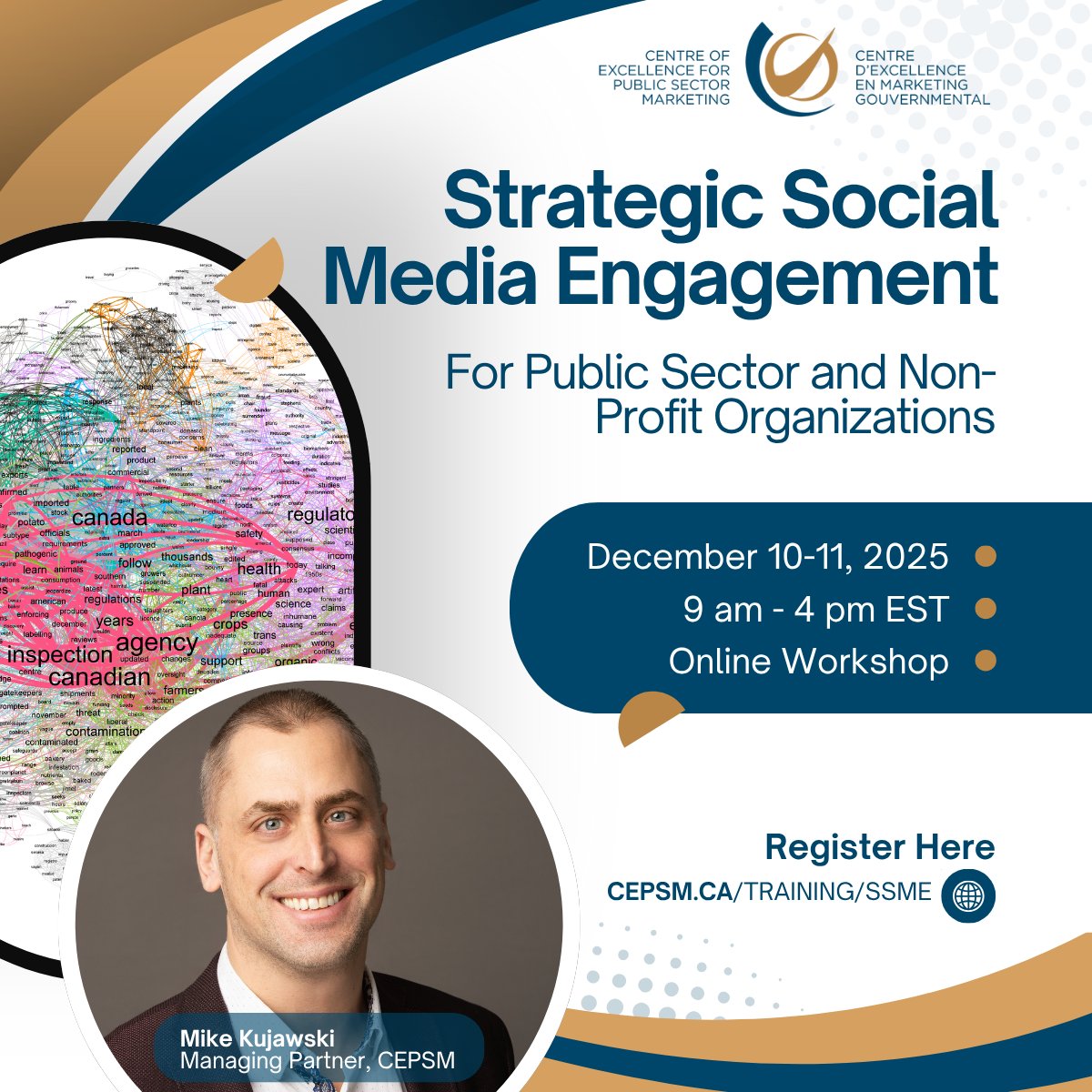
Dec 10–11: CEPSM’s Strategic Social Media Engagement workshop for public sector and non-profit teams. Proven process. Practical tools. Small group.
Register here: https://t.co/4a5PVjQXmM