Exec Dir of Peterson Center on Healthcare & PHTI. Formerly Avalere & NORC. Expert in heath policy, insurance, digital health, Rx & aging. Views are my own.
NIC TALKS: Bringing Together Healthcare and Housing to Stimulate Move-ins and Margins – Tuesday, October 24 at 1:15pm CT – @CF_Pearson@bobgkramer@Natl_Inv_Ctr#SeniorHousing#healthcare
View the full agenda for 2023 NIC Fall Conference:
https://t.co/QEBRE9peSb
Join me at #HLTH2023 on Monday at 2:10pm PT to hear what employers, plans, and providers are looking for when purchasing #digitalhealth solutions. We'll help you navigate through the sea of sameness!
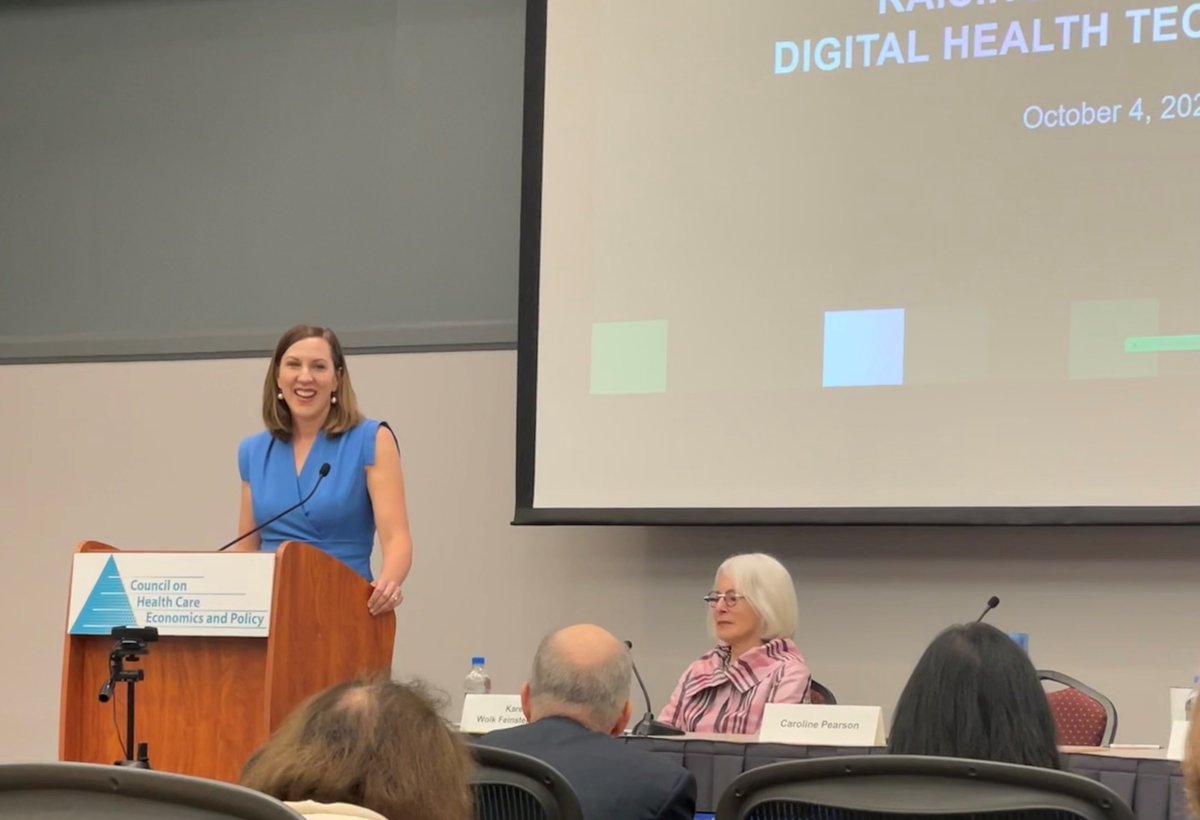
PCH executive director @CF_Pearson joined @KarenWFeinstein & @vivianleemd at Brandeis @TheHellerSchool’s Princeton Conference to discuss the biggest healthcare trends, including the need for excellence in #digitalhealth tech evaluation. When discussing what @Peterson_HTI will bring to the table in determining the value of digital health products, Pearson said: “I don't want to produce a bunch of publications that sit on a shelf – I want to produce information that people can use to make informed decisions.”
TODAY: Exec Dir @CF_Pearson speaks at @AHIP Coverage’s Consumer Experience & Digital Health Forum with @KyuRheeMD and John Mathewson "Evaluating Digital Health Tools to Improve Experience and Outcomes." #AHIPDigital https://t.co/hmW24dz3R8
Congrats to my good friend @CF_Pearson on the launch of the Peterson Center on Healthcare! Amazing mission supporting programs that raise care quality and drive down costs. S/o to @ravindranize for a great write up in @statnews. Check it out 👇
https://t.co/KqTKQDDdqF
Read more about the new @Peterson_HTI in this article from @statnews. @arieldora raises an important question about how an independent evaluator for digital health can move the needle. We are working closely with purchasers (payers, providers, employers) to inform their decision making, thereby raising the bar for evidence across the industry.
“Increasingly, I think patients, health insurers, providers and even investors are really saying, ‘How do we make sure digital health tools work, and what does work even mean?’ " https://t.co/82U730V1yU
I am proud to announce the launch of @Peterson_HTI, a new institute for the evaluation of health technology from @PetersonCHealth. Now the hard work begins to ensure that patients, providers, and payers can be confident that health technologies are delivering on their promise for better outcomes.
We are thrilled to announce the launch of @Peterson_HTI, a new banner initiative of the Center that provides independent evaluations of digital health technologies to improve health and lower costs.
Learn more:
https://t.co/3mfhCNFnCu
Since 9 in 10 people living with Parkinson’s disease in the U.S. are covered by Medicare, @CF_Pearson + team could dive into the data and find:
"People of color and rural residents were least likely to access a neurologist or therapy services." https://t.co/cM920KZaHA
We’re supporting analytic capacity and transparency about healthcare costs and outcomes in Washington state to improve access to quality, affordable care for its residents.
Learn more about this effort. @WA_Health_Care@IHME_UW
https://t.co/VJyql610Ip
If we held health spending as a % of GDP to 2021 levels (18.3%), we would save almost $0.5T in 2031 compared to projections. I bet you can think of other amazing ways to deploy that money.
When I was pregnant, I had no desire for at-home ultrasounds that would allow me to peer at baby in utero. Yet, I regularly wish for an at-home x-ray to check the progress of bone healing in my broken leg. Not sure what exactly that says about me...
As vertical integration in healthcare continues, site neutral payment policies can play an important role limiting healthcare spending growth. Good to see such policies gaining traction at both state and federal levels.
👏 New #bipartisan legislation will lower health care costs & disincentivize consolidation via site-neutral payment reforms in Medicare and the commercial market. Read more: https://t.co/pdHYWKnsdI
I believe pricing data is important to help rationalize spending across providers. However, unit pricing data becomes much less relevant in a value-based payment arrangement. Sadly, the service-specific pricing data is still very relevant in our current payment environment.
What data do you think would most dramatically transform healthcare if it was widely available and easy to use?
(A) Pricing data;
(B) Utilization data;
(C) Quality data;
(D) Provider financial data;
(e) Other, please specify.
*Assume privacy / security risks are fully mitigated.
Thanks to the hard work and support of Joseph at @Athletico Hyde Park West, I was able to wear high heels today to testify at the US Senate. This was my first time back in heels post-op, since I broke my tibia and fibula in a skiing accident 12 weeks ago.
I am honored to have been able to testify before @SenFinance on the importance of healthcare data transparency. Better data is an essential underpinning of broader policy and market efforts to reduce healthcare spending.
Our Executive Director @CF_Pearson speaking today to @SenateFinance@SenFinance about the importance of data transparency:
“My testimony puts forth a range of policy options that Congress and the Executive Branch should consider to advance healthcare data transparency…
Policymakers need better, more actionable data on healthcare utilization, spending, and outcomes. With this information, states like WA are better positioned to improve the performance of their hc system. We at @PetersonCHealth are thrilled to be supporting this effort.
We’re supporting a new effort between @WA_Health_Care and @IHME_UW to provide policymakers with timely evidence to improve access to quality, affordable care for Washington state residents.
https://t.co/VJyql610Ip
In this weekend's weird mashups...Taylor Swift fans in head-to-toe sequins take a shortcut to the concert through McCormick Place, which is hosting some 40k+ people in business attire for ASCO.