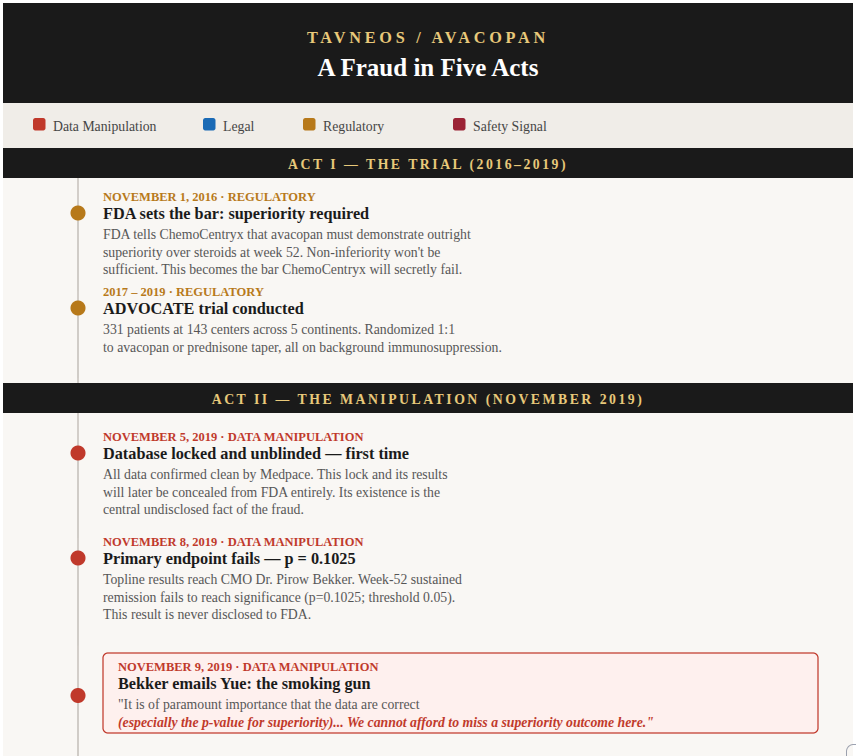
On June 30, 2026, the NEJM retracted the clinical trial that got a drug approved by the FDA, triggering a $3.7B acquisition by Amgen.
The reason: the primary endpoint data was manipulated.
Here's how it happened, how it came to light, and who paid the price. 🧵
💧 Fluid Responsiveness ≠ Fluid Tolerance
For years, critical care clinicians have focused on a fundamental question:
Will this patient increase cardiac output if I give fluids?
A new multicentre study from France and China suggests we may need to ask a second question:
What price will the patient pay for that fluid?
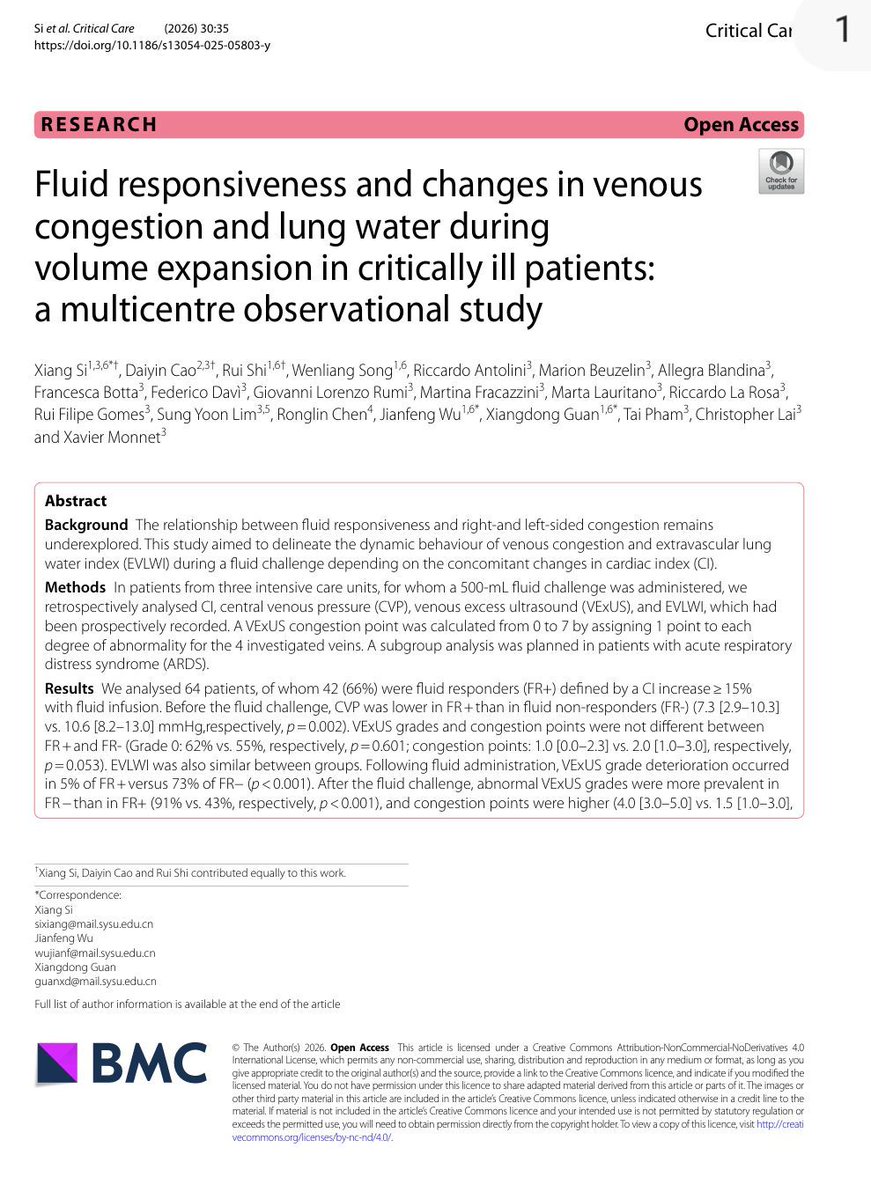
In this observational study of 64 critically ill patients receiving a standardized 500 mL fluid challenge, investigators evaluated not only cardiac index (CI), but also venous congestion using VExUS and pulmonary congestion using extravascular lung water (EVLWI).
The findings are striking.
Before fluid administration, venous congestion could coexist with fluid responsiveness. In fact, many patients remained preload responsive despite already demonstrating evidence of systemic venous congestion.
However, what happened after fluid administration was even more important.
Among fluid responders:
✅ Cardiac index increased significantly
✅ Venous congestion remained largely stable
✅ Only 5% experienced worsening VExUS grade
✅ Lung water remained relatively unchanged
Among fluid non-responders:
❌ Cardiac output barely changed
❌ Venous congestion worsened dramatically
❌ VExUS deterioration occurred in 73%
❌ EVLWI increased significantly
❌ Congestion became evident across hepatic, portal, and renal venous territories
Perhaps the most important physiological message is this:
When the heart cannot convert preload into flow, the fluid has to go somewhere.
And where it goes is congestion.
The study also found a strong correlation between CVP and VExUS, suggesting that while advanced ultrasound provides valuable organ-level information, a carefully interpreted CVP may still remain a useful bedside marker of right-sided congestion.
The ARDS subgroup provides another important lesson.
Even fluid-responsive ARDS patients accumulated more extravascular lung water after fluid administration than non-ARDS patients, highlighting the role of pulmonary permeability in determining fluid tolerance.
This study reinforces a concept that is increasingly central to modern hemodynamic management:
The goal is not simply to identify fluid responsiveness.
The goal is to identify patients who are both:
✔ Fluid responsive
✔ Fluid tolerant
A fluid challenge that increases congestion without increasing flow is not resuscitation.
It is fluid accumulation.
The future of hemodynamic management may lie at the intersection of:
• Fluid responsiveness
• Venous congestion assessment
• Pulmonary permeability
• Organ-specific fluid tolerance
Because the best fluid is not the one that can be given.
It is the one that provides benefit without causing harm.
Reference , 📚
Si X, Critical Care. 2026;30:35.
Full house at MCW-Milwaukee’s Match Day event! Just a few minutes more before the envelopes are opened! So proud of ALL @MedicalCollege medical school grads! #MCWmatch23
2/2 Check out my new articles in Respiratory Medicine:
Does Transbronchial Lung Cryobiopsy Improve Diagnostic Yield of Digital Tomosynthesis-assisted Electromagnetic Navigation Guided Bronchoscopic Biopsy of Pulmonary Nodules? A pilot study (https://t.co/rW5RgY6pM8)
1/2 Check out my new articles in Respiratory Medicine:
Size and Vision: Impact of Fluoroscopic Navigation, Digital Tomosynthesis, and Continuous Catheter Tip Tracking on Diagnostic Yield of Small, Bronchus Sign Negative lung nodules (https://t.co/KHl4cY5E2t)
This article using #LTCFocus data investigates the impact of #nursinghome location, quality, & staffing levels on #COVID19 incidence among residents in Wisconsin. Check it out here! @JAMDAcom@CGGmehlin https://t.co/z4THJZ2Wl7
Check out our new article, exploring the factors that impacted the spread of COVID-19 through Wisconsin nursing homes:
SARS-CoV-2 and Wisconsin Nursing Homes: Temporal dynamics during the COVID-19 pandemic https://t.co/r3G4cbgwvQ
Very excited for the second day of poster presentations! If you are attending #SHEASpring2021 please consider coming to view my poster "Coronavirus in Wisconsin Nursing Homes". I would love to hear your comments!
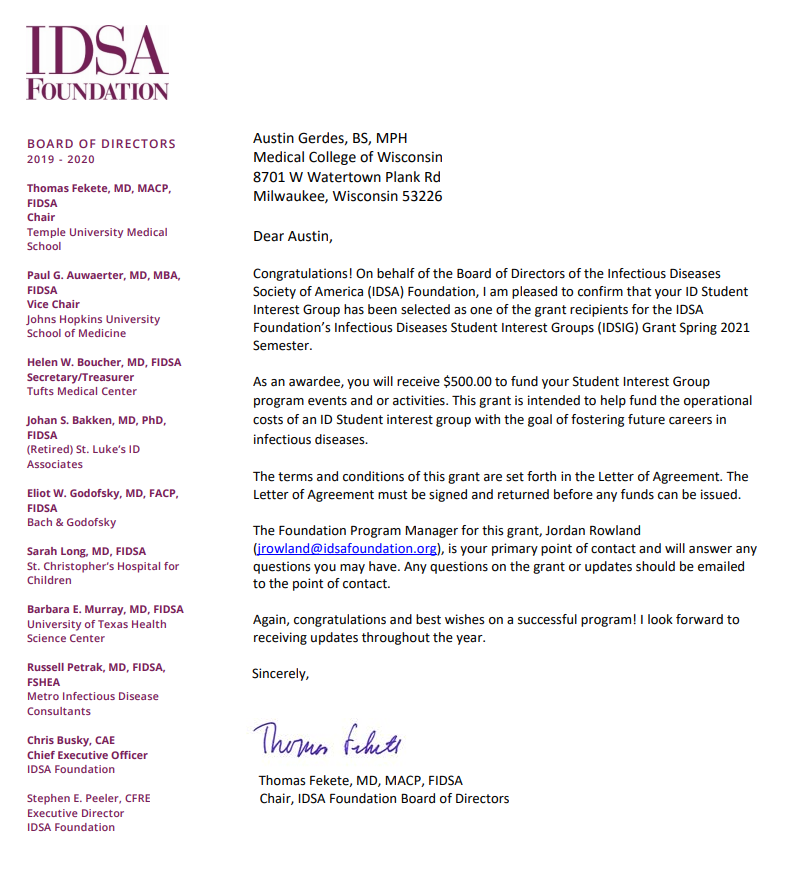
Thank you @IDSAFoundation 🙏
Our inaugural event is coming up soon!
Excitement is palpable as some of our ID fellows and Med residents interested in ID are joining the event too to support our students 😊
@Austin__Gerdes@tmklaborde@CGGmehlin
Check out my newly published review article, examining COVID-19 in long term care facilities.
COVID-19 in Long Term Care Facilities: A Review of Epidemiology, Clinical Presentations, and Containment Interventions https://t.co/ESPGUG4mqH