PROJECT MENDY — EP.1 🤺
Just getting home from college, a couple weeks ago, working with one of my college guys.
Early on, he was extremely quad dominant and constantly trying to “sit” into the lower half.
Instead of moving efficiently down the mound, he would sink into the back leg and get stuck over the rubber.
That affected:
• Momentum
• Timing
• Lead leg block
• Energy transfer
Biggest adjustment:
We rebuilt how he controlled and moved his center of mass down the mound.
Instead of forcing excessive depth into the back hip, we focused on allowing the center of mass to move earlier and smoother down the slope.
We also adjusted his landing pattern slightly more open to match how his hips naturally wanted to rotate.
That allowed:
• Cleaner hip clearance
• Better lead leg stability
• Improved rotational sequencing
• More efficient energy transfer
Instead of forcing positions that didn’t fit his movement profile, we built the delivery around how his body naturally organizes movement.
Result:
Cleaner movement.
Better timing.
Easier velocity.
— CG
#Baseball #PitchingDevelopment #1%
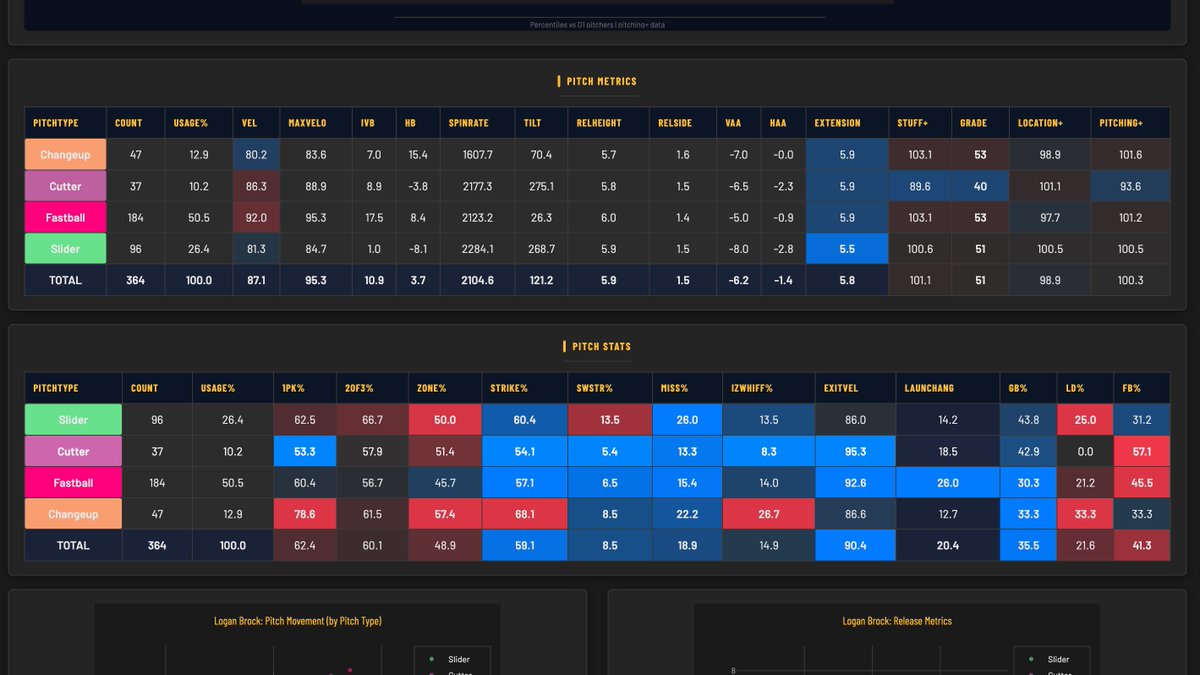
I am officially entering the transfer portal from Kennesaw St. I am looking for an opportunity to compete and contribute while continuing to develop as a pitcher.
RHP 6'2" 195lbs
FB 92-93 T95
CT 86-87 T89
SL 81-82 T84
CH 80-82 T83
GPA 3.8
2 Years eligibility - DSA
770-825-3208
I am officially entering the transfer portal from Kennesaw St. I am looking for an opportunity to compete and contribute while continuing to develop as a pitcher.
RHP 6'2" 195lbs
FB 92-93 T95
CT 86-87 T89
SL 81-82 T84
CH 80-82 T83
GPA 3.8
2 Years eligibility - DSA
770-825-3208
I would like to thank the coaching staff, teammates, support staff, and everyone at the University of Texas for the opportunity.
After careful consideration, I have decided to enter the transfer portal with 4 years of eligibility remaining as a redshirt freshman.
Most unstable lead legs aren’t a front leg problem.
They’re usually a symptom of inefficient movement patterns happening BEFORE foot strike.
If the body is drifting, collapsing, or leaking force earlier in the delivery, the lead leg ends up trying to absorb and organize chaos instead of transferring energy efficiently.
Poor COM movement.
Poor pelvic organization.
Energy leaks.
The lead leg can only stabilize what the body delivers into it.
— CG
#JustTalkingBall #PitchingMechanics #Pitching
A lot of pitchers are late at foot strike not because the arm is “slow”…
But because the body is moving faster than the arm can organize.
And when the arm is outside of the “arm window” at front foot strike…
The last 10% of the throw becomes extremely difficult.
Now the throw starts turning into compensations instead of efficient movement.
That’s why abbreviated drills matter.
They:
• Simplify movement
• Improve awareness
• Create cleaner timing windows
• Help athletes FEEL what “on time” actually is
Over time, they start programming the body to naturally organize into better positions without forcing movement.
You can incorporate these drills on the slope or flat depending on the plyo day and throwing focus for the week.
Stop trying to rush the arm up.
Create better sequencing so the arm can work WITH the body instead of constantly playing catch-up.
☔️
— CG
#JustTalkingBall #Pitching #PitchingDevelopment
Project NBA Tyson Ep. 1 ☔️
Tyson originally had almost zero drift and would get stuck on the backside early.
A big reason?
He was forcing an exaggerated vertical shin angle that didn’t match how his body naturally wanted to organize down the mound.
Instead of moving athletically down the slope, he was artificially trying to stay stacked into the backside.
Result:
• Killed momentum
• Disrupted sequencing
• Inconsistent lead leg stabilization
• Poor rotational organization
Biggest focuses so far:
• Earlier COM drift
• Better backside direction
• Improved tempo
• Cleaner lead leg stabilization
• Better connection with the rubber
• Tighter rotational turns
Big cue:
“Stay behind the lead leg. Let the foot come down, then throw.”
Tyson was QB1 in high school, so the athleticism has always been there.
The process now is organizing and directing that athleticism more efficiently within the delivery.
Only 2 sessions in.
Still cleaning up:
• Rubber connection
• Rotational Planes
• Getting into more powerful spots throughout the throw
• Setting the body up to make a violent punch
• Holding posture through rotation
• Last 10% of the throw
But he’s already moving more athletic, fluid, and explosive.
A lot more left in there ☔️
— CG
#JustTalkingBall #PitchingDevelopment
Hips limited in mobility? Struggling to hold positions down the mound?
Start by addressing the hips and adductors.
A pitcher can have elite arm talent, great intent, and still fight an uphill battle if the lower half isn’t functioning efficiently.
The hips help create:
• Direction
• Stability
• Rotation
• Force transfer
When the hips lack mobility, strength, or coordination, especially through internal and external rotation, the body starts searching for movement somewhere else.
That’s when you start seeing pitchers:
• Lose posture
• Leak forward early
• Spin off
• Struggle to maintain strong positions down the mound
One of the biggest areas affected is the back leg.
The back leg isn’t just there to “push.”
It helps control center of mass, create tension through the hinge/coil phase, and guide the pelvis into efficient positions moving down the slope.
But when the hips and adductors are inefficient, the back leg angle becomes difficult to maintain.
Instead of riding the slope with stability and direction, pitchers often:
• Collapse into the quad
• Lose pelvic control
• Shift side to side excessively
• Open early
• Get forced into a “sit” position just to find balance and become stuck there
A lot of this comes from:
• Limited hip IR/ER
• Poor adductor strength/control
• Or trying to move in ways the athlete’s body simply doesn’t organize movement efficiently
Some pitchers naturally organize movement better through internal rotation strategies. Others move more efficiently through external rotation strategies.
Neither is wrong.
The mistake is forcing every athlete into the same delivery instead of building around how their body naturally moves.
If a pitcher naturally clears and rotates better with a more open landing strategy, forcing him closed can restrict pelvic rotation and kill efficiency.
On the other hand, a pitcher who stabilizes better through internal rotation may need:
• More direction
• Longer hip containment
• More closed landing strategies
The goal isn’t to copy mechanics.
The goal is creating efficient movement solutions that allow the athlete to:
• Control center of mass
• Maintain back leg angle longer
• Create anchored tension
• Improve hip/shoulder separation
• Rotate powerfully without compensation
• Transfer force more efficiently into the baseball
When the hips and adductors function correctly, the delivery starts looking smoother because the body no longer has to fight itself to get into positions.
Efficient movement creates efficient velocity.
— CG
#JustTalkingBall #Pitching #PitchDevelopment #PitchingMechanics
Mature performance from 2027 RHP Andres Jimenez to earn the GM1 win.
Gave up some early runs before setting in for the 8 K complete game outing.
FB: 90-93 T94; ASR
CB: 73-76; 2600+ RPM, manipulates
CH: 80-84
@CoastalBaseball commit.
@ViewBoysGA || @ShooterHunt#GAHS26
A lot of pitchers are quad dominant because an adult spent years teaching them to “sit” into the backside.
Stop coaching force production with cues you don’t understand.
— CG
PROJECT MENDY — EP.1 🤺
Just getting home from college, a couple weeks ago, working with one of my college guys.
Early on, he was extremely quad dominant and constantly trying to “sit” into the lower half.
Instead of moving efficiently down the mound, he would sink into the back leg and get stuck over the rubber.
That affected:
• Momentum
• Timing
• Lead leg block
• Energy transfer
Biggest adjustment:
We rebuilt how he controlled and moved his center of mass down the mound.
Instead of forcing excessive depth into the back hip, we focused on allowing the center of mass to move earlier and smoother down the slope.
We also adjusted his landing pattern slightly more open to match how his hips naturally wanted to rotate.
That allowed:
• Cleaner hip clearance
• Better lead leg stability
• Improved rotational sequencing
• More efficient energy transfer
Instead of forcing positions that didn’t fit his movement profile, we built the delivery around how his body naturally organizes movement.
Result:
Cleaner movement.
Better timing.
Easier velocity.
— CG
#Baseball #PitchingDevelopment #1%