#NCLAT upheld @CCI_India order, closing complaint alleging abuse of #dominance by #Kerala's state-owned #liquor procurement agency. Spikes appeal by @CIABC1 & Association of Distillers, Brewers and Vintners #ADBVI against #KSBC
https://t.co/g9tCRnVwSu
“Double advantage” for imports is the concern.
As UK whisky duties reduce under the India-UK FTA, CIABC has urged States to remove policy concessions that already favour BIO imports over Indian-made products.
Read the full article: https://t.co/vE2aeUaDqt
CIABC DG Anant S. Iyer’s views featured in @EconomicTimes on the India-UK CETA.
CIABC welcomes the agreement but urges State Governments to ensure competitive neutrality between Indian-made products and BIO imports.
Read the full article here: https://t.co/e2qIRGfNHy
With GST reshaping revenue streams, states lean heavily on alcohol taxes as a major source of income.
But here’s the twist: while input costs remain uncontrolled, selling prices are tightly regulated by state governments, leaving the industry caught between rising costs and fixed margins.
#Gst #AlcoholTax #indiaeconomyimpact #StateRevenue #policytalks #RegulatedIndustry
India’s liquor industry may still carry the “sin product” tag, but behind the stigma lies a sector driving massive revenues, employment, and exports.
With nearly 70% of liquor prices going into taxes, complex state-wise rules, and no GST relief, the industry continues to operate under intense pressure. At the same time, companies are advocating responsible consumption while battling rising costs and pricing restrictions.
@CIABC1@radicokhaitan@AmrutMalt
#LiquorIndustry #IndiaEconomy #AlcoholPolicy #GST #Taxation #ResponsibleDrinking #EconomicGrowth #TradePolicy #IndianMarkets #BusinessNews #IndustryInsights #MakeInIndia
https://t.co/Fs0sZjOvR0
CIABC has reiterated that while trade liberalisation under the India-EU FTA is welcome, effective safeguards and a level-playing field are essential to ensure fair competition.
🔗 https://t.co/BlLa65o7VI
CIABC has described the India-EU FTA as a historic trade agreement, while stressing the importance of safeguards such as Minimum Import Price and strict Rules of Origin to protect domestic industry interests.
🔗 https://t.co/6Xecbr1HBK
CIABC has termed the India-EU FTA a historic step, while emphasising the importance of strict enforcement of Rules of Origin, prevention of under-invoicing, and reciprocity for Indian spirits.
#WATCH | Delhi: On the India-EU FTA, Director General of the Confederation of Indian Alcoholic Beverage Companies (CIABC), Anant S. Iyer says, "It seems that there is going to be a staged year-on-year reduction on both spirits as well as wines. Wines are very critical in terms of discussions as far as the EU is concerned with India... There seems to be a reduction in the wines, and there could also be a minimum import price for wines... I think it's a very welcome deal as far as the India-EU FTA goes... A lot of our industry sectors and the Indian economy are going to benefit..."
CIABC has welcomed the conclusion of the India-EU FTA, noting that several key concerns of the domestic alcobev industry have been addressed, while underscoring the need for safeguards against dumping and misuse of trade provisions.
🔗 https://t.co/BoWhvtx7x7
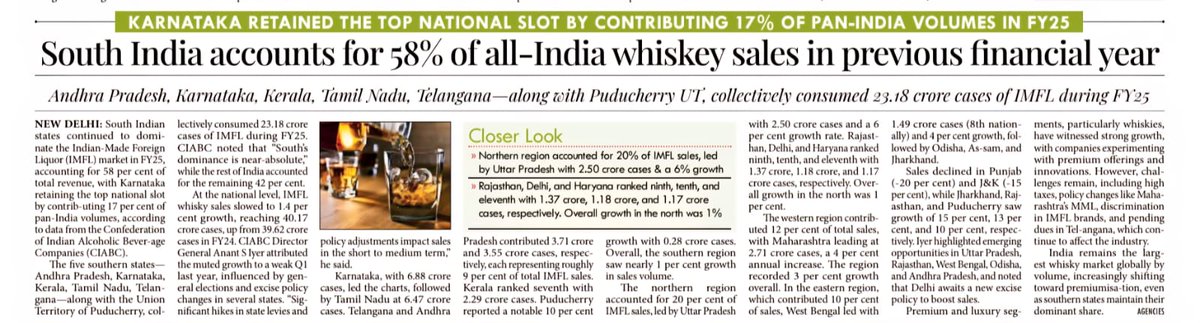
According to @mpostdigital, drawing from @CIABC1 report, South Indian states together accounted for 58% of whiskey sales in FY25, underscoring the region’s dominance in India’s liquor market.
NDTV Profit highlights, based on CIABC findings: Karnataka topped India’s whiskey sales chart in FY25 with a 17% share, driving South India’s commanding 58% contribution.
🔗 https://t.co/PKMU1ikoLh
Economic Times reports, citing CIABC data: South India dominated India’s IMFL market in FY25, contributing 58% of total whiskey sales. Karnataka alone led with 17% of pan-India volumes.
🔗 https://t.co/uRfuY8SGzP
VIDEO | Kerala plans to introduce home delivery of liquor through online vendors to address issues such as long queues at liquor stores and to potentially increase state revenue.
Harshita Attaluri, CMD of the Kerala State Beverages Corporation, says, "...This is not a new proposal. It has been around for the last three years, and we are trying to get it approved. We sent it to the government last month as well. There would be an app through which people could book liquor. The delivery partner would verify the ID and deliver only to those over the age of 23. This is a legal business, and I want my customers to have a dignified environment where they can purchase what they want without standing in long queues. We have the fewest liquor shops in the country... Ideally, there should be a shop every 5 km. If everything is available online, why should liquor be an exception?"
Indian spirit makers have raised concerns over alleged discriminations by several states, saying their excise polices are biased in favour of imported #alcoholicbeverages as compared to domestic brands.
#businessnews#alcohol
https://t.co/WnNZbtZ0EG
FTA negotiations should balance global trade with domestic industry protection.
The India–UK deal is a step forward, but execution must be thoughtful.
📢 Read CIABC’s full official statement here:
🔗 https://t.co/aj3EVOKoP9
#IndiaUKFTA#CIABC#AlcoholIndustry#FTA#TradePolicy
The India–UK Free Trade Agreement marks a major shift in the alcoholic beverage sector.
CIABC welcomes the progress—but urges caution on key issues that could affect domestic producers.
Finally, Rules of Origin must be robust.
GI-tagged products like Scotch, Cognac, Tequila must only receive tariff benefits if they truly originate from their respective countries.