@henrywinter@SamWallaceTel BS. It's hacks like you that help spread the delusion that England's players are good enough to win the World Cup. Was Tuchel the coach for the past 60 years of failure? Norway & Mexico are not the same as Argentina. England always lost when they faced quality opposition.
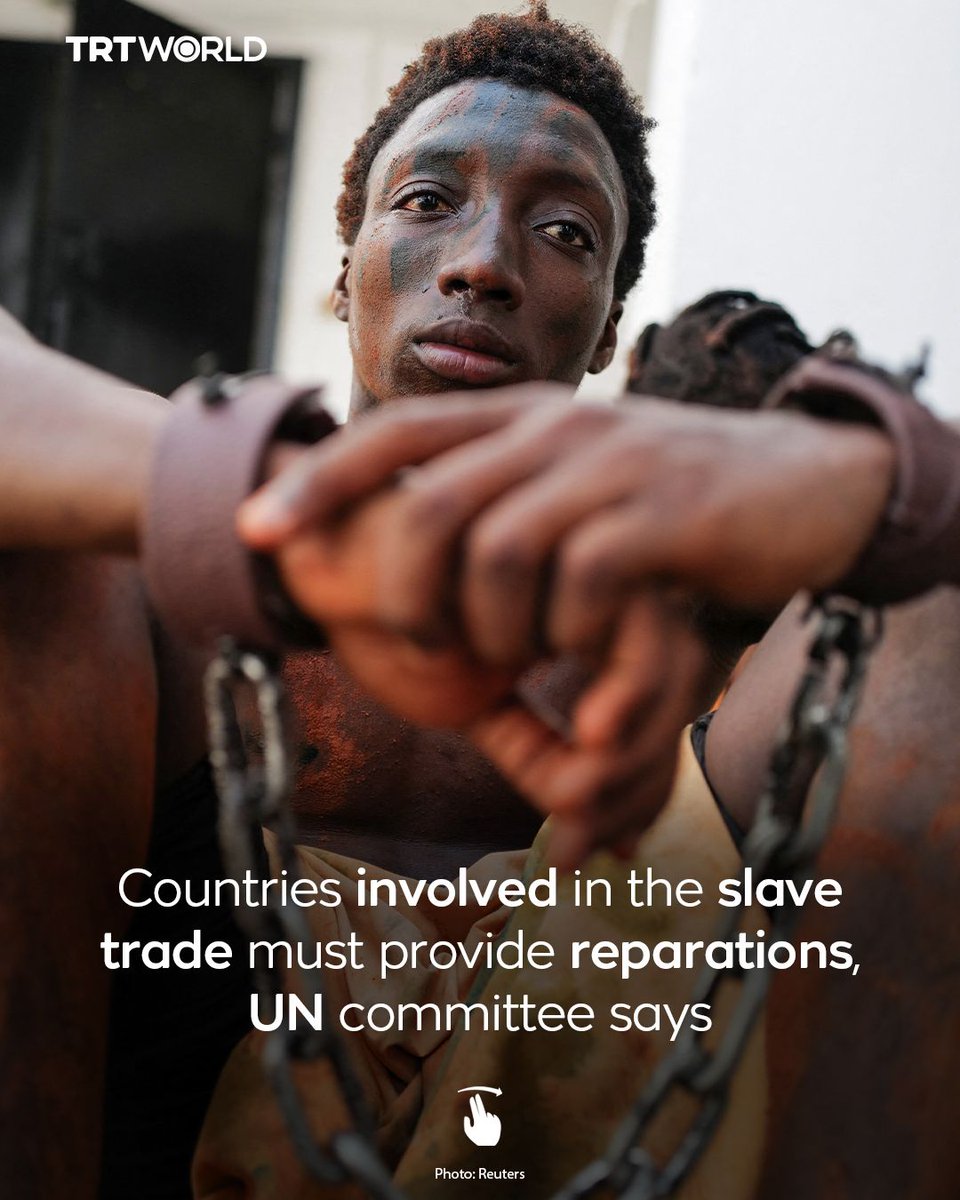
Countries are legally obliged to provide broad reparations for harms resulting from both direct and indirect involvement in the transatlantic African slave trade, a United Nations committee said Monday.
“States parties must implement comprehensive reparatory measures for people of African descent, covering all aspects of remedies,” the UN Committee on the Elimination of Racial Discrimination (CERD) said, providing a fresh interpretation of an international human rights treaty.
The document, which was approved last week but only published on Monday, is expected to provide a powerful new tool supporting reparations claims.
It stressed that reparatory justice combined “a wide range of measures conceived as monetary, non-monetary and structural”.
The fresh analysis comes after the UN General Assembly in March adopted a landmark resolution recognising the transatlantic slave trade as “the gravest crime against humanity”, despite opposition from the United States and some European countries.
The vote in the 193-member world body was 123-3, with 52 abstentions. Argentina, Israel and the United States were the three members voting against the resolution. The United Kingdom and all 27 members of the European Union were among those that abstained.
In June, a conference organised in Ghana by African and Caribbean leaders called for formal apologies from countries that benefited from the slave trade.
The conference also demanded the return of cultural property, human remains and archives to their countries of origin, as well as adequate compensation for Africans and people of African descent.
Arewa Is Burning, and We Are Arguing About Everything Except the Fire
There was a time when Northern Nigeria was relatively safe. People travelled long distances with little fear. Communities traded, disagreed, worshipped differently and still found ways to coexist.
I am not romanticising that past. There was intolerance and terrible violence. Ethnic, religious and political tensions existed. But what we are living through today is different in scale, reach and normalisation.
Over roughly two decades, something fundamental has broken. Much of North Nigeria is consumed by insecurity, hate, polarisation and violent crime.
Too many Muslims have been conditioned to view non-Muslims with suspicion or contempt. Too many Christians carry their own suspicion and hostility towards Muslims. Words such as arne and kafiri are thrown around casually. Dehumanisation begins long before someone picks up a weapon.
Boko Haram and other violent extremist groups exploited these fractures and wrapped depravity in religious language. Across parts of the Middle Belt, weak institutions and repeated violence have pushed communities towards systems of protection and vengeance, where retaliation produces retaliation.
The absence of justice becomes its own form of violence.
Highways that once connected our communities are now corridors of fear. Kidnapping for ransom has become an economy involving kidnappers, informants, negotiators, suppliers, collaborators and those who move the proceeds. In some communities, criminal networks exercise authority that functioning local governments should.
How did we get here?
Local government was weakened. Schools deteriorated. Poverty expanded. Institutions lost legitimacy. Political leaders repeatedly failed to confront structural problems.
But leadership did not descend from another planet. Our leaders emerge from our society. A society that tolerates corruption, mediocrity, prejudice and dishonesty will reproduce them in its institutions. This is the part we rarely want to confront.
Look at our public conversations, particularly among young people online. A region facing an existential crisis should be consumed by education, security, justice, jobs, healthcare, agriculture, religious coexistence and political accountability. Instead, enormous energy goes into arguments about Rarara, Hadiza Gabon's weight loss, Nafisa Abdullahi's views on marriage, or Sheikh Jingir's distasteful and divisive claims about which religion has the larger population.
Entertainment has its place. Religious debate has its place. But Arewa is burning while we exhaust ourselves over distractions.
We complain about bad leadership while reproducing many of the same values in our homes, businesses and communities. We retreat into ethnic and religious camps. We defend wrongdoing when the offender belongs to "our side". We demand justice when our people are victims and manufacture excuses when they are perpetrators.
No society survives indefinitely on selective morality.
I speak about Arewa because this is where I come from. It is the society I know intimately, and where I want my advocacy to begin. That does not mean hating the North. It means loving it enough to refuse to lie about what we have become.
We cannot repair Northern Nigeria through nostalgia, religious supremacy, ethnic chauvinism or political propaganda. We cannot insult our way out of insecurity. Social media outrage cannot substitute for institutions, justice, education and organised civic action.
We need a different politics of citizenship. One that values every human life irrespective of identity. One that condemns a criminal without first asking his ethnicity or religion. One that teaches children that disagreement is not an invitation to violence.
We need justice stronger than vengeance, citizenship stronger than sectarian identity, and leaders committed to serve.
Arewa is burning. We have spent far too long arguing about everything except the fire.
@A_Salkida I was at ABU Zaria 1980-84. I was in the North for the 1st time & a teenager on my own. I found it the safest part of Nigeria. There were some religious extremists that we called "Ayatollahs". But they were a very small minority. Politicising Islam is the root of the insecurity.
Jeremy Corbyn didn't endorse a neo-Nazi who was jailed for antisemitism but Kemi Badenoch did and she gave him a job as an advisor.
The mainstream media will move on and won't keep asking Kemi Badenoch to apologise in every interview.
“I love playing for Nigeria, but you have to pay for your own flight. 😭You get to the hotel and there’s no electricity. You wash your own kit, the pitch is only half grass, and if you make one bad pass the coach is screaming at you. 😂 But I love the food.”
— Alex Iwobi
@henrywinter This is delusional. The problem is people like you hyping overrated & overpriced average players. Fabio Capello won titles wherever he went & came unstuck with England. No coach in 60 years has been able to win a damn thing with England. It's time you accepted it's the players.