The International Policy Journal intends to be the premier home of in-depth foreign policy discourse by progressive internationalists. A project of @CIPolicy
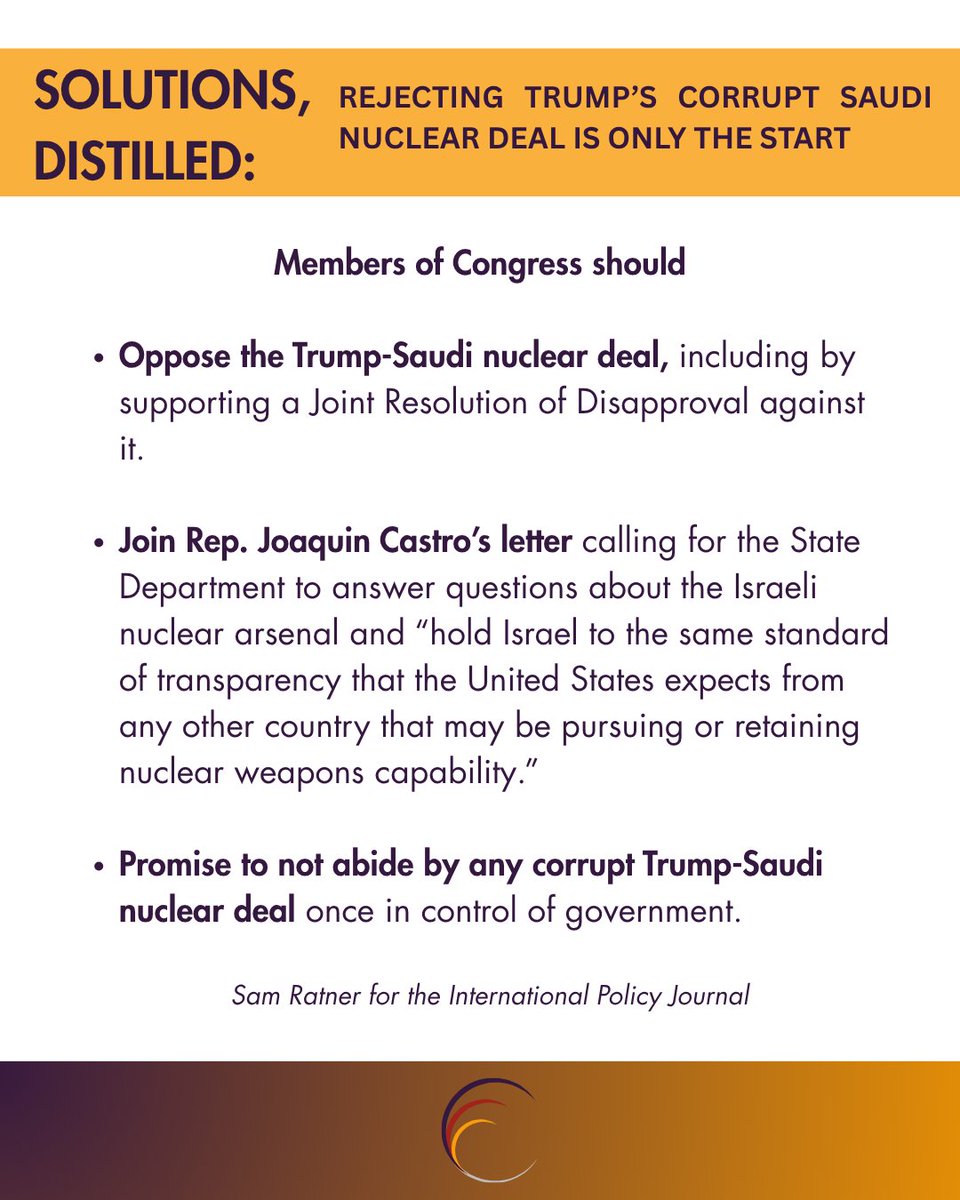
Trump’s proposed Saudi nuclear deal is both a nuclear proliferation risk and a self-enrichment scheme for the Trump family. Congress should reject it, argues @samratner of @winwithoutwar
https://t.co/Bj2T6Bh4cy
⭕️ In my latest article for @CIPolicyJournal, I question the assumption that great-power war is preordained. “The Price of Imaginary Wars” examines how narratives of impending conflict misshape strategy and entail substantial political, economic, and human costs of preparing for wars that need not happen. https://t.co/LczOtjQToN
Constant preparation for and anticipation of a coming great power war makes it harder for nations to imagine and plan for alternatives to armed conflict, while treating an unwanted war as inevitable, argues @JKRozpedowski https://t.co/rRZ4dJWsAT
Iranian leadership signaled this week that it's willing to end the war, if Trump is willing to demonstrate reciprocal action and return towards the diplomacy of the MoU. There's a 7-day proposal on the table. CIP's own @NegarMortazavi reports https://t.co/Im9uLZMO1a
New Zealand's aging frigates are set to retire. For the International Policy Journal, Bryan Harris argues forgoing bigger warships in favor of smaller, more regionally useful vessels,meeting local needs without pulling Wellington into hegemonic wars https://t.co/rOmYJKL3xw
This month, Trump abruptly announced that the US was scaling back participation in joint military exercises with South Korea. The reaction filtered through DC along predictable channels, leaving out the big question: what does South Korea want? https://t.co/dXaqrf4T1I
It remains unlikely that the Trump Administration will pursue policy in coordination with South Korea on North Korea, but the door is open for getting to a deescalation, on that protects allies in the region while allowing cooler heads to set stable terms. https://t.co/dXaqrf4T1I