Ontario farmers don’t just put food on our tables, they contribute over $51 billion to our economy every year.
As leader and as Premier, I will be a champion for Ontario agriculture so that farmers have the stability they deserve and young farmers have the support they need to get started.
I would enable more food processing to be done here in Ontario, not across the border. If we grow it here, we should process it here.
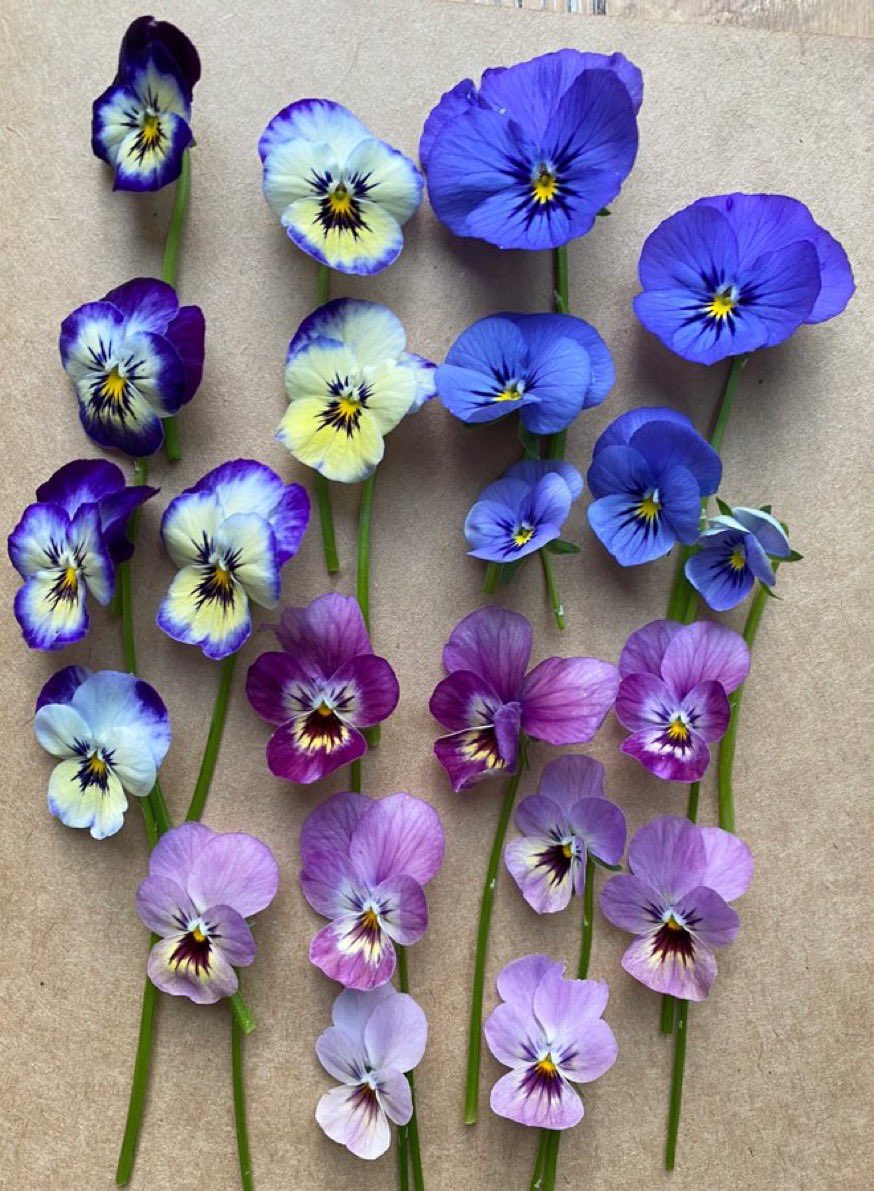
I had 3-4 weeks off Twitter with autistic burnout recently & my engagement is right down (also due to standing up to a vile group of trolls on here-they reported me lots, restricting my reach). If you see this photo it would be so ace if you could RT it or drop me a quick hello if you have a moment, both of which help an account get back on track. I also hope these little violas ping some floral dopamine in your meat computer & give you a small lift 🌿
Reminder if you are an American Citizen and you live abroad you have the LEGAL right to vote and yes your vote will matter this year more than most. So if you are an American living abroad go to https://t.co/4REyZyDV42 and register today.
In collaboration with @munkschool, I am sharing a ten-lecture course I taught at @UofT this past year. The course is called “Hitler and Stalin Today.”
Watch the first lecture here: https://t.co/ry7GSIspXv
Chlorophyll, beta carotene & anthocyanins are as bonny as any oil paint I reckon & creating botanical rainbows with them in my photos genuinely medicinal for & really quietens my very noisy anxious auDHD meat computer 🧠🌈✔️👍🏼
Late July garden floral palette. Our brains evolved to look at plants carefully every day while foraging & become more relaxed while doing so due to the presence of good snacks & medicine. This photo is for those ancient pathways that still exist among your neurons🌿🧠:
"Just put the fires out!"
Ever seen a boreal wildfire? I have. I used to fight them.
When fire behaviour becomes extreme, you're not getting close to them.
The radiant heat from a crown fire is face-melting from hundreds of metres away.
All attempts at direct attack will fail, because dropping water on it becomes akin to trying to spit on a campfire...it evaporates before it even hits the flames.
Additionally, reduced visibility, high winds, and turbulence makes aerial attack hazardous.
As a wildland firefighter, I've been extracted off of wildfires twice as our fires blew up, both times having our gear burned over. We returned to find firehoses and metal melted into the ash.
I've seen fireballs launched hundreds of feet high, and fires intense enough to produce lightning, influencing the weather around them. I've seen wildfires grow to the size of a major city in a short period of time.
So no, we can't just put the fire out.
Not being able to stop such a natural process is a truly humbling feeling.
Whatever the Environment Agency says, we *will* restore our river…
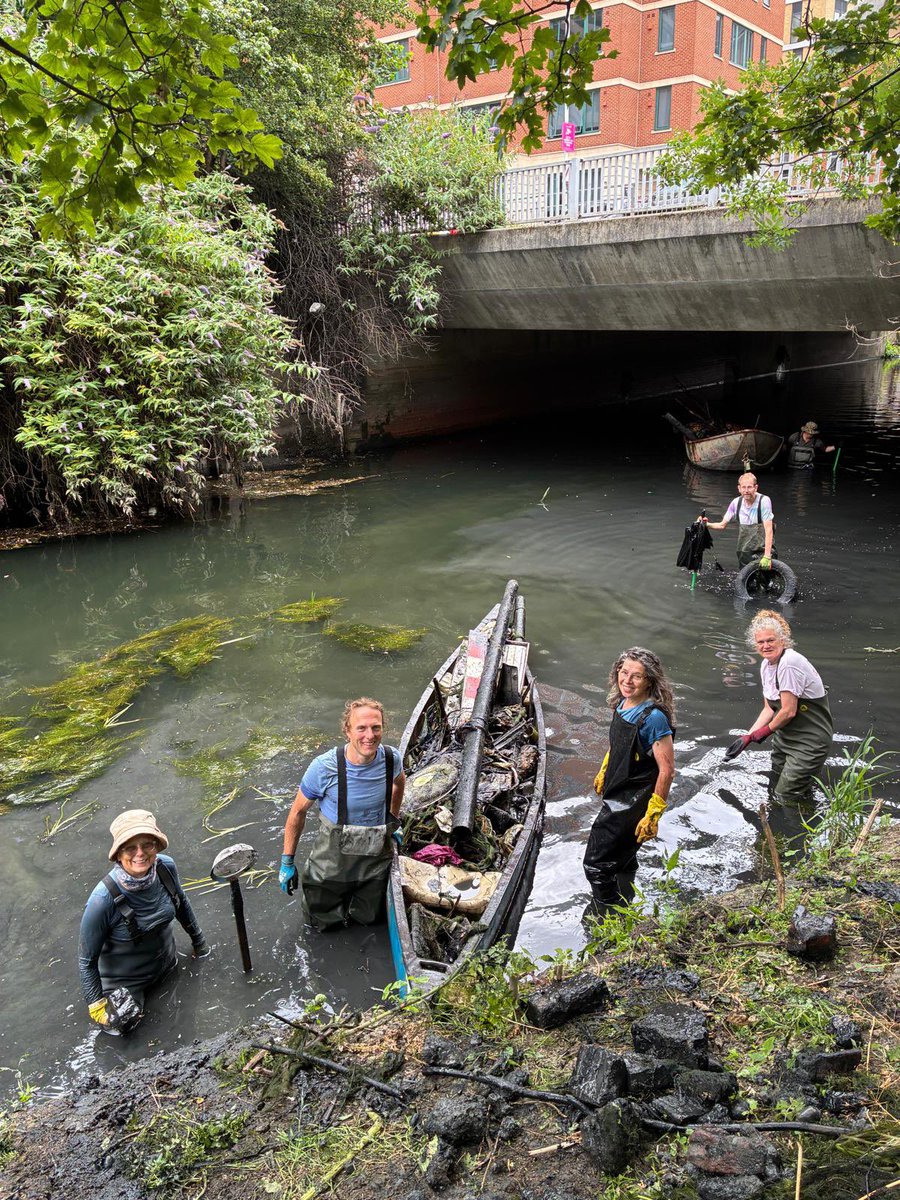
Volunteers were back out on the River Roding this weekend, ignoring the threats & lies of @EnvAgency, to battle against the odds to restore a part of the river that the authorities have left to die. The stretch of the Roding around Ilford has some of the worst problems on the river: rubbish and invasive species on its banks; sewage in its water; and huge amounts of rubbish & debris in the channel. I applied for funding from the Mayor to sort out this part of the river (which would have paid for floating barges and skips), but having been rejected twice, I decided we should just get on with it.
This is not an easy part of the river to clean, as the water is deep in places & the high concrete banks means it’s impossible to get large objects out of the river in most places. Luckily, our previous clearance of the area north of ilford bridge in May gave us an exit point, and I brought up a large rowboat and canoe. Teams in waders could load these boats with rubbish & then float them to be unloaded & the waste taken up onto the road. As some of the debris was deeply buried in the mud, we set up a winch on one of the trees to haul it out. We got an unbelievable array of crap from the river: a TV, mattress, shopping trolleys, pipes, traffic cones, random bits of metal and even a bench, which is now cleaned off and offers a place to sit beside the river.
This section of river- right in the centre of Ilford- could be genuinely lovely. Whilst it’s in a desperate state, we saw large mullet, dragonflies and reedbeds slowly returning along the edge where we had removed invasive species. There’s still much to do though. Do message if you’d like to join us on Sunday 26th of July for another day of in-river cleaning at this spot.
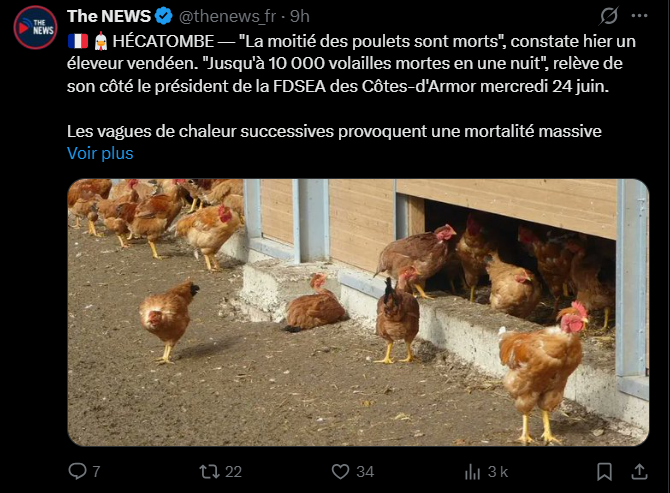
+1000% de mortalité chez les poules, +200% chez les porcs, +45% chez les bovins.
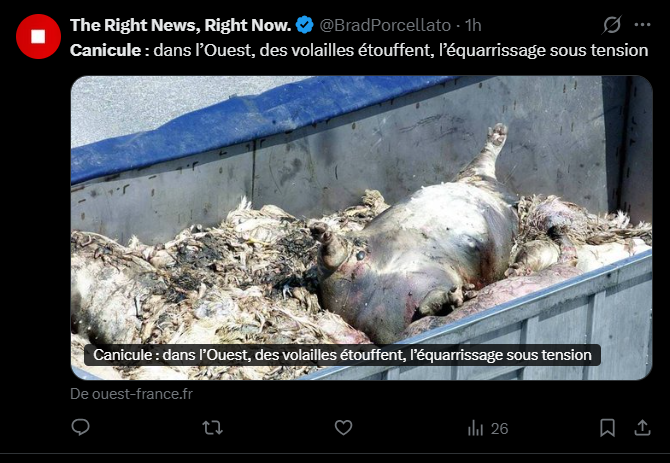
Plusieurs millions d'animaux d'élevage sont morts sous l'effet de la canicule. Nous sommes en train de vivre une catastrophe agricole majeure, qui rejoint le traumatisme de 2003 comme étant les deux plus grandes hécatombes animales de l'histoire récente de l'agriculture française.
Face à l’afflux de carcasses, les autorités bretonnes autorisent à titre exceptionnel l’enfouissement des animaux morts dans le sol même des exploitations agricoles.
Et cette surmortalité est observée dans l'ensemble des élevages : du Label Rouge (accès à un parc extérieur arboré) au bâtiment ventilé, du bio au conventionnel. Sans compter le traumatisme de l'éleveur.
Je suis en colère. Nos débats se focalisent sur la climatisation ce qui nous fait passer à côté du véritable problème : écosystèmes souffrants, eau eutrophiée et prolifération de cyanobactéries, mortalité forestière, mortalité des oiseaux... Depuis des décennies, les gouvernements successifs appliquent une politique du sparadrap à court terme : on s'efforce de limiter les dégâts plutôt que de s'attaquer aux causes du problème...
L'adaptation de l'agriculture française au changement climatique reste largement insuffisante au regard des défis qui nous attendent. Les agriculteurs sont prêts à s'adapter. Ce qui fait défaut, ce sont une vision politique ambitieuse, des investissements à la hauteur des enjeux et une stratégie cohérente pour préparer l'agriculture de demain.
Il faut un véritable plan national de rénovation des bâtiments d’élevage, soutenu par une politique publique ambitieuse, et qui ne repose pas uniquement sur les épaules des agriculteurs : ventilation, brumisation, douches, gestion des flux d'air et des matériaux, ombrage des bâtiments, parcs arborés, aménagements extérieurs.
Tant qu'on parle d'ambition ? Donner aux éleveurs les moyens de produire en France, durablement et avec fierté, plutôt que de dépendre d'importations de viande à bas coût.
La production de viande (notamment rouge) émet des gaz à effet de serre. Autant privilégier une viande française, issue autant que possible d'élevages au pâturage, qui répondent à des exigences environnementales et de bien-être animal plus élevées. Cela implique sans doute d'en consommer moins, mais de meilleure qualité, pour celles et ceux qui choisissent d'en manger.
On vit une catastrophe agricole, mais on pourra au moins manger des cailloux dans une bulle d'air climatisée. C'est tellement agréable. J'ai besoin de prendre l'air après ces jours intenses. Je suis fatigué.
Have weather forecasts seemed less accurate lately? There's a major contributing factor: nearly half the morning weather balloons in the Lower 48 are "missing."
This is an ongoing crisis that is degrading critical severe weather forecasts that we all rely on. It's having real, tangible impacts on degrading forecast quality.
If you work in transportation, agriculture or commerce, this should matter to you.
Regardless of the causes, this negatively affects people of ALL political backgrounds. Weather affects everyone. And it's impacting ALL of us negatively.
We can't look at weather balloon data that doesn't exist. We can't pump nonexistent data into models. We can't rely as heavily on models that don't "know" what's happening above our heads.
This is especially concerning for severe weather forecasts. We can't go 18 hours without ascertaining how the atmosphere is layered, how much storm fuel has built up and if severe thunderstorms are going to erupt. The Storm Prediction Center has even acknowledged forecasting frustrations in at least one public bulletin.
As an atmospheric scientist myself, I can say firsthand – the forecasts I'm able to offer you are less accurate than they would otherwise be. I'm not able to predict severe weather with the confidence I normally would. That is extremely concerning.
The United States is "supposed" to launch balloons at 0Z and 12Z ideally – a.k.a. around 7 a.m. and 7 p.m. Eastern time. That's not happening. Many sites, due to staffing issues stemming from broader political and organizational issues, have pushed to 18Z, or early afternoon. That's not helpful for morning severe weather forecasts. In other words, you get less lead time. Less advanced notice. Quicker ramp-ups and ramp-downs to the forecast.
We're not able to get jet stream, temperature, moisture or wind profiles of the atmosphere each morning like we otherwise would.
Moreover, the World Meteorological Organization encourages 12Z soundings; that data is shared via the Global Observing System (GOS) under the World Weather Watch (WWW). That's not happening.
Here's what WCK teams are seeing in Venezuela in the wake of Wednesday's devastating earthquakes. We're on the ground in the region serving meals to families and first responders. Alongside trusted partners, we're moving as quickly as possible to expand our response to reach the hardest-hit areas. #ChefsForVenezuela
Esto es lo que los equipos de WCK están viendo en Venezuela tras los devastadores terremotos del miércoles. Estamos sobre el terreno en la región sirviendo comidas a familias y rescatistas. Junto a socios de confianza, nos estamos moviendo lo más rápido posible para ampliar nuestra respuesta y llegar a las zonas más afectadas. #ChefsForVenezuela
Luis from @wckitchen is on the ground in Caracas where the earthquakes damaged buildings all over the city. We are already serving meals and quickly expanding to other towns...We will be there with the urgency of now to make sure everyone has food and water! #ChefsForVenezuela
In Boca de Aroa—a coastal community in the state of Falcón, more than 100 miles west of Caracas—power is out and homes have collapsed in the wake of Wednesday's earthquakes. WCK restaurant partner Madre Masa is going directly to families, delivering hot meals to one of the hardest-hit communities and showing just how far the devastation extends beyond the capital. #ChefsForVenezuela
En Boca de Aroa—una comunidad costera en el estado Falcón, a más de 160 kilómetros al oeste de Caracas—la electricidad está cortada y varias casas han colapsado tras los terremotos del miércoles. El socio restaurantero de WCK, Madre Masa, está llegando directamente a las familias, entregando comidas calientes a una de las comunidades más afectadas y mostrando hasta dónde se extiende la devastación más allá de la capital. #ChefsForVenezuela
Quel enfer ! L’anomalie thermique moyenne sur une semaine continue de pulvériser tous les plafonds, atteignant désormais +10.00°C à l’échelle nationale. C’est très largement au-dessus de la canicule d’ordre millénaire de mai 2026. Celle qui faisait encore la une de l’actualité il y a à peine deux semaines paraît déjà presque dérisoire en comparaison. L’ampleur et la rapidité avec lesquelles ces records sont dépassés sont tout simplement sidérantes.
The Justice Department quietly deleted thousands of press releases about the Jan. 6 insurrection
So Lawfare restored them: more than 5,700 pages recovered and publicly archived.
@TylerMcBrien, Michael Feinberg, and Benjamin Wittes explain how. https://t.co/qtcxOnOmfa
Il est désormais attendu 42 à 45°C de la Bretagne (!!) jusqu'aux Pays de la Loire mercredi, avec des rafales pouvant atteindre 50 km/h et une humidité relative inférieure à 10 %.
Dans ces conditions, il apparaît de plus en plus probable qu'un épisode majeur de Heat Wave Flash Drought (HWFD) (plus connu du grand public sous le nom d'« effet sèche-cheveux » ou de sécheresse éclair) se mette en place sur une superficie immense (carte 1).
L'association d'une chaleur extrême, d'un air exceptionnellement sec et d'un vent soutenu provoque une accélération brutale de l'évapotranspiration et du dessèchement de la végétation. Les conséquences peuvent être très rapides : pertes foliaires massives, mortalité de jeunes plants particulièrement sensibles, stress sévère pour la faune et l'élevage, et risque d'incendie atteignant des niveaux extrêmes à très extrêmes (carte 2).
L'ampleur des valeurs envisagées pour l'ouest de la France est difficile à appréhender. Voir de telles conditions s'étendre jusqu'à la Bretagne est tout simplement stupéfiant. En tant qu'agroclimatologue, je suis profondément sidéré par ce que les modèles continuent de simuler.
I don't know why I didn't think of this before! The local paper is automatically delivered free to thousands of people in my community.
Since it landed on everyone's doormats I've had about ten people wave in the street and holler, " hey, saw your article!"
1/