Building Cleo. The Presence Engine - one platform across search, AI search, content, and social signal. Mastery deserves an audience.
↓ Free AI visibility scan
We asked four AI engines where to shop on Black Friday. I expected a runaway winner. We got a three-way tie, and the most AI-ready sites were not the most recommended. That gap is the whole story. Week one of CLEO running its own marketing in public.
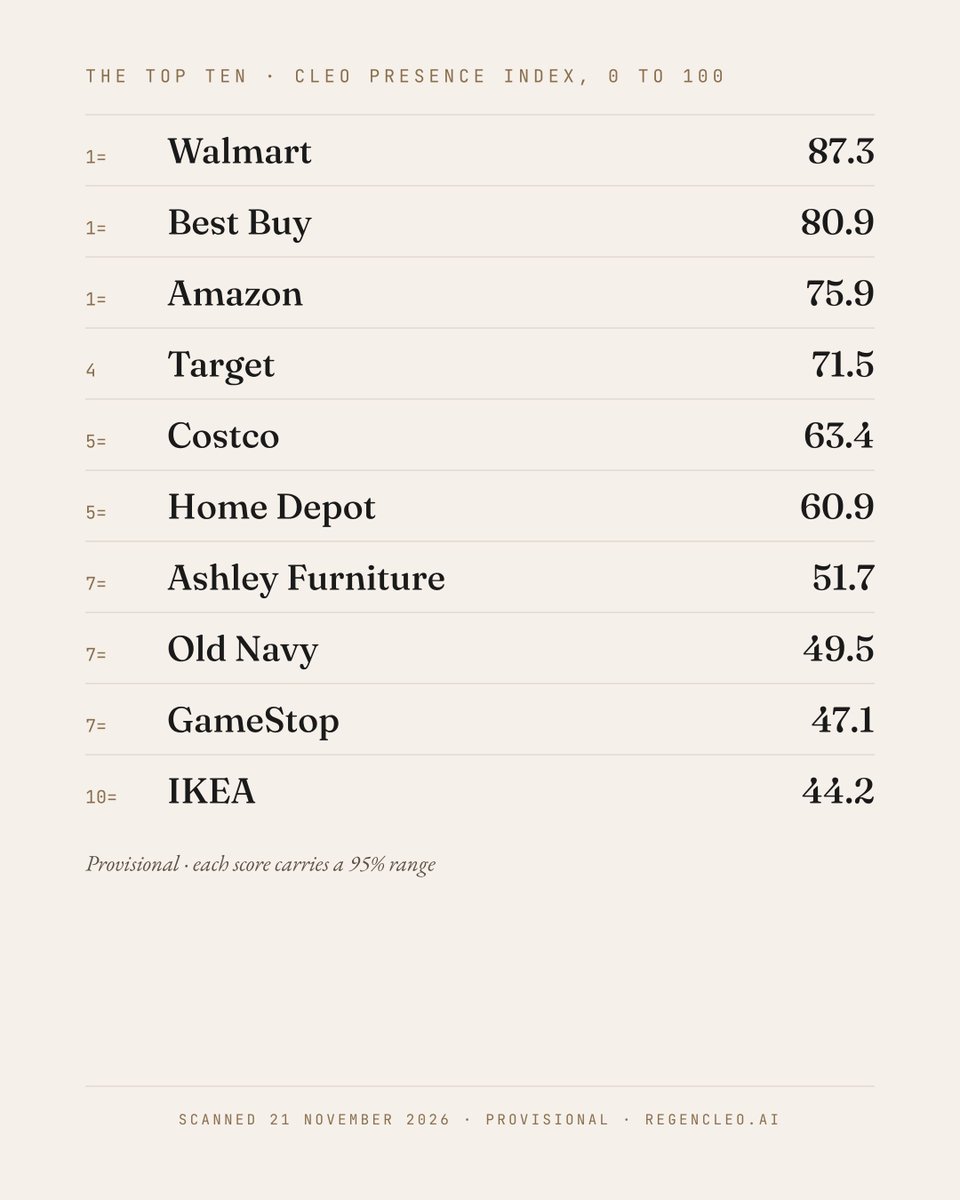
Three days before Black Friday, we asked four AI engines where to shop. The first public CLEO Presence Index ranking is live: ten retailers, one score each, every number published with its method. @Walmart leads at 87.3. First place is a three-way tie.
Being named in an AI answer and being cited as its source are two separate counts. A brand can be named often and never linked, or cited often and rarely named. The first gap is a reputation problem; the second is a page problem. https://t.co/J8lJUxoU2d
@regencleo#CLEObyRegenAI
A shift in your AI visibility score doesn't always mean a shift in how often you're cited. Tracking changes and sampling limits can move the number by themselves. Before you react, check what changed in the measurement.
https://t.co/eUTYLwl7Mb
@regencleo#CLEObyRegenAI
Ask an answer engine one question and we often see it generate short, machine-written sub-questions that your customers don't type.
So a page answering one narrow question might be cited even without targeting a head term.
Which narrow questions do your customers never type?
We think volume is the wrong target. Recent search spam updates and research aim at scaled, unreviewed pages.
Fewer pages with original value are safer than many nobody checked.
How many pages can your team genuinely review in a week?
A brand can be named in an AI answer without being linked as a source. If the answer names you but links only to a review site, is that a mention or a citation?
Which one is your team counting?
Review is more than paragraphs.
We think recent guidance emphasizes that manual review of AI content is critical. Recheck titles, alt text, links, figures and dates, where drafts most often slip.
Who on the team owns that last check?
We see AI answers can draw on external sites (review sites, LinkedIn, YouTube) instead of a brand's own pages.
If your presence is limited to your own site, outside content can shape what AI says about you.
Where are your customers' questions being answered?
AI can give two different answers to the same question, so one check tells you almost nothing.
Fix a list of questions, word them identically, and ask on a schedule. Then any change reflects your visibility, not the phrasing.
Which five do your customers ask?
Blocking some crawlers doesn't remove you from AI answers. Some crawlers train models, others fetch pages for live answers. Block the latter and you may lose visibility in third-party answer surfaces.
What does your robots.txt say today?
We treat manual fact-checking of AI-generated content as critical. Before anything goes live, read five things:
1. Title tag
2. Meta description
3. Structured data
4. Alt text
5. Body claims
Skimmed fields are where errors hide.
Ranking first in search and being quoted by an AI answer are different contests.
Search ranks many pages in order. An AI answer typically quotes only a few sources, so a top-ranked page can go unchosen.
When did you last check whether your top page is the one being quoted?
We see every number looking fine in its own tool.
Nobody can say if the brand shows up overall.
The gap is the missing shared view, not a faulty tool.
What one question can your reports not answer?
https://t.co/kycJ8kt7fm
Your site can be flawless and still miss the citation.
Recognition often happens on pages you don't control.
We ask: who's writing about you, and would an AI model trust what they said?
A single measurement isn't the same as many, one is noise, many give signal.
Citation share without a confidence interval is just directional.
We use a Wilson interval instead: 17% → 67% over 90 days, 95% confidence.
If a tool gives you a single number, ask: what's the n?
We see two pages with identical answer text getting cited at completely different rates by the same AI engine.
The text isn't what's scored. The source behind it is.
Trust builds over time through consistent signals, not a single page.
What's building yours?
Most brand content optimizes for scrolling readers. AI answer engines don't scroll; they parse structure: headings, clear claims, citations.
Writing for a reader and writing for a model that summarizes you aren't the same skill.
Which one are you optimizing for?
AI engines trust what they can't control.
A brand describing itself is self-interest. A reviewer, a forum thread, a comparison, that's evidence.
Self-description answers "what do you claim."
Third-party proof answers "did it hold up."
Which would you trust?
Ranking #1 and being "the answer" are different wins.
A search can put you on the page. An AI assistant can skip you in the sentence entirely, even if you outrank everyone.
Same query, two outcomes.
Which one actually mattered to the person asking?
Two ways to run SEO + AI visibility:
Team A: write, then wait weeks to see if AI engines notice.
Team B: content and monitoring loop together, results feed the next move, same week.
Integrated teams tend to see bigger AI-linked traffic lifts.
Where does your handoff break?