Centre for Policy Research is a non-partisan, independent think tank with no institutional stance. Retweets-not endorsements. We only share our faculty's work.
What does formalisation secure, and who actually makes a formal system work?
To explore these questions, we were joined by Nidhi Subramaniam (Assistant Professor in the Department of Geography and Planning at the University of Toronto).
The session was moderated by Arkaja Singh (Fellow, CPR).
Assessing different waste management models across the case study cities, the research revealed that the benefits of formalisation remain uneven and often uncertain.
Watch.
https://t.co/tslehnOIOJ
Call for Applications!
We are inviting applications for a five-day "Capacity-Building Workshop on Social Science Research" for scholars and lecturers belonging to Scheduled Castes, Scheduled Tribes, and other marginalised groups.
The programme is sponsored by the Indian Council of Social Science Research (ICSSR).
Apply here: https://t.co/SBsJ7eqMIv
Has TWAIL overlooked a different history of colonial rule?
Just as International law textbooks should take history more seriously, so should Third World Approaches to International Law (TWAIL).
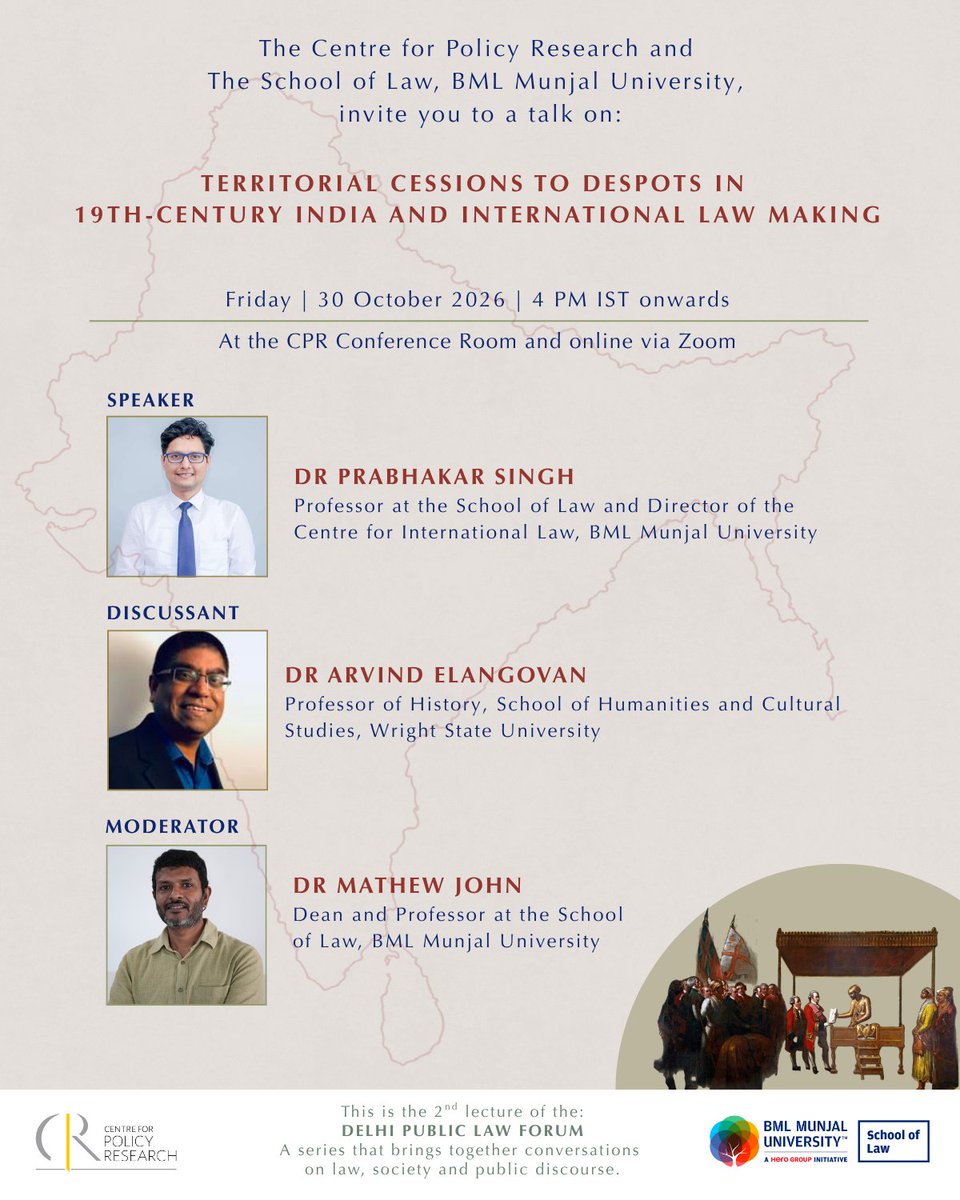
On October 30, CPR along with School of Law, BML Munjal University is hosting their second series of lectures under ‘Delhi Public Law Forum.’
The session featured Dr Prabhakar Singh (Professor at the School of Law and Director of the Centre for International Law, BML Munjal University) as the speaker, Dr Arvind Elangovan (Professor of History, School of Humanities and Cultural Studies, Wright State University) as the discussant, and Dr Mathew John (Dean and Professor, School of Law, BML Munjal University) as moderator.
Together, they will be exploring nineteenth-century legal history to unpack how South Asia’s geography and legal order shaped the East India Company’s peacetime cessions of territory, thereby raising debates on “Oriental despotism” and influencing the development of international law on territorial cession.
Register to attend in person: https://t.co/4OhhDgY3XB
Register to attend via zoom: https://t.co/C9Wn4t2B2t
Read these field notes by Bel hadj Moussa Garba and Claireshelmith Mwende Macharia, two international students studying in India, as they explore Dhampur’s economic growth, civic infrastructure gaps and gendered public spaces through observations and encounters that reveal the changing realities of a small Indian town.
https://t.co/5tJSsRZ5wn
The CPR–CSH Urban Workshop series marked a significant milestone this month with its 200th workshop!
The workshop turned attention to one such challenge that often goes overlooked — ‘Determinants of Household Resilience to Fire in Informal Settlements: Evidence from the Bastis of Delhi, India’, led by Satorupa Karmakar (PhD candidate at the University of Queensland–IIT Delhi Research Academy).
While fires can affect any part of a city, residents of informal settlements are particularly vulnerable, where crowded homes, narrow lanes, flammable building materials, lack of fire safety measures and limited access to water can make fires difficult to contain and emergency response challenging. The discussion underscored that reducing fire risks in informal settlements requires more than emergency response and calls for safer living conditions, better access to basic services and greater community participation in urban planning.
Watch: https://t.co/Sn7sAW5B2o
What could a Democratic victory in the US midterm elections mean for President Trump’s legislative agenda and foreign policy?
Join us on Wednesday, 28 October, at 3:30 PM IST for a talk by Amit Gupta (Senior Visiting Fellow, CPR) as he discusses election data, the balance of power in Congress, and the limits of congressional influence over US policy on Iran, Ukraine, India, China and Europe.
This talk will be held in a hybrid mode at the CPR Conference Room and online via Zoom.
Register to attend in person: https://t.co/60BiWTpvQz
Register to attend via zoom: https://t.co/IMpblz8DkT
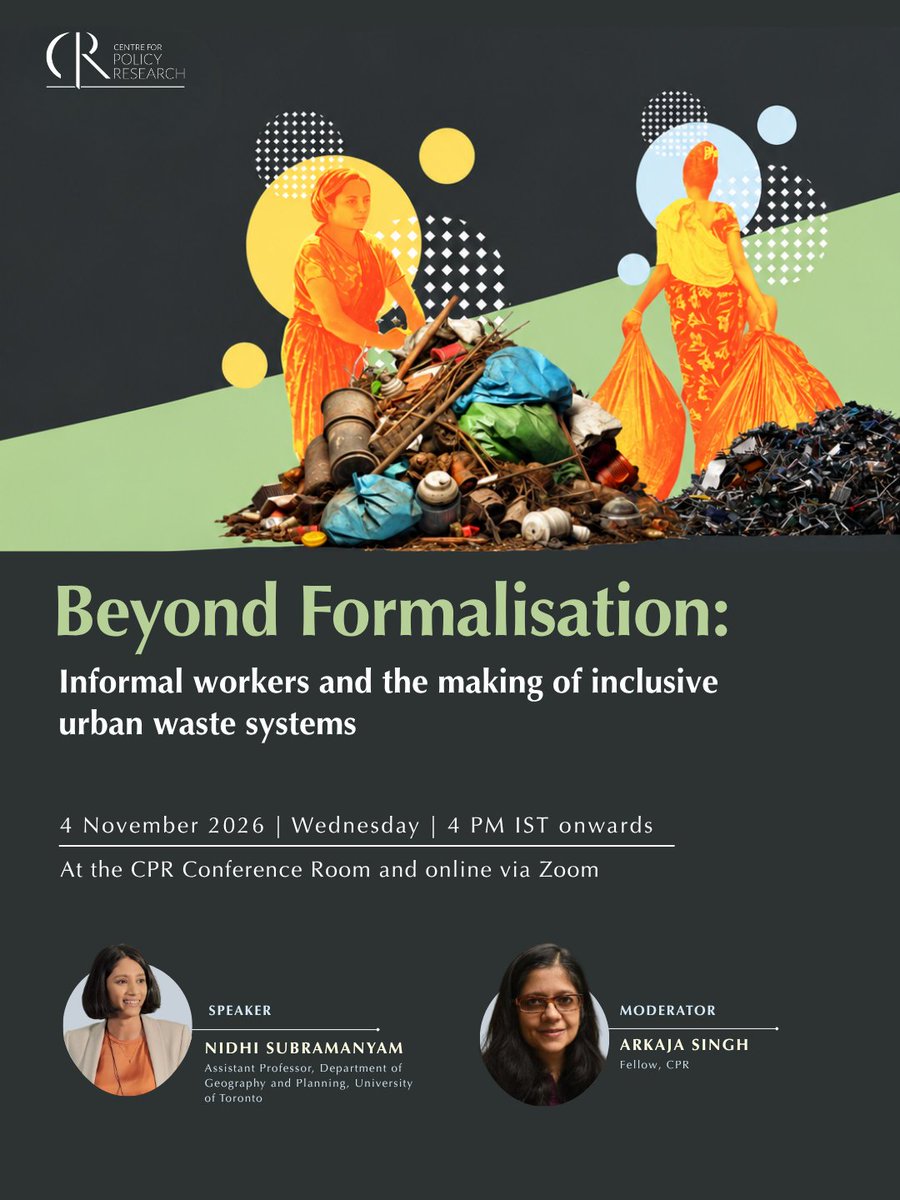
Across Indian cities, municipalities are increasingly seeking to integrate informal waste workers into formal waste management systems. Yet these efforts do not always result in secure or lasting inclusion.
Why is this the case?
To explore this question, Nidhi Subramanyam (Assistant Professor, Department of Geography and Planning at the University of Toronto) will share findings from her comparative research in Bengaluru, Bhubaneswar, and South Goa. The talk will examine what it takes to make these arrangements work in practice.
The discussion will be moderated by Arkaja Singh (Fellow, CPR).
Join us on Wednesday, 4 November, from 4 PM IST onwards.
Register here to attend in person: https://t.co/Al608dimI5
Register here to attend via zoom: https://t.co/rCbvSGJ7v1
What could a Democratic victory in the US midterm elections mean for President Trump’s legislative agenda and foreign policy?
Join us on Wednesday, 28 October, at 3:30 PM IST for a talk by Amit Gupta (Senior Visiting Fellow, CPR) as he discusses election data, the balance of power in Congress, and the limits of congressional influence over US policy on Iran, Ukraine, India, China and Europe.
This talk will be held in a hybrid mode at the CPR Conference Room and online via Zoom.
Register to attend in person: https://t.co/60BiWTpvQz
Register to attend via zoom: https://t.co/IMpblz8DkT
How do you prevent fires in informal urban settlements? What shapes how people react to a fire? Listen to Satorupa Karmakar of IIT Delhi in today's @CPR_India CSH Delhi Urban workshop at 3.45PM IST
Urban fires remain among the most significant yet underreported disasters in the Global South, with informal settlements facing disproportionate risk. In India, the factors that shape household resilience to fire remain underexamined.
Join us on Tuesday, 27th October at 3:45 PM IST for a Special Milestone 200th Urban workshop on "Determinants of Household Resilience to Fire in Informal Settlements: Evidence from the Bastis of Delhi, India" by Satorupa Karmakar, PhD Candidate, UQIITD Research Academy (University of Queensland–Indian Institute of Technology Delhi), co-organised with the Centre de Sciences Humaines (CSH Delhi).
Based on 253 households surveys across 30 bastis in Delhi, this workshop will look at different factors that shape household resilience to fire, including prior experience, economic conditions, social support and sense of place.
Register to attend in person: https://t.co/J0qf5FFNYF
Register to attend via zoom: https://t.co/45lU8X7n24
TOMORROW 3.45PM IST @CPR_India CSH_Delhi Workshop No.200. Register Online at
https://t.co/5ertU46zdg
Or join in person at @CPR_India conference room with the best think tank coffee in town
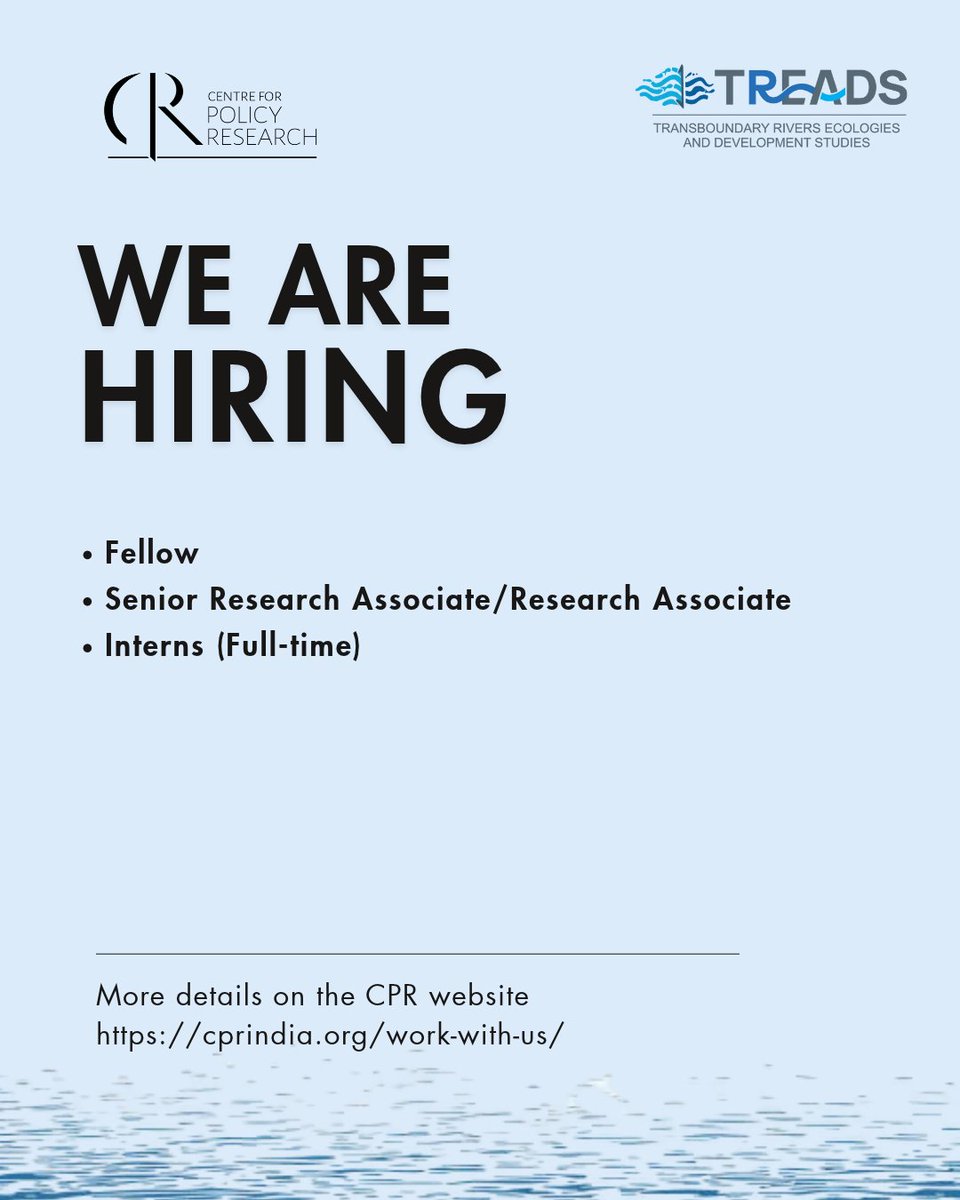
JOB ALERT!
We are looking for researchers and interns to join the Transboundary Rivers, Ecologies & Development Studies (TREADS) initiative at CPR.
Positions open:
1) Fellow
2) Senior Research Associate/Research Associate
3) And Full-Time Interns.
Job Description: https://t.co/68u45ILsiM
Please note: These are full-time, in-office roles based in New Delhi.
Applications are reviewed on a rolling basis until the positions are filled.
To apply, email your cover letter, CV with references and one or two writing samples to [email protected].
Interns, please apply through: https://t.co/vnwn9KoPyA
Use the subject line POSITION_YOURNAME (for example, FELLOW_AshaSharma).
Has TWAIL overlooked a different history of colonial rule?
Just as International law textbooks should take history more seriously, so should Third World Approaches to International Law (TWAIL).
On October 30, CPR along with School of Law, BML Munjal University is hosting their second series of lectures under ‘Delhi Public Law Forum.’
The session featured Dr Prabhakar Singh (Professor at the School of Law and Director of the Centre for International Law, BML Munjal University) as the speaker, Dr Arvind Elangovan (Professor of History, School of Humanities and Cultural Studies, Wright State University) as the discussant, and Dr Mathew John (Dean and Professor, School of Law, BML Munjal University) as moderator.
Together, they will be exploring nineteenth-century legal history to unpack how South Asia’s geography and legal order shaped the East India Company’s peacetime cessions of territory, thereby raising debates on “Oriental despotism” and influencing the development of international law on territorial cession.
Register to attend in person: https://t.co/4OhhDgY3XB
Register to attend via zoom: https://t.co/C9Wn4t2B2t
What could a Democratic victory in the US midterm elections mean for President Trump’s legislative agenda and foreign policy?
Join us on Wednesday, 28 October, at 3:30 PM IST for a talk by Amit Gupta (Senior Visiting Fellow, CPR) as he discusses election data, the balance of power in Congress, and the limits of congressional influence over US policy on Iran, Ukraine, India, China and Europe.
This talk will be held in a hybrid mode at the CPR Conference Room and online via Zoom.
Register to attend in person: https://t.co/60BiWTpvQz
Register to attend via zoom: https://t.co/IMpblz8DkT