Benfica SAD have tonight informed CMVM - Portuguese Securities Market Commission of Real Madrid's formalised intent to trigger the €15m clause for Jose Mourinho.
Exactly two days after Florentino Pérez’s re-election, turning the campaign promise into a done deal. #RMCF ⤵️
The Texas AG release pushes the FIFA debate beyond football politics.
On June 9, Ken Paxton opened a probe into whether FIFA misled fans about World Cup seat location and quality in Texas.
It makes Michel Platini’s filing one front in wider scrutiny of FIFA’s power.
Michel Platini’s Paris filings ask French courts to examine how the 2015 case that kept him out of the 2016 FIFA race was built.
Days before the World Cup, the paper trail runs through FIFA discipline, CAS, Swiss criminal acquittals and pressure around Infantino.
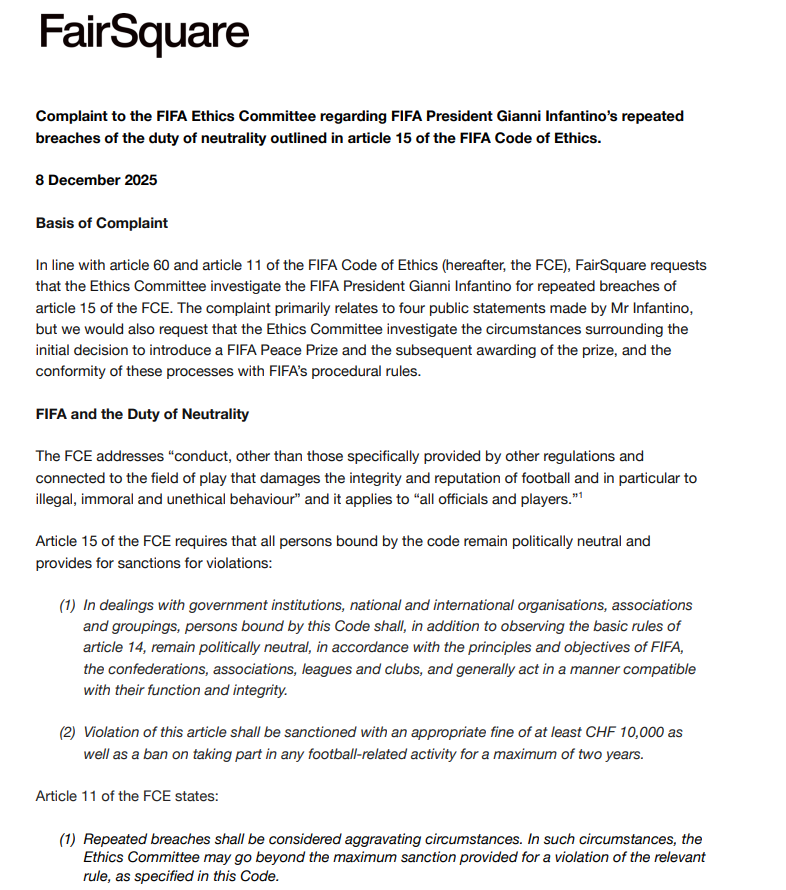
FairSquare’s complaint over Infantino’s FIFA Peace Prize for US President Donald Trump is separate from Platini’s allegations.
It turns the wider governance theme into a document about political neutrality, presidential discretion and the limits of FIFA ethics oversight.
Michel Platini is 70. He can't win back the 2016 FIFA race.
His French cases seek something else.
A judicial record of how the 2m CHF payment case that ended his football-administration career was built.
This is why succession in sports marketing is lethal.
Adidas Backyard Legends turns 90s legacy into 2020s cultural currency via generational LCV transfer + cultural arbitrage.
World Cup ads are rewriting nostalgia, authenticity and unity right now.⤵️
https://t.co/rVgn6nzoof
Succession in sports marketing is lethal.
To protect a projected €250M World Cup tournament product revenue cycle, Adidas engineer a clinical bypass. LOLA USA and director Mark Molloy (SMUGGLER) operationalise spatial contraction to transfer LCV from legacy icons to the new guard.
Global IP is forced into a hyper-localised concrete court, manufacturing psychological proximity to the consumer.
The narrative deployment of an "untouchable street crew" operates as a necessary ego-neutraliser, stripping the alienating aura from billion-dollar assets. It subordinates elite talent to the environment, with the brand owning the environment.
The historical component functions as a closed-source asset. Competitors possess their own legacy lineups, but they are not able to legally or culturally spend the institutional IP, official match balls and tournament symbology, that anchor these legends to the sport's definitive moments. It is a unique market advantage Adidas holds over rivals.
The edit mandates a generational Lifetime Customer Value (LCV) transfer.
16mm heritage grain collides with 8K digital formats via precise match-cut vectors. The timeline collapses as the match ball natively morphs from Tricolore to Fussballliebe.
Adidas seamlessly grafts the cultural capital of the archive - Zidane, Beckham, Del Piero - directly onto the newly minted futures of Lamine Yamal, Trinity Rodman, and Jude Bellingham.
Timothée Chalamet and Bad Bunny act as the bridge for cultural arbitrage. Their deployment transcends endemic sports marketing, forcing immediate demographic cross-pollination.
Adidas tap into the cultural gravity to capitalise on music, high-fashion and cinema audiences, converting a localised football asset into a mass-market cultural event.
The campaign effectively converts the Gold Standard of the late 1990s and early 2000s into the Crypto of the 2020s.
The #YouGotThis directive dictates a closed-loop succession mandate.
Legacy is a proprietary currency.
When Jose Mourinho took his grievance with Turkish football authorities to the European Court of Human Rights, at first it looked like just another episode in a career built on confrontation.
The sanctions in question - a one-match ban from the dressing room and bench, together with fines totalling around €18,000 - stemmed from remarks he made after Fenerbahçe’s 3-2 win at Trabzonspor on 3 November 2024.
He had criticised VAR decisions, declared that the Turkish league “smells bad”, and questioned the impartiality of officials. The Professional Football Disciplinary Board deemed the comments unsportsmanlike and damaging to the game’s reputation. The federation’s arbitration panel upheld the penalties. Case closed, or so it seemed.
The application lodged in March 2025 and made public via an official ECHR notice on 1 June 2026 goes far beyond a simple appeal against a fine or touchline suspension.
Mourinho’s lawyers contend that the Turkish disciplinary system itself, the PFDK and the arbitration board, does not meet the standard of an “independent and impartial tribunal” required by Article 6 of the European Convention on Human Rights.
Both bodies operate under the umbrella of the Turkish Football Federation, the very organisation whose decisions they are meant to review. The argument is that clubs, sponsors and, on occasion, political influence can shape outcomes. It mirrors challenges already upheld by the ECHR against disciplinary systems in several other Council of Europe member states.
The case is not about defending Mourinho’s temperament, a coach known for his combative style, but about testing whether any coach, in any league, can be sanctioned by a body whose independence is open to question.
If the court accepts this view, the case will challenge how Turkish football regulates itself.
A parallel claim rests on Article 10, the right to freedom of expression.
Mourinho’s post-match comments are presented as legitimate criticism of a matter of genuine public concern: the quality and fairness of refereeing in a high-stakes league.
European human-rights jurisprudence has repeatedly protected robust commentary on public institutions, even when it is sharp or unflattering, provided it does not descend into outright falsehood or gratuitous abuse.
Turkish officials counter that the remarks crossed that line, discrediting the league as a whole. Strasbourg will now weigh where the boundary lies.
The timing lends the case an extra edge.
The application was filed while Mourinho was still in post at Fenerbahçe. Its communication by the court came after he had left the club in late August 2025, following a brief and ultimately trophy-less spell.
It also arrived in the wake of a separate scandal in June 2025, when the entire PFDK board, including its chairman, resigned after leaked WhatsApp messages appeared to reveal institutional hostility towards both Mourinho and Fenerbahçe. The leaked messages, which prompted the entire board’s resignation in June 2025, are now part of the public record cited in Turkish media and have been submitted as supplementary material to the ECHR.
Those exchanges supply precisely the sort of concrete evidence that strengthens claims of bias.
Such cases are uncommon.
Coaches have railed against referees for decades, very few have elevated a routine disciplinary spat to the highest human-rights forum in Europe.
A ruling against Turkey would carry implications beyond one Portuguese manager. It could establish that national football federations must satisfy basic standards of due process and institutional detachment if they wish to impose sanctions without external scrutiny.
What began as a flash-interview rant on the Black Sea coast has quietly become a test of whether a sporting body can act as both prosecutor and judge in its own cause.
Turkey now has six months to submit its observations.
Its lawyers are expected to argue that sporting discipline is an internal matter, that domestic remedies were fair and exhaustive, and that Mourinho’s language went beyond acceptable criticism.
Any financial award, should one eventually materialise, would be modest. The reputational impact on the Turkish Football Federation, and on perceptions of the Super Lig abroad, would be more lasting.
In the end, the drama on the pitch may prove less consequential than the procedural question now before Strasbourg - whether a national federation can serve as both regulator and judge.
#ECHR #TurkishFootball
FIFA World Cup 2026 ticketing is now a consumer-disclosure story, not only a resale-price story.
The live issue is not just SeatGeek.
It is what a fan knows at purchase:
• ticket category
• seat location
• inventory release timing
• final activation inside FIFA’s system
FIFA’s rules allow tickets to be added or removed from sale, category boundaries to vary and seat location to be determined or changed later.
SeatGeek says its World Cup confirmation is a receipt, not the ticket; delivery still moves through FIFA confirmation, barcode and seat-number stages.
That is why the legal pressure is moving towards release schedules, public statements and seating categories.
The market question is simple:
Were fans buying a fully specified seat product, or a seller-controlled ticketing framework?
Fifa has been accused of working with unofficial resale platforms in an effort to sell tickets for low-demand World Cup games to avoid compensation claims from supporters who have already paid face value
Story by @Lawton_Times and @martynziegler ⬇️
https://t.co/Rv62d8H4h2
Macron at Clairefontaine, the night before Les Bleus fly out for the 2026 World Cup.
He sits next to Mbappé, reminds the squad of 2018 glory and the 2022 final, then lands the only question that matters, the third star.
He then walks straight across to the women’s team under Laurent Bonadei with the exact same message and the same demand. One roof, two squads, one French ambition.
In a football world that sometimes feels too business-driven, this remains one of the last pure rituals, the President showing up at the training centre to say “we believe in you.” Nothing more, nothing less.
Now it’s on them. Third star in 2026?
#EquipeDeFrance #LesBleus #WorldCup2026
Tonda Eckert’s backroom staff wanted a ruthless, surveillance apparatus to drag Southampton into the Premier League.
Instead, today's unsealed WhatsApp logs reveal they ran a spy ring with the administrative competence of a Sunday League side.
The League Arbitration Panel’s written reasons, dropped on 1 June 2026, confirm the massive sporting cost with a historic expulsion from the Championship play-offs, handing Middlesbrough a reinstatement they ultimately wasted by losing the Wembley final to Hull City.
But the real masterpiece is the digital paper trail they left behind. Setting aside the structural breach of EFL regulations, the sheer operational clumsiness laid bare in these leaks reads like a masterclass in how to completely compromise an intelligence asset.
In professional espionage, human source management (HUMINT) requires absolute care. You do not burn a valuable agent for a fleeting tactical advantage.
The logs show a panicked junior analyst intern placed under intense, top-down pressure to stake out Middlesbrough’s Rockliffe Park training ground ahead of the semi-finals. The kid openly voiced ethical and career concerns, only to be met with a cold, corporate command, "the boss is adamant".
Forcing an unwilling, terrified asset into a high-risk theatre without a safety net is an open invitation to an operational blowout.
Then there is the collapse of basic operational security (OPSEC). Good spies leave a ghost-like footprint, Southampton's left a stadium-sized trail of digital receipts.
Once Middlesbrough staff spotted the analyst and closed the trap, the emergency extraction plan degenerated into pure farce. The intern had to flee into a local golf club restroom, perform a frantic wardrobe change, and desperately try to scrub his own LinkedIn profile before Boro’s media team could match his face to the Southampton staff directory.
If your agent's survival protocol relies on a public toilet quick-change, your security architecture has structurally failed. The cover identities were even worse.
For a previous reconnaissance mission against Ipswich Town, the backroom team decided the ultimate deep-cover disguise was to dress the intern in the bright, full kit of National League side Eastleigh FC.
Dropping an operative into a closed-door training session wearing the gear of an entirely unrelated, local non-league club is an active visual anomaly. It practically begs counter-espionage, or a sharp-eyed security guard, to intervene.
Worst of all, they broke the golden rule of any conspiracy, never put the operation in writing on consumer software.
After an early run against Oxford United, a senior staff member text the intern, “You legend. Manager loved it.”
This unencrypted Signal Security (SIGSEC) disaster handed the Independent Disciplinary Commission its smoking gun on a silver platter.
True to form, Southampton broke their silence today with a desperate counter-offensive, questioning the independence of the arbitration panel.
Their grand defence? Targeting panel member David Winnie because he played a single game on loan for Middlesbrough back in 1994.
"You legend. Manager loved it"
- the Spygate WhatsApps in full
- how Southampton tried to delete pic of spy
- club tries to question appointment of panel member who played one game on loan for Boro 33 years ago
- intern feared sack if he refused to spy https://t.co/vOfnWcNqOk
Alan Tyers is currently public enemy No. 1 for the Arsenal faithful.
Safe to say 90% of the anger is locked behind The Telegraph's paywall, too.
His only sin? Expecting TNT Sports to cover the Champions League final neutrally, instead of treating it like an Arsenal TV stream.
CBS Sports Just Showed TNT How It’s Done.
The 2026 Champions League final exposed a serious problem with UK coverage.
Paris Saint-Germain beat Arsenal on penalties in the 2026 Champions League final in Budapest. Back home, though, a major talking point had nothing to do with the shoot-out.
It was TNT Sports’ broadcast. Alan Tyers in The Telegraph nails it. “Saturday’s broadcast was all Arsenal, all the time,” he writes, “thanks to fan presenter Laura Woods and a pundit roster loaded lopsidedly in favour of the north Londonders at the expense of PSG balance.”
Presenter Laura Woods, a proud Gooner, called Mikel Arteta “The Boss” on air. The studio was stacked with ex-Arsenal men Martin Keown, Jack Wilshere plus Steven Gerrard and Owen Hargreaves.
Even commentator Darren Fletcher slipped in “one-nil to the Arsenal has a nice ring to it.”
Pre-match segments doubled down on the red-and-white love. Neutrals noticed. Rival fans noticed.
The backlash is well deserved and it goes deeper than one final. TNT paid a fortune for the rights, slapped the showpiece behind a paywall for the first time in decades, and still served up a broadcast that felt built for one club’s supporters than the millions watching across the country.
Even Sir Keir Starmer, himself a season-ticket Arsenal fan, joined the criticism over the paywall. When your own side is calling you out, you know the optics are rough.
CBS Sports delivered something altogether different from the same stadium.
🔹Over 10 hours of proper big-game television on CBS, Paramount+ and the Golazo Network.
🔹Host Kate Scott led a studio with Thierry Henry, Jamie Carragher and Micah Richards with sharp analysis, real chemistry, and no obvious agenda.
🔹Henry brought genuine French insight into PSG.
🔹Carragher and Richards went toe-to-toe the way fans actually talk.
🔹They threw in an innovative Beckham & Friends altcast, crisp pitchside reporting and production values that made the occasion feel global.
TNT went all-in on the English side and CBS treated the fixture for exactly what it was, a European showpiece between two massive clubs.
In a market where Amazon Prime already earns praise for more balanced regular-season coverage, TNT’s final-night effort stands out for the wrong reasons.
Viewers have options now and they’re comparing. And more of them keep saying the same thing, TNT’s approach is starting to feel tired, biased and commercially risky.
Football broadcasting should deliver the game to everyone. On this evidence, CBS understands that. TNT still has plenty of work ahead.
As 16m+ UK viewers turned to piracy for Champions League final, the dark nexus between sports streaming and unlicensed gambling comes into sharp focus.
TNT Sports' paywall strategy for UCL final proved a failure and simply fuelled the black market.⤵️
https://t.co/n4IiFozJtB
CBS Sports Just Showed TNT How It’s Done.
The 2026 Champions League final exposed a serious problem with UK coverage.
Paris Saint-Germain beat Arsenal on penalties in the 2026 Champions League final in Budapest. Back home, though, a major talking point had nothing to do with the shoot-out.
It was TNT Sports’ broadcast. Alan Tyers in The Telegraph nails it. “Saturday’s broadcast was all Arsenal, all the time,” he writes, “thanks to fan presenter Laura Woods and a pundit roster loaded lopsidedly in favour of the north Londonders at the expense of PSG balance.”
Presenter Laura Woods, a proud Gooner, called Mikel Arteta “The Boss” on air. The studio was stacked with ex-Arsenal men Martin Keown, Jack Wilshere plus Steven Gerrard and Owen Hargreaves.
Even commentator Darren Fletcher slipped in “one-nil to the Arsenal has a nice ring to it.”
Pre-match segments doubled down on the red-and-white love. Neutrals noticed. Rival fans noticed.
The backlash is well deserved and it goes deeper than one final. TNT paid a fortune for the rights, slapped the showpiece behind a paywall for the first time in decades, and still served up a broadcast that felt built for one club’s supporters than the millions watching across the country.
Even Sir Keir Starmer, himself a season-ticket Arsenal fan, joined the criticism over the paywall. When your own side is calling you out, you know the optics are rough.
CBS Sports delivered something altogether different from the same stadium.
🔹Over 10 hours of proper big-game television on CBS, Paramount+ and the Golazo Network.
🔹Host Kate Scott led a studio with Thierry Henry, Jamie Carragher and Micah Richards with sharp analysis, real chemistry, and no obvious agenda.
🔹Henry brought genuine French insight into PSG.
🔹Carragher and Richards went toe-to-toe the way fans actually talk.
🔹They threw in an innovative Beckham & Friends altcast, crisp pitchside reporting and production values that made the occasion feel global.
TNT went all-in on the English side and CBS treated the fixture for exactly what it was, a European showpiece between two massive clubs.
In a market where Amazon Prime already earns praise for more balanced regular-season coverage, TNT’s final-night effort stands out for the wrong reasons.
Viewers have options now and they’re comparing. And more of them keep saying the same thing, TNT’s approach is starting to feel tired, biased and commercially risky.
Football broadcasting should deliver the game to everyone. On this evidence, CBS understands that. TNT still has plenty of work ahead.
Saturday’s broadcast was all Arsenal, all the time, thanks to fan presenter Laura Woods and a pundit roster loaded lopsidedly in favour of the north Londonders at the expense of PSG balance, writes Alan Tyers ⬇️
https://t.co/F3V1w508cA
@GuillemBalague Instincts on both vindicated. With Pep, there at tiki-taka idealism start at Barça to full City decade. With Villa, early Emery honeymoon to Istanbul trophy bookend. Give it a season, Iraola next?