El seu treball ha estat clau en la comprensió dels fluxos en dimensió 3, amb la construcció d’un contraexemple suau a la conjectura de Seifert, un resultat que ha marcat la teoria moderna dels sistemes dinàmics.
within the framework of the parameterization method and strengthens the link between rigorous mathematical theory and computer-assisted verification in dynamical systems.
On the convergence of flow map parameterization methods for whiskered tori in quasi-periodic Hamiltonian systems
🔗 Access the article: https://t.co/FLtAMu0XNj
This presentation took place on May 23, 2024, as part of the Maria de Maeztu Annual Workshop, an event that brings together the CRM community to share results and research lines strengthened through the Unit of Excellence María de Maeztu Award.
🎥 Counting Polytopes
We revisit the talk by Arnau Padrol (@unibarcelona - @crmatematic ) on counting polytopes, exploring combinatorial and geometric techniques to study and enumerate these structures.
▶️ Watch the full video: https://t.co/SU3a1w8hIx
Wall Drawing #610 was created in 1989. It was first installed at the Fundació Joan Miró (Barcelona) and can currently be seen as part of the long-term installation at MASS MoCA (USA). @MASS_MoCA@fundaciomiro
Sol LeWitt, a pioneer of Conceptual Art. His work is based on the idea that the concept behind an artwork is more important than its physical execution. Rather than creating each piece himself, he often provided precise instructions, allowing others to carry out the work.
Using simple elements — lines, geometric forms and primary colors — he developed structures governed by rules, sequences and variations. His practice bridges art and mathematics, turning drawing into a process shaped by logic, systems and repetition.
BTSP: Learning Without Repeating
BTSP: the mechanism that explains single-shot learning.
How the brain can learn from a single experience.
Music: Light my brain by Sero
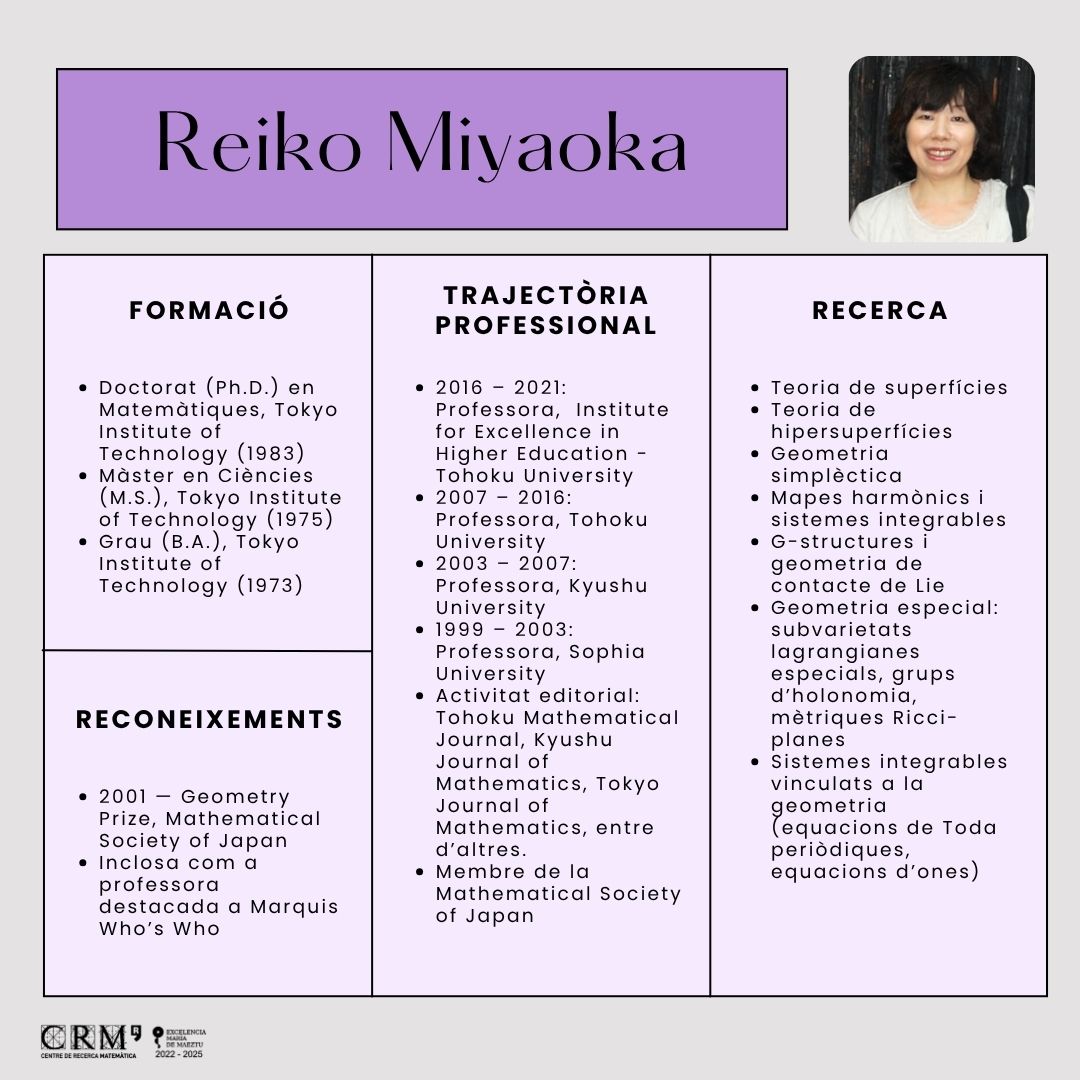
Reiko Miyaoka
Matemàtica japonesa i professora emèrita de la Universitat de Tohoku, reconeguda per la seva recerca en geometria diferencial i en l’estudi de les hipersuperfícies.
@TohokuUniPR@sciencetokyo_ja
Differentiation: The Foundation of Calculus
The derivative df/dt represents the instantaneous rate of change of a function f with respect to time t. It is formally defined as the limit as h approaches 0 of the difference quotient [f(t + h) − f(t)] / h, capturing how the function behaves as the time interval becomes infinitesimally small.
This powerful tool is essential in physics for velocity and acceleration, in economics for marginal analysis, and in machine learning for optimization algorithms.
graph theory by establishing nearly optimal bounds for advanced variants of graph coloring, strengthening open conjectures and broadening our structural understanding of important graph classes, with potential impact on combinatorics and theoretical computer science.
Boundedness for proper conflict-free and odd colorings
https://t.co/o2Li6I0c9T
This work, authored by A. Jiménez (Universidad de Valparaíso & Millennium Nucleus for Social Data Science), K. Knauer (@UniBarcelona - @CRMatematica ), C. N. Lintzmayer and M. Sambinelli (@ufabc ),
M. Matamala and J. P. Peña (@uchile ), D. A. Quiroz (Universidad de Valparaíso), Y. Wakabayashi (@usponline ), W. Yu (Zhejiang Normal University) and J. Zamora (@uandresbello ), has been recently published in Discrete Mathematics.
This article provides significant advances in
And yet, he felt a deep fascination for algebra: “When the blackboard was crowded with symbols and equations, my heart rejoiced; I put all five senses into it.”
📐✨ Sometimes mathematics is not just calculation: it is also memory, emotion, and beauty.
Miguel de Unamuno, Spanish writer and philosopher of the Generation of ’98, also found inspiration in mathematics… and in his struggles with it.
Today we recommend “The Multiplication Table”, a poem that evokes childhood and memory through numbers.
Interestingly, Unamuno admitted that arithmetic was not his strength. In Memories of My Childhood and Youth, he wrote: “I always got tangled up in the multiplication table and never managed to develop a quick eye for division.”









![mathemetica's tweet photo. Differentiation: The Foundation of Calculus
The derivative df/dt represents the instantaneous rate of change of a function f with respect to time t. It is formally defined as the limit as h approaches 0 of the difference quotient [f(t + h) − f(t)] / h, capturing how the function behaves as the time interval becomes infinitesimally small.
This powerful tool is essential in physics for velocity and acceleration, in economics for marginal analysis, and in machine learning for optimization algorithms.](https://pbs.twimg.com/media/HJGd4JTa0AAz2a9.jpg)


