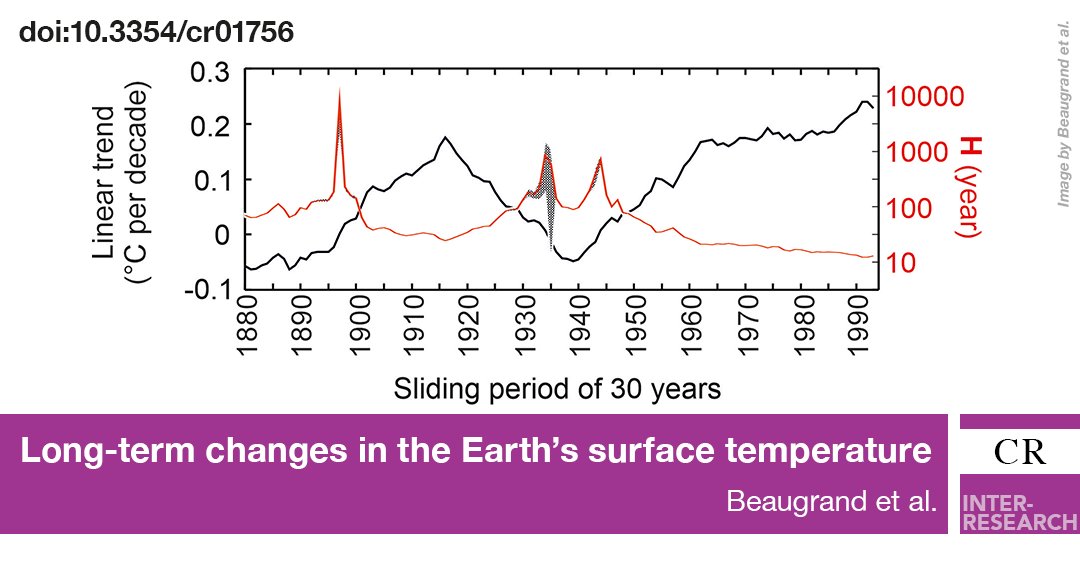
This study shows Earth’s climate likely crossed a tipping point between 1965-1977. Analysis of global temperature anomalies with new indicators reveals accelerating warming, signaling a shift toward a new dynamic equilibrium that has already begun. https://t.co/MCth8TIesA
How will climate-driven rainfall shifts affect #mosquito populations? Our study predicts future changes in #Culex pipiens and #Aedes albopictus under various precipitation scenarios in Tokyo. https://t.co/Z0B996SPYB
‼️‼️‼️ We are currently experiencing technical issues that may be affecting general access to our Inter-Research website. We are working to resolve them as soon as possible. ‼️‼️‼️
Global climate has shown an increasing trend in warming and more frequent abnormal weather. We reveal a significant peer effect of the decision-making process of large grain farmers in adopting adaptive behaviors towards weather-related disasters. https://t.co/p0EPtJ9OJt
We investigate agroecological methods employed by Myanmar rice farmers to adapt to changing climatic conditions, factors that influence their adaptation strategies, and their levels of adaptive capacity and its relationship with rice yield. https://t.co/vGNjiCI7Ht
For 4 #MongolianLakes, we determined the correlation between lake area, depth and volume, and climate variables. Our results reveal the #SpatioTemporalPatterns and causes of the lakes’ #morphometric changes in relation to #ClimateChange. https://t.co/NuzsjcZDlu
Extreme #precipitation events over #southernChina during the 2015/16 winter featured notable intraseasonal variation. We explore the oceanic precursors and possible mechanisms involved for the intraseasonal variation of extreme rainfall. https://t.co/zqcLE8z8rW
Towards more sustainable wildlife #harvesting with adaptive management models; a case study of the high-arctic Svalbard #reindeer living in a climate change hotspot, challenged by selective hunting and strong interannual changes in population structure.
➡️https://t.co/8od0lu8nxl
What a brilliant wildlife watching day. We have explained why bluefin tuna 1) returned to our waters and 2) may now persist here, in two recent papers: 1) https://t.co/pU4TfC2Ohy & 2) https://t.co/RPaczXNyfz.
#ClimateChange at Theodore Roosevelt National Park in #Medora, ND, was examined (1960–2019). Trends in air temperature, precipitation, snow, soil moisture regime, and growing season are presented; park management implications are discussed.
Read more: https://t.co/oIHfG8KRGc
Authors found that erosive #rainfall had significant monthly variation, moderate rains decreased and rainstorms increased, in a local area within #Ganjiang River Basin. Change may lead to extreme #drought or #flood disasters.
Read more about this study: https://t.co/Em5EYEomJw
How do #populations respond to #harvesting in fluctuating environments? Spatial patterns and species interactions play major roles. And don’t forget density dependence.
Find out more in this review ➡️ https://t.co/q299NGzpOp
The study applies local climate zones (lcz)in a high-altitude tropical city to identify thermal differences and patterns, showing that, while high temperatures were not identified, the urban area notably reduces low temperature values.
Read more ➡️ https://t.co/MNxtzqQ7JQ
Impacts of climate change on industrial water demand varied in different sectors under the average precipitation–temperature change rate in Hebei Province. The total impact changed between 12.8% and 4.1% as the different impacts neutralized each other. https://t.co/I1UWGN1Bym
📢Le #Cirad et ses partenaires d'@IsiteMUSE vous donnent rendez-vous au Montpellier Global Days. Un événement, en amont du Sommet @AfriqueFrance, qui réunira scientifiques, politiques, citoyens et journalistes.
🗓️ 4 au 7 octobre
Plus d'infos👉 https://t.co/AqTiEZU9xe
Investigation of predicted change in future max. temperatures in SE Iraq as representative of Middle East region, via downscaling using the GCMs CanESM2, HadGEM2-ES & MIROC5. Climate model projections show warming across all four seasons, in relative terms.https://t.co/6r6hCBqna3
Size and experience do matter! New paper by @MWStubberud and colleagues on the impact of spawning experience on population growth rate.
Part of special Theme Section. Advanced view available here: https://t.co/ukM1bDktwE