We’re working with many global manufacturers that are digitizing their factory floors and building secure, highly functional OT environments to support Industry 4.0 initiatives. A modern approach is essential, given the complex threat landscape faced by manufacturers.
#ITleaders in manufacturing must understand #cybersecurity vulnerabilities to stay ahead in #Industry40.
By actively addressing these risks, enterprises can safeguard their operations and reputation while ensuring resilience in a changing landscape.
https://t.co/5cCW0vrZmT
At the @CatoNetworks Partner Summit in Las Vegas - looking forward to learning more about what’s next for this strategic @coevolvetech partnership #SASE
Multinational enterprises are frustrated by the lack of innovation from telcos, leading to outdated, costly infrastructure that hinders transformation. At @coevolvetech we believe success comes from focusing on outcomes, not tech. Ask us how we can help! https://t.co/ISvsorTWpy
OK, here is my best guess on the state of LLMs:
- The scale increase between gpt-3 and gpt-4 was 100x
- Doing that for the next model is going to be very hard
- We're nearly out of general language tokens. So let's say we can 2x that. And perhaps get more proprietary tokens and get to 3-4x. And do a lot of data cleaning and get to 6-7x.
- A 100x training run also requires a Gigawatt datacenter which we don't have yet
- Synthetic data is great, but it's not clear how that can be used for general language. I suspect this is why both OAI and Anthropic are focusing on math and code which can be improved via various "synthetic" compute methods (simulated data, or recursive self improvement of some sort)
- In the meantime, there is focus on getting more learnings from the same data. Perhaps there is a breakthrough there but I've not heard of it
- Planning can be pushed to inference in some domains (e.g. coding) which we're starting to hear about. But again, not clear how much this buys.
- Moronic policies like SB 1047 are threatening to slow all this down.
So tl;dr I don't see where the 100x jump will come from for general language reasoning. This is why we're seeing a focus on math and code. I'm glad teams are working hard at new algorithmic unlocks.
(btw, this is pure speculation, would love to know where I'm wrong!)
As toolsets become more complex, enterprise teams struggle to grasp their overall security. This article explores layered defenses, unified platforms, and AI's role in security management. Great insights on balancing security and overcomplication! https://t.co/Lu5e1cGZ23
The BBC had a camera - a smartphone, of course - live-streaming pictures from every single election count.
Here is how it was done, in terms of kit. For the signal, it was a sim card bonding to wifi at the venue.
This concept makes a lot of sense - there's so much data and business context locked away in ERP systems, and a genAI layer could be the ideal way to tap into it to find a competitive advantage: https://t.co/8k9IwjqVCl
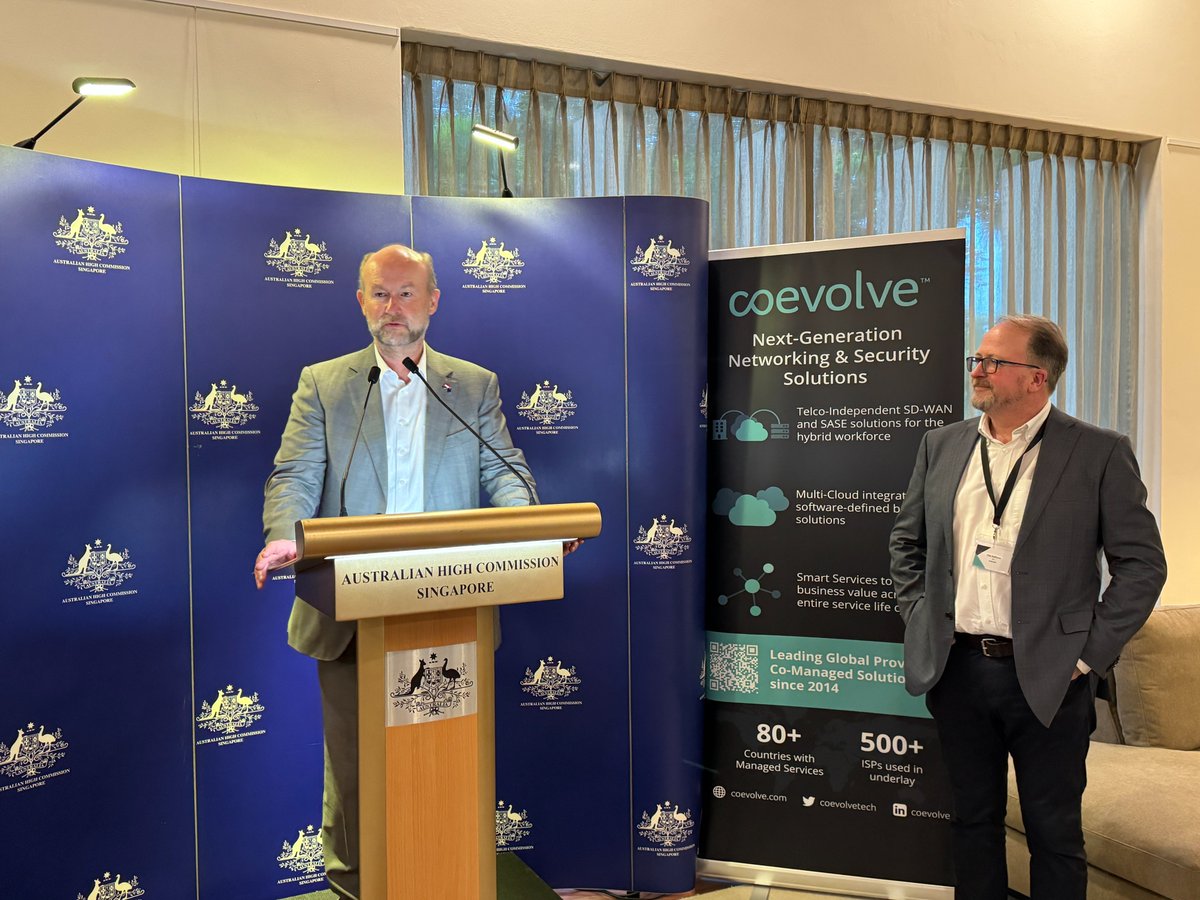
Coevolve was delighted to host clients, technology partners, and industry friends at the Australian High Commission, Singapore with @Austrade.
Celebrating our #10years of success we extend our sincere gratitude to the @AusHCSG, Allaster Cox, for welcoming us into your home.
@joshuastenhouse@CTOAdvisor It’s networking *for* AI, not AI networking. Think about how the vast infrastructure used to train any of today’s LLMs - what’s interconnecting all of those GPUs? AI is one of the first real use cases for that level of density.
Important point by Andrew Coward from IBM: "LLMs aren't great on their own in networks because they don't understand time series data". They need to be combined with other techniques to efficiently handle the vast amount of time series data in network environments #ONUGSpring2024
Just landed in Dallas for what should be an interesting two days ahead. Looking forward to many conversations on #AI in networking and security at the #ONUGSpring2024 event! @ONUG_
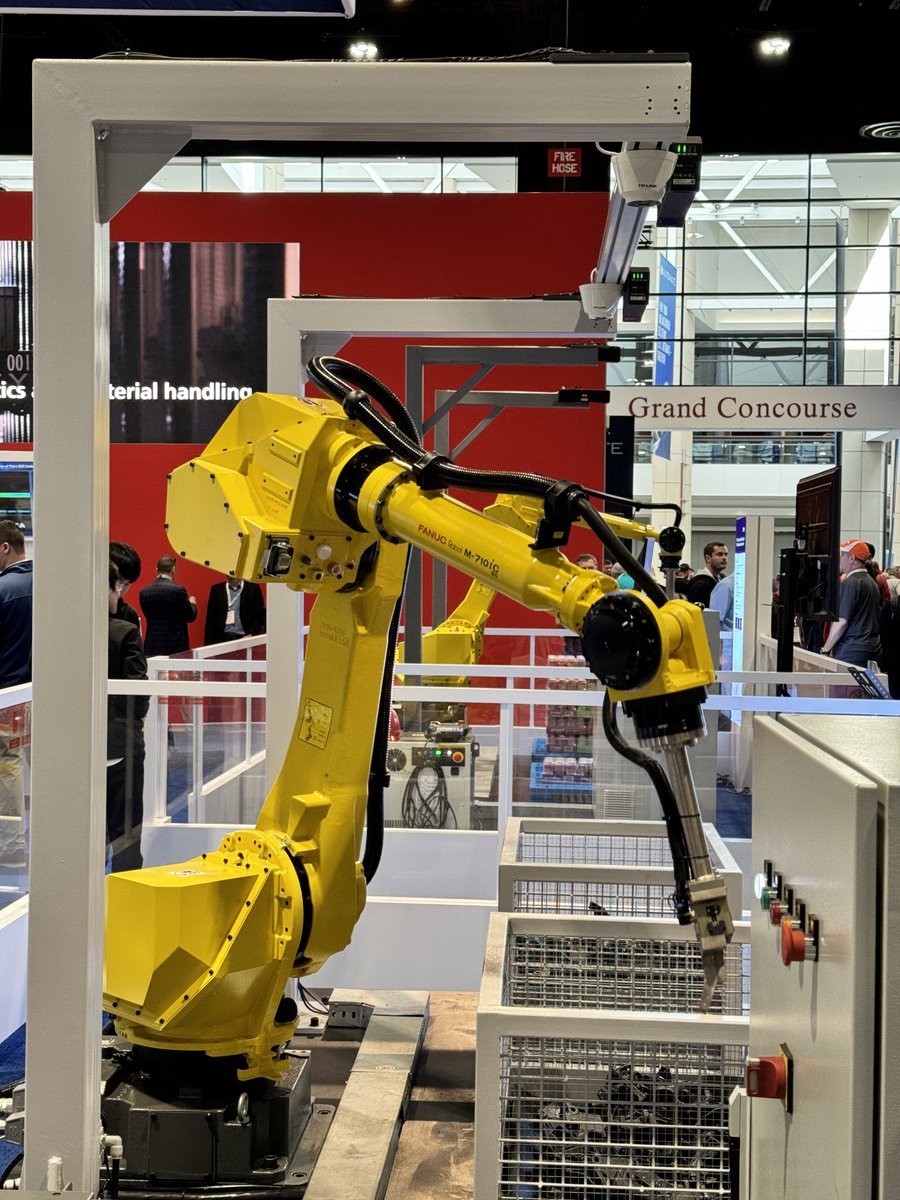
Spent the morning at #Automate2024 in Chicago learning more about the industrial automation technologies that our @coevolvetech clients are using. So many robots!
This seems like a very likely outcome as enterprises invest in fine-tuning models and prompt engineering, building a competitive advantage that they will want to protect: https://t.co/33o3UdbIt4
The energy impact of AI infrastructure on data centers is going to require new innovations as growth continues to skyrocket. By 2027, it’s estimated that 20% of all data center ports will be connected to AI servers: https://t.co/y5zzSMSdvG
As enterprises continue to embrace #hybridwork models, there is increasing pressure and heightened expectations to provide a consistent #userexperience globally.
Learn how a #telcoindependent software-defined approach can help.
#SDWAN#cloudnetworking
https://t.co/5TEL7MWiMv
Very true. And high latency makes this significantly worse. Reducing even apparently low levels of packet loss can dramatically improve “goodput” - we’ve seen this frequently when replacing IPsec VPNs with multi-path SD-WAN.
Goodput is how much throughput you get without packet loss. I’ve seen links with 20% consumed by retransmissions because of 1% packet loss. Those retransmissions are bad-put and wasted resources.
Securing the network perimeter is more complex for enterprises with distributed workforces accessing a variety of cloud apps. It was great to be featured in this @ForbesTechCncl article alongside many industry experts sharing best practices on this critical topic