In December 1968, 20-year-old Emory University student Barbara Jane Mackle was kidnapped from a motel room in Decatur, Georgia, where she was recovering from the flu with her mother.
Two people posing as police knocked at 4 a.m., claiming her boyfriend had been in an accident.
They were Gary Steven Krist, an escaped convict, and Ruth Eisemann-Schier. They chloroformed and bound her mother, then took Barbara at gunpoint.
They drove her to a remote wooded area in Gwinnett County, forced her into a specially built fiberglass-reinforced box roughly the size of a coffin, and buried her under about 18 inches of earth.
Inside she had air tubes, a battery-powered light and fan, blankets, some food, and water laced with sedatives.
Before sealing the box, they took a Polaroid of her holding a sign that read “KIDNAPPED” as proof of life.
Her father, a wealthy Florida developer, paid the $500,000 ransom. After roughly 83 hours underground—much of it in darkness after the light failed—FBI agents located the site, dug with their bare hands, and pulled her out alive.
She was dehydrated and had lost about 10 pounds, but otherwise remarkably composed.
Krist and Eisemann-Schier were both caught. Barbara later wrote a book about the ordeal (83 Hours Till Dawn), married, and largely stepped out of the public eye.
The photo of her inside the box remains one of the most haunting images from the case.
The collage photos you shared are from the real case (the proof-of-life shot, the burial site, and portraits of Barbara).
Michigan Army Airborne Combat Medic Private First Class Dennis Alvin McKellar passed away on October 24, 1966 from wounds sustained the previous day in South Vietnam. For his extraordinary heroism and bravery in combat, “Doc” McKellar was awarded the Silver Star. #American Hero.🇺🇸🎖️🦅Forever 20
The Pentagon has spent months building a new agency to covertly disrupt and sabotage foreign technology programs seen as threats to U.S. military superiority, according to a dozen current and former U.S. national security officials who spoke to Politico.
The Pentagon denies it with Deputy press secretary Jacob Bliss saying the claims are “simply not true.” The White House did not respond to Politico's request for comment.
The Technology Support Office (TSO) was established in April, the officials say. Politico reports it is mentioned in previously unreported Department of War records, including a memo Deputy Secretary of War Steve Feinberg signed April 14 placing it under the Under Secretary of War for Intelligence and Security. Its goal is to “buy time or stop adversaries from developing technologies” that most threaten the U.S. military in a major conflict, one former official said. The sources describe building hacking tools and planning deception operations, such as tricking adversaries into installing faulty components in weapons. Politico reports TSO lacks legal authority to conduct clandestine operations itself and works with military and intelligence officers who do.
It was built by merging two classified Pentagon intelligence programs that have run smaller tech sabotage efforts since 2023. Sources say Special Operations Command and Cyber Command objected, fearing budget cuts. While budget details are unclear, one former official estimated classified contracts alone are likely more than $1.5 billion.
Source: https://t.co/pi9W5EmKbi
In 1941, a Spaniard walked into the British embassy in Madrid and offered to spy on the Nazis.
The British turned him down.
So he went to the Germans instead, pretended to be a loyal fascist, and got hired as a German spy. His plan was to lie to them for the rest of the war.
It worked better than anyone could have imagined.
His name was Juan Pujol García. Before the war he had tried his hand at running a chicken farm and a movie theater. He had no spy training. What he had was a deep hatred of both fascism and communism after the Spanish Civil War, and an incredible imagination.
The Germans gave him a codename, invisible ink, money, and orders to go to Britain and recruit spies.
He didn't go to Britain.
He went to Lisbon, Portugal, and made everything up.
Using a tourist guidebook, maps, magazines, newsreels, and a British railway timetable from the library, he wrote long, detailed reports about life in England. Military movements. Morale. Ports.
He'd never been there. He made mistakes. He didn't understand British money. He once reported that dockworkers in Glasgow would do anything for a liter of wine.
The Germans loved him anyway.
Then British codebreakers reading German messages noticed something strange. The Germans were hunting for a convoy that didn't exist, based on a report from some agent in Britain they'd never heard of.
The British went looking for this mystery spy. They found Pujol. In 1942 they finally took him on and brought him to London.
Now he had real help. MI5 gave him the codename Garbo, after the actress, because they thought he was the greatest actor in the world.
Together with his British handler, Pujol built a fake spy network for the Germans. It eventually had 27 imaginary agents. Each had a name, a personality, a job, and a backstory. A Welsh nationalist. A Venezuelan student. A Greek sailor. Some of them recruited their own imaginary sub-agents.
When they needed to explain why one agent had gone quiet, they killed him off. They even put a fake obituary in a Liverpool newspaper. The Germans reportedly paid a pension to his widow.
Who also didn't exist.
Then came D-Day.
Hours before the landings, the British let Pujol send a message warning the Germans that the invasion was coming in Normandy. It was timed so it would arrive too late to matter, but it made him look brilliant.
Three days later he sent the most important message of his career. Normandy was a trick, he said. The real invasion was still coming, at Calais, led by a huge army under General Patton.
That army was fake too. But the Germans believed him.
German forces that could have been rushed to Normandy were held back near Calais for weeks, waiting for an attack that never came.
The Germans were so grateful they awarded him the Iron Cross.
A few months later, King George VI made him a Member of the Order of the British Empire.
He's one of the only people known to have been decorated by both sides of the war.
After the war, afraid of revenge from surviving Nazis, he faked his own death from malaria in Africa and disappeared to Venezuela, where he lived quietly running a shop.
For decades the world thought he was dead.
In 1984, a British writer tracked him down. Pujol came back to Normandy for the 40th anniversary of D-Day and met veterans who had landed on the beaches.
Some of them thanked him.
Former Eagles cheerleader Rachel Washburn left the squad in 2010 to serve in the U.S. Army.
She served as a U.S. Army intelligence officer on two Afghanistan tours, engaging Afghan women and children on special ops missions. She even helped deliver a baby in a snowstorm.
Critical to the special ops team because Afghans use women and children as human shields, she earned a bronze medal.
Way to go, Rachel! 🔥🔥🔥
Ilhan Omar Says She Didn't Know She'd Married Her Brother As They Were Separated At Birth And Hidden From Their Father, Darth Vader https://t.co/LioPMYHOiG
We just lost a good one.
Tom Skerritt did four years in the Air Force as a classifications specialist before he ever played a pilot on screen.
He enlisted in 1951 right out of high school in Detroit. Most of the hitch was at Bergstrom Field in Austin, Texas, sorting airmen and handling admin. No flying job, just the paperwork side of the force. He got out in 1955 and used the GI Bill for college, eventually landing at UCLA.
Later he played Duke in the MASH movie, Dallas in Alien, and Viper in Top Gun. He also helped start the Red Badge Project for veterans with PTSD. The uniform came first. The rest of the roles followed.
22 October 1943 | The number of women prisoners in the Auschwitz II-Birkenau camp, in all-female sub-camps and the experimental station of Prof. Carl Clauberg was 33,649 prisoners.
During a selection that took place on that day, 1,260 women were selected (394 of them at the camp hospital). They were all murdered in a gas chamber on the same day.
A short video showing the ruins of gas chamber and crematorium III: https://t.co/LQFeX1T7Bj
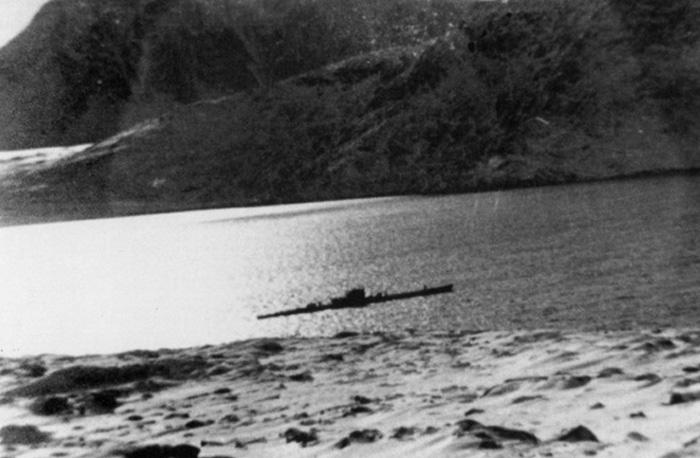
On this day in 1943, a German U-boat quietly landed a crew on the coast of Canada, set up a secret weather station on a windswept hill, and slipped away. It was the only known armed German operation on North American soil in the entire war, and it sat undiscovered for almost forty years. This is Weather Station Kurt.
In the Second World War, accurate weather forecasting was a weapon. Weather in the North Atlantic moves from west to east, so whoever knew what was happening off Canada and Greenland could predict the skies over Britain and Europe days ahead, priceless knowledge for planning operations. The Allies had the advantage, with stations and ships all across the north. The Germans were nearly blind, and they went to remarkable lengths to fix it, including building automatic weather stations and planting them in the far corners of the Arctic.
One of those stations was nicknamed Kurt, a set of canisters packed with instruments and a transmitter that could automatically measure the weather and radio it back to Germany. To deliver it, the Germans chose the submarine U-537, commanded by Peter Schrewe. She sailed from Germany in the autumn of 1943 with the weather station aboard, along with the meteorologist who had designed it. Crossing the Atlantic, she made for one of the loneliest places imaginable, Martin Bay, at the barren northern tip of Labrador in Canada.
On October 22, 1943, U-537 crept into the bay. It was an enormously risky moment. A surfaced submarine sitting off an enemy coast, unable to dive while her crew worked ashore, was terribly vulnerable. For about two days the Germans landed the heavy canisters, hauled them up onto a hill a short way inland, and assembled the station. To disguise it, they scattered American cigarette packs around and labeled the canisters as belonging to a fictitious Canadian weather service, so that any passerby would assume it was harmless. Then they packed up and vanished back out to sea.
The station began transmitting automatically, but it did not last. Within days to weeks its signals faltered and failed, whether from interference, a fault, or jamming, and Kurt fell silent, its brief career over. U-537 herself did not survive the war. About a year later she was caught and sunk with all hands far away in the Java Sea, taking the men who had made that strange Canadian landing down with her.
And here is the most remarkable part. Nobody in Canada knew the station was there. It sat on its lonely hill for decades, forgotten. In the 1970s a geologist stumbled across the canisters and antenna but assumed they were an old Canadian installation and gave them barely a second thought. The truth only emerged years later when a retired German engineer, going through the old wartime papers of the meteorologist who had built Kurt, found photographs of the thing being set up on the Labrador coast. He alerted Canadian historians, an expedition went north to the remote site, and there it still was, a genuine Nazi weather station sitting quietly in Canada, undisturbed for almost forty years.
Weather Station Kurt was recovered, restored, and today it stands on display in the Canadian War Museum in Ottawa, the strange relic of the one time the German military reached out and planted itself, armed, on the soil of North America, on this day in 1943.
IT HAPPENED AGAIN: A Haledon man with an ICE detainer faces first-degree aggravated s*xual as$ault charges in sanctuary-state New Jersey.... after allegedly luring an 11-year-old Asbury Park girl from her home and repeatedly as$aulting her.
⠀
Adolfo A. Cruz-Garcia, 23, met the child on social media on October 2. Knowing her age, he solicited partially n*de photos and offered money for s*xual acts.
⠀
Hours later he arrived at her house and threatened to send the images to her family and friends unless she came outside. He then drove her away.
⠀
Investigators say he s*xually as$aulted her multiple times in the back of his vehicle before dropping her near home. Additional charges include first-degree kidnapping, first-degree endangering the welfare of a child, and second-degree aggravated s*xual extortion.
⠀
Cruz-Garcia was arrested Tuesday near his Passaic County home and remains in Monmouth County jail under the ICE detainer. Prosecutor Raymond Santiago is seeking continued detention at a hearing set for October 26.
New Jersey policies limit local cooperation with ICE detainers absent a judicial warrant.
⠀⠀
#ChildSafety #ICEDetainer
A search and rescue mission is underway in the Black Sea after an incident with the Comoros flagged cargo ship "Khoryv", reportedly a Russian drone attack, about 13 nautical miles east of Constanta, Romania. One person is dead and three are missing, Romanian authorities said. The Romanian Naval Authority says it was reported around 10 a.m. local time. Video has surfaced online showing a life raft and response vessels near a capsized ship, purportedly from the attack this morning.
The Interior Ministry says the ship suffered major damage and capsized. Another commercial vessel recovered 10 people, nine alive and one dead. The vessel had 13 crew on board. Data from MarineTraffic shows the ship left Turkey Oct. 21 headed for Romania’s Sulina port. Authorities said a helicopter could not be deployed because of weather and low visibility.
Multiple Romanian media outlets reported it was struck by a drone, AP reports. The incident follows drone attacks on at least seven cargo vessels off the Black Sea coasts of Romania and Bulgaria in October this month alone and Romanian pilots shot down two drones over Romanian territorial waters on Saturday.
Source: https://t.co/c1du9JMEYw
Heartbreaking 💔 Two IDF soldiers were killed today in a terrorist attack by two Palestinian terrorists near Hebron.
🕯️Sergeant Yuval Shay Svilem (20)
🕯️Staff Sergeant Ron Yonatan Roitman (23)
May their memory be a blessing.
BOSTON — It started with a slap to a side mirror. It ended with two punches to the head.
A cyclist told a Boston City Council hearing Thursday that a driver was parked in the bike lane on Lomasney Way in 2022. So as he rode past, he smacked the car's mirror with his open hand.
At the next red light, he says, the driver caught up to him, shoved him off his bike onto the sidewalk, stood over him screaming about his car, and punched him twice in the head while calling him sexual slurs.
Then the driver reversed down a one-way street and took off. Police showed up 30 minutes later, he said.
He was one of dozens who lined up for Councilor Sharon Durkan's two-and-a-half-hour hearing on drivers blocking bike lanes and crosswalks. Durkan opened by telling the room she doesn't own a car.
Her campaign pays for plenty of rides, though. State campaign finance filings show Durkan's campaign account has covered 874 Uber trips since late 2023, about $14,800 worth. At least 114 are labeled as trips to City Hall. And 154 of the rides cost less than $10.
City officials told councilors Boston wrote 1.1 million parking tickets last year and is on pace for 9% more. Boston is also the only city in Massachusetts that state law bars from mailing out camera tickets. Durkan wants to change that.
Then Greg Maynard of the Pioneer Institute stepped up and called the hearing "a real missed opportunity."
He said Durkan's committee never held a hearing in 2025 on Mayor Wu's own review of bike lane projects, in the year bike lanes were one of the biggest issues on the ballot. He said three other street safety orders were sitting in her committee with no hearing scheduled, including Councilor Ed Flynn's pedestrian safety and Vision Zero order, filed back in February.
Durkan's answer: "It's very easy to come in and throw shots when you're driving in from Brockton."
She called his criticism "a little bit disparaging" to the people who showed up.
Next stop could be Beacon Hill, where Boston would need lawmakers' permission to mail out camera tickets. Durkan says she'll file "soon."
🇦🇺 His name was Leonard Siffleet. He was 27. There was a woman waiting for him in Australia.
The photograph of his final moments became one of the Pacific War’s most haunting images. But Len had a life before that beach.
He grew up in Gunnedah, New South Wales. After his mother died, he helped his sister care for their two youngest brothers. He was engaged to Clarice Lane.
An Australian Army radio operator, he volunteered for special duties and joined a mission to establish a secret observation post behind Japanese lines in New Guinea.
Captured, beaten and interrogated, he spent weeks in captivity.
On October 24, 1943, Len and two Ambonese soldiers serving with the Netherlands East Indies forces, Pattiwahl and Reharin, were taken to Aitape Beach and executed.
Their bodies were never recovered.
American troops found the photograph the following year. It preserved the moment before Len’s death. It could not show everything that had come before it.
Remember Leonard Siffleet. Remember Pattiwahl and Reharin. Three men whose lives were more than their final moments.
Georgia Army Light Infantryman Specialist Four Harvey Black
Gave All on October 23, 1968 in South Vietnam. Remember Harvey today. Bronze Star #American Hero.🇺🇸🎖Forever 22
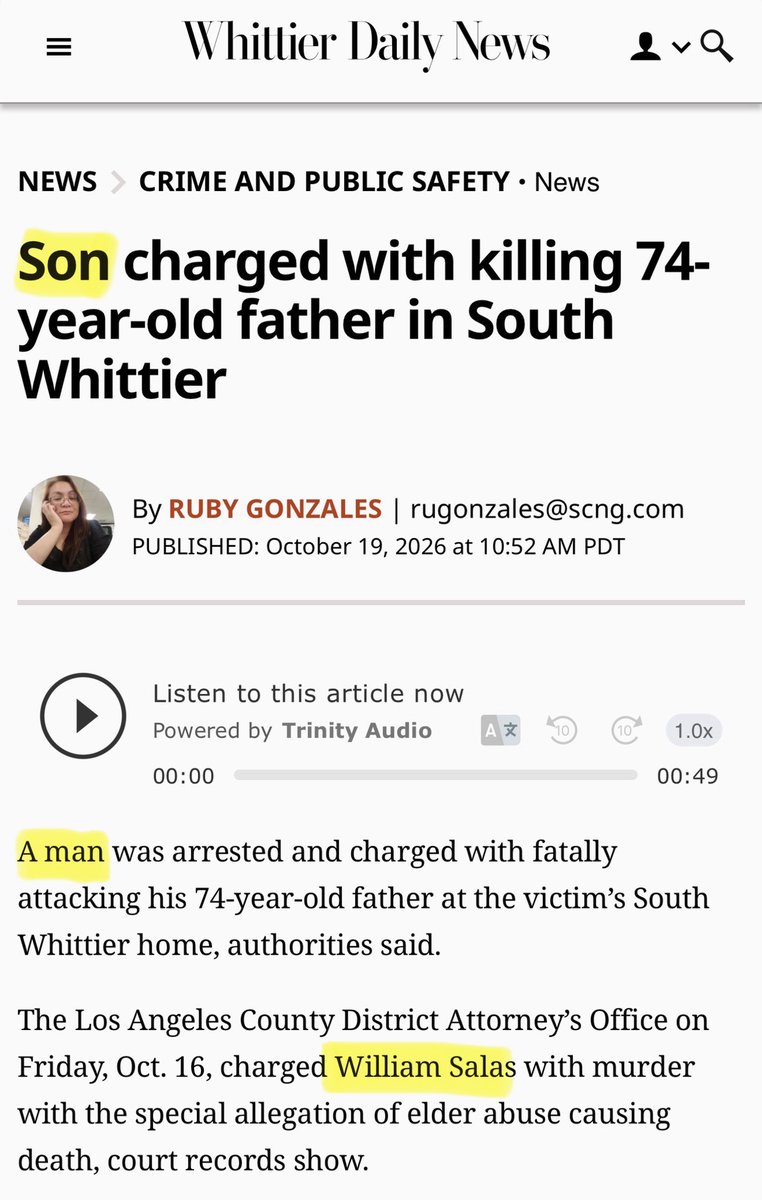
More trans parricide? Media is reporting that a Los Angeles “man” had brutally beaten “his” elderly father, pictured below, to death at a home in South Whittier.
But on Oct. 13, Saul Salas, 74, wasn’t killed by his son. The suspect who was arrested is his daughter, a woman who identifies as trans and uses the name “William.”
A family friend contacted me after being fed up about the cover-up in the press.
As I reported in my new book, The Zizians, there is a growing new phenomenon of trans people, both male and female, killing their parents. They often justify their violence through accusations of “transphobia.”
https://t.co/ob7bSGrwM6