Chandan Singh Padiyar |
SEBI Registered Investment Advisor |
INA000008251
Flat Fee Advice only Model |
Helping people Learn Personal Finance in Simple Manner |
A client who works in RBI brought this to my notice:
Indian residents may not invest in ETFs like VWRA or VFEA, which in turn invest in India.
The wording of Para. 20(2) in RBI's Master Direction – Overseas Investment is relevant here:
https://t.co/WbBybewNeo
It prohibits "The financial commitment by a person resident in India in a foreign entity that has invested or invests into India at the time of making such financial commitment or at any time thereafter, either directly or indirectly, resulting in a structure with more than two layers of subsidiaries is not permitted in accordance with rule 19(3) of the OI Rules."
Vanguard Fund PLC's prospectus mentions it even more explicitly:
https://t.co/RUrWLGx93K
It states:
"Due to Indian regulatory requirements, no Shares of the Vanguard FTSE All-World UCITS ETF, the Vanguard FTSE Emerging Markets UCITS ETF or the Vanguard FTSE All-World High Dividend Yield UCITS ETF shall be knowingly offered to, directly or indirectly, sold or delivered within India or, transferred to, purchased by, held for or on the account of or for the benefit of (i) a “person resident in India” (as such term is defined in the Foreign Exchange Management Act, 1999 as may be amended or supplemented from time to time), or, (ii) any other entity or person disqualified or otherwise prohibited from accessing the Indian securities market under applicable laws, as may be amended from time to time."
When checked with IBKR, they replied:
"Product specific guidance and other matters needs to be consulted with your tax and financial adviser."
ICICI Direct hasn't responded for over 10 days now. (I have an IBKR account through ICICI Direct)
If you check with AI, it answers 'Yes' as well as 'No', depending on how you frame the question.
Can anyone help find a clear answer to this?
I am not recommending these ETFs until I find a clear answer.
Healthcare in India is becoming a money making machine.
A friend’s grandmother is in ICU for the last 4 days.
Daily medicine cost alone is around 40–50K.
He is not allowed inside ICU.
He cannot see the treatment.
He cannot see which medicines are actually being used.
He can only stand outside and keep paying.
Medicines go from pharmacy to ICU.
Families don’t know what is used, what is not.
Maybe some goes back from the back door.
But there is no transparency. Only bills.
Private hospitals know families won’t argue when their loved one is in ICU.
This is not just treatment.
For many families, this is financial destruction in the name of healthcare.
@JioCare I use 399 prepaid plan every month, since yesterday the STB has stopped working, however the customer care is not registering the complaint stating that they cannot register complaint for stb issue as I am using 399 plan
How truly conflict-free advice looks
At the introductory stage, the adviser clearly explains how he works, his style of advice, what he offers, and what he does not. The prospective client can then decide whether the engagement makes sense.
He takes up only those engagements where he believes he can add more value than the fee he charges.
If another adviser is better suited to a client’s needs, he will say so and direct the client to that adviser.
He has no insecurity that if the client learns everything he knows, the client may decide to go DIY.
When a better option becomes available for the client, he brings it to the client’s attention, even if it reduces his own income.
He does not dilute the quality of his work to increase revenue.
He takes up only as much work as he can do justice to.
He does not create unnecessary complexity just to appear valuable.
He does not recommend something simply because it is fashionable or widely marketed.
He explains the limitations and uncertainties of any recommendation instead of presenting it with false confidence.
He is willing to say “doing nothing is fine for now” if that is the best course of action.
He does not push products, strategies, or changes simply to justify his fee.
He does not try to control the client’s decisions. He helps the client make better ones.
He does not try to create dependence; he wants the client to become more capable of making decisions over time.
He communicates in plain language, not jargon designed to impress.
He is comfortable saying ���I don’t know” when something is outside his competence.
He is comfortable when a client questions his recommendations.
When he makes a mistake, he acknowledges it openly.
And he is happy when the client becomes more knowledgeable over time.
@ActusDei There is No Battle as such,
Every one has their share based on the audience they address.
Everyone is complimenting each other - it's a huge market.
@canarabank My Father 80 years of age has got a notification for Re-KYC, he cannot visit the branch, does not have net banking or mobile banking, Branch is not providing door step kyc, what is a feasible option to get it done - please guide.
Thank You
I am incredibly proud to be a co-founder/supporter of this group. "Big things have small beginnings" - Lawrence of Arabia (1962)
https://t.co/txEokiKzGT
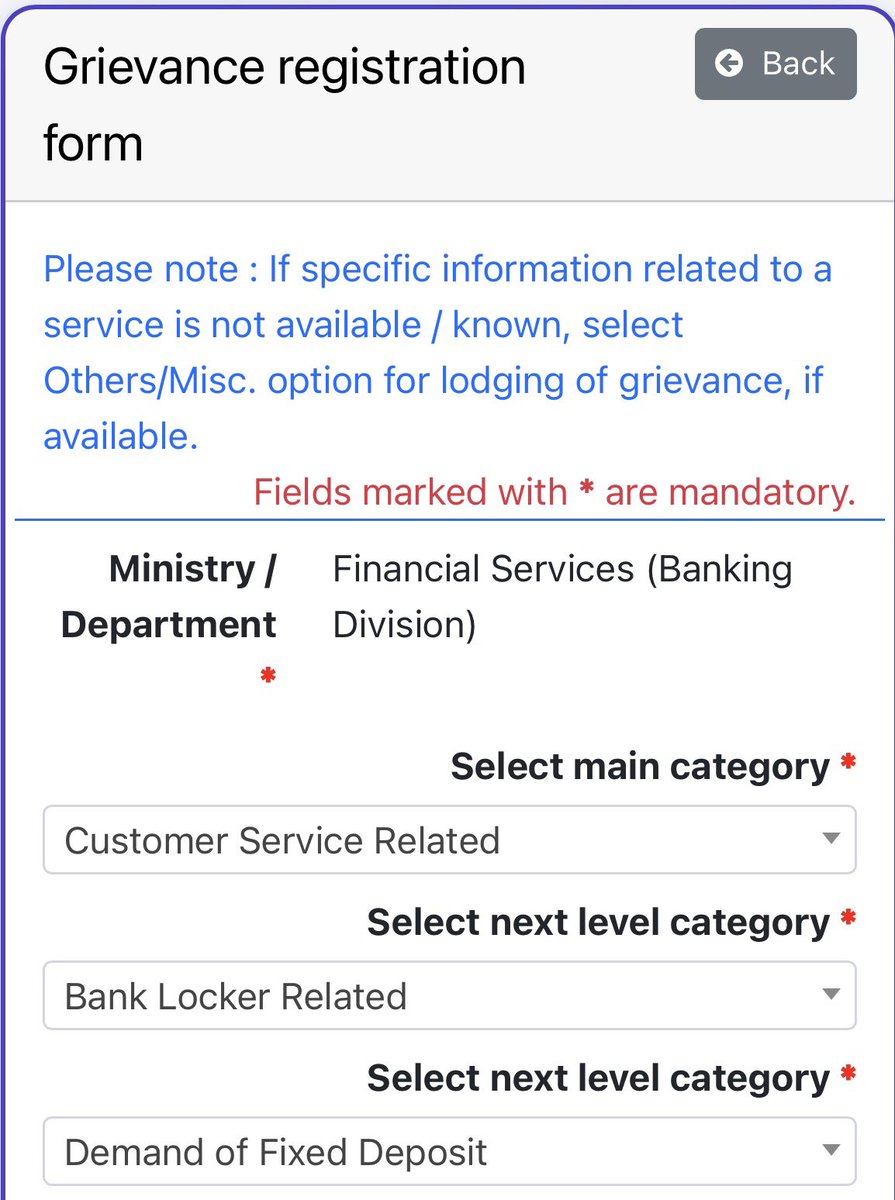
So I did what most people don’t:
I emailed the bank’s nodal officer
and filed a complaint on the PMO grievance portal.
The irony?
Even the PMO portal acknowledges this as a known issue it has a separate category for such complaints.
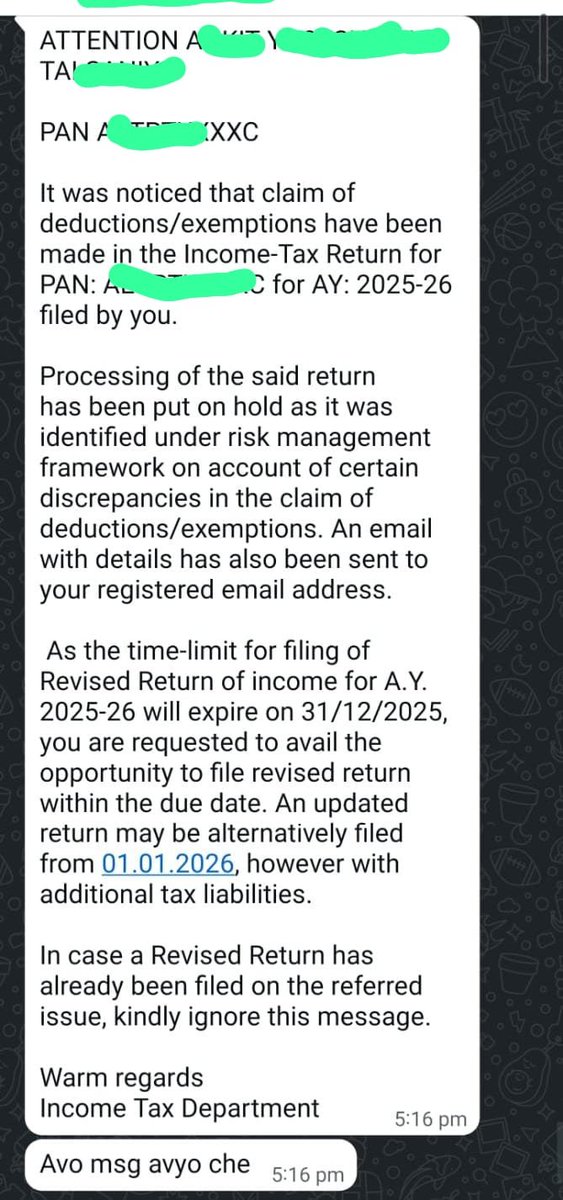
Dear @IncomeTaxIndia
Is This Intimation or Threat ?? Please Clarify
As this is intimation , wording should be polite and requesting Taxpayer to file ITR to avoid further consequences.
There may be a Thousands of reason for non filling of ITR which may be beyond the control of Taxpayer and This kind of Wording may leave Taxpayer in Fear and absolute Panic.
Improve The Wording They are Taxpayer not a Criminal or Murderer, They pay their hard earned Money for the development of this Country.
Kindly use respectfull and Polite word in Intimation & Notice.
Thank You.
Height of mis-selling!!
An HDFC Bank Relationship Manager sold three traditional life insurance policies to a woman with a total annual premium of Rs.17.5 lakh, while her annual income is around Rs.40 lakh. The most shocking part? She doesn’t even need life insurance. She is unmarried, has no financial dependents, and she is clear that she does not plan to marry.
She has already paid one year of premium and is now stuck in a terrible trap—neither can she afford to exit due to heavy losses, nor can she comfortably continue paying such a huge premium every year.
Received Income Tax Notice for Foreign Stocks via INDmoney?
Here is the Solution 👇👇(Read Full Thread in Comment)
🔁 Retweet Max to help other investors as well