@PenguinIndia The dust jackets of your hardbound books have become godawful these days. Rather than using such low-quality paper for the dust jackets, you might as well do away with the farce altogether.
Happy Mother's Day! Today, we celebrate the incredible women who have nurtured, inspired, and guided us through life's journey. To all the amazing mothers, thank you for your endless love and wisdom.💐
#MothersDay#Love#Gratitude
Among the best lessons I learned in 2023: The power of saying ‘No’ to many things. This has empowered me to say ‘Yes’ to the things I truly love.
#motivationmonday#successmindset#happiness
It’s easy to treat someone with respect when they’re your equal; treating everyone with respect, regardless of their status, requires a just and balanced mind.
#Mindfulness#empathy#inspiration
A: "Have you heard about the recent shipping route changes?"
B: "Yeah, now it takes longer for my packages to travel than my relatives visiting from overseas!"
A: "And with the truckers' strike in India, even local deliveries are taking a vacation!"
B: "Seems like the only thing moving fast these days are the news headlines!
#supplychainstruggles #economicimpact
I strongly believe that robotic surgeries will be a major advancement in healthcare, bringing numerous positive changes. However, a pressing concern is the inadequate insurance coverage for these surgeries compared to conventional ones.
Robotic surgeries boast several advantages: they allow for more precise operations, quicker discharges, and reduced ICU costs. These procedures offer a win-win for both patients and healthcare providers, not only in surgical precision but also in significantly reducing hospital stays.
Yet, robotic surgeries are typically 3 to 4 times more expensive than conventional ones, with costs varying across hospitals. The high expense can be attributed to the costly equipment and substantial annual maintenance charges.
As highlighted at the start of this post, a major barrier to making robotic surgeries widely accessible is the limited insurance coverage. Many insurers impose sub-limits for these surgeries in their policies. There are numerous instances where insurers advise clients to opt for conventional surgeries, leading to patients complying for fear of claim rejection.
For the long-term benefit of society, it's crucial that hospitals and insurers collaborate to reduce the cost of robotic surgeries, making them accessible to all societal strata. Additionally, the government and regulators should intervene by promoting domestic production of surgical robots and promoting medical robotics startups and reducing import duties and taxes in this regard.
#healthinsurance #healthtech #roboticssurgery
The attrition of talent is a universal concern across industries, sparking numerous discussions on mitigating its impact. This issue, complex and multifaceted, warrants a deep dive into its root causes.
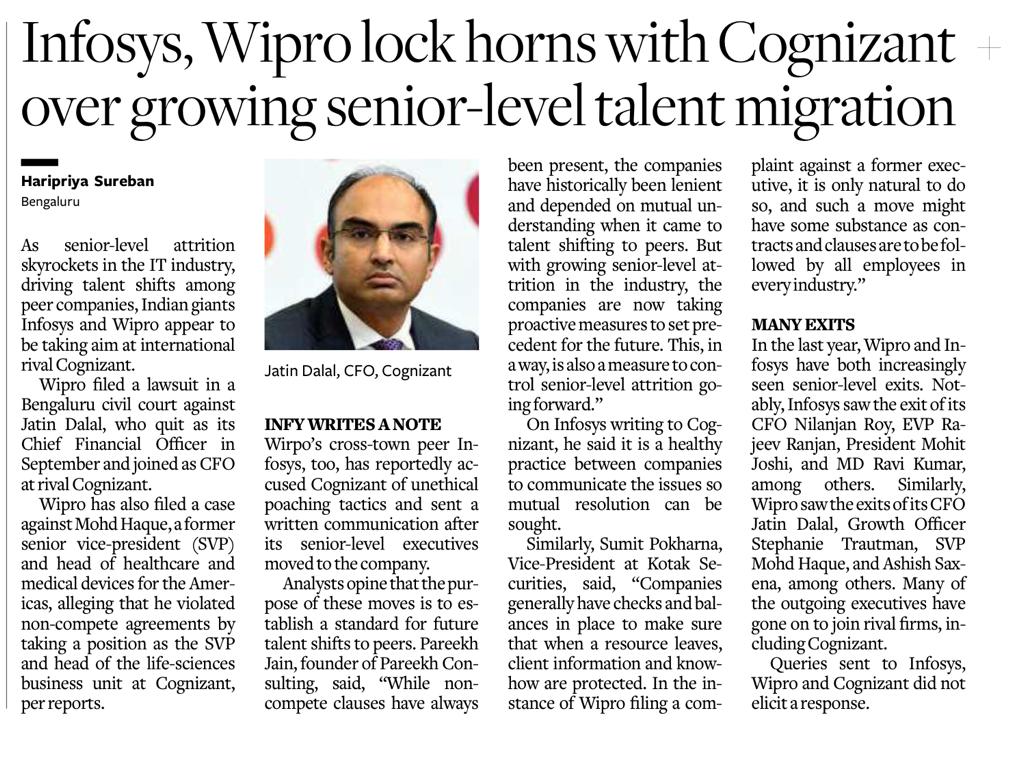
A case in point is the recent departure of senior-level talent from Infosys and Wipro, who have subsequently joined rival organizations. This scenario raises several key questions:
1. Are These Unethical Poaching Practices?
In the highly competitive business environment, the ethics of poaching talent can be subjective. Nonetheless, it's advisable for headhunters and recruiters to adopt industry-specific, sensitive practices. For example, many companies have established non-poaching agreements, ensuring they do not hire employees from each other under certain contractual conditions.
2. Legal Enforceability of Non-Compete Clauses
According to Section 27 of the Indian Contract Act of 1872 and Article 19(g) of the Constitution, any agreement that restrains a lawful profession or trade is void. Every citizen has the right to choose their profession or business. While non-compete clauses often face initial skepticism, courts have, in various instances, upheld them to protect employers' confidential information and trade secrets.
Case Laws:
- Gujarat Bottling Co. Ltd. v. Coca Cola Co. (1995)
- Mr. Diljeet Titus, Advocate v. Mr. Alfred A. Adebare and Ors.
3. The Shift in Companies' Stance on Non-Compete Clauses
When companies shift from leniency to stringency in enforcing non-compete clauses, the burden of proof lies with them. They must demonstrate how the employment of their former employees by competitors could be detrimental to their interests.
#talentattrition #legalinsights #noncompeteclauses
#workplaceethics #businessStrategy #careerMobility
It's always been surprising to me how food delivery apps like Zomato and Swiggy have maintained their duopoly for so long, despite charging hefty commissions of up to 35% per order. I believe such high commissions significantly erode the profits of restaurants.
In the past 2-3 years, direct food delivery platforms like Thrive and Peppo emerged as alternatives to Swiggy and Zomato. However, none have managed to replicate the impact or capture a significant market share.
The challenges faced by these direct food delivery platforms include:
> Inability to compete with the deep discounting strategies of Swiggy and Zomato.
> Reliance on third-party delivery platforms, which often struggle to provide delivery agents during peak times.
> Limited restaurant options compared to the extensive choices offered by Swiggy and Zomato.
A closer examination reveals a stalemate where no stakeholder - be it delivery partners, restaurants, or aggregators - is making substantial profit.
It's unfortunate that even though these direct delivery platforms charge significantly lower commissions, they haven't taken off as expected.
The way forward for these direct delivery platforms could involve:
> Increasing their advertising and marketing budgets.
> Fostering long - term associations with local businesses and restaurants.
> Exploring the bundling of ancillary services.
> Investing more in delivery infrastructure, including employing more reliable delivery agents.
#foodtech #restaurantbusiness #startupindia #digitaltransformation #ecommerce #innovation #businessstrategy #sustainablebusiness
It's fascinating to observe the burgeoning affinity of the upper middle class towards sending their wards to international schools. A clear trend emerges with a rapid 31% increase in the number of International Baccalaureate (IB) affiliated schools since 2019. Delving into the reasons for this surge reveals layers that go beyond the surface.
Reasons for the Surge:
- Aspirations among the urban elite and upper middle classes.
- The easy availability of loans.
- Perception of an IB education as a status symbol.
- The diminishing vigor in the existing educational system.
- The esteemed positioning of Ivy League and international universities.
Considering the lucrative potential of the Indian market, the IB board is set to expand its reach. It aims to claim a larger share of the educational ecosystem in India by expanding into Tier-2 cities and approving 100 more schools in the country.
Challenges Ahead:
- A shortage of adequately trained teachers in the IB curriculum.
- Astronomical fees ranging from Rs 2 lakh to Rs 10 lakh per annum.
- The IB curriculum's no-examination approach, which is challenging for a marks-obsessed society like India.
Concerns about how students might adapt to assessment-focused systems if they continue their education in India after graduating from an international school.
Morale:
The IB education system emphasizes self-development by fostering self-reliance and inquiry among students, which is commendable. However, educational systems evolve based on regional preferences and cultural ethos. Choosing the IB Education system solely as a status symbol, without weighing its pros and cons, can significantly impact students in the long term.
#educationtrends #globallearning #futureofeducation #innovativelearning #educationreform
I had gone through a very interesting article in The Hindu, stating how funding winter—minimal capital infusions—for a prolonged period in 2022-2023 helped companies become more disciplined and aided them in achieving greater profitability. Yes, you heard it right!
Deductions:
- Gone are the days of funding for companies with mindless valuations and minimal profitability.
- Investor trends are shifting towards startups with sustainable business models and well-defined MVPs.
- Many startups pivoted their business models when the funding inflows became minimal to plug financial leakages.
- Profitability increased owing to lesser cash burn.
- Companies started focusing on their niche areas, culling unprofitable verticals.
Inference:
When push comes to shove, it’s all about surviving at any cost.
#funding #fundingwinter #capitalraising #businessmodel #investmenttrends #corporateresilience #startupshift #startupsurvival