On 9/11, I was an award-winning photojournalist. I covered Ground Zero the 1st week, sleeping there 2x at firehouse 10/10. The site was clearly toxic. Ground Zero smelled for weeks. It's a SHAMEFUL long cover-up about toxicity & denial there were records.
https://t.co/Ld3nz64aZY
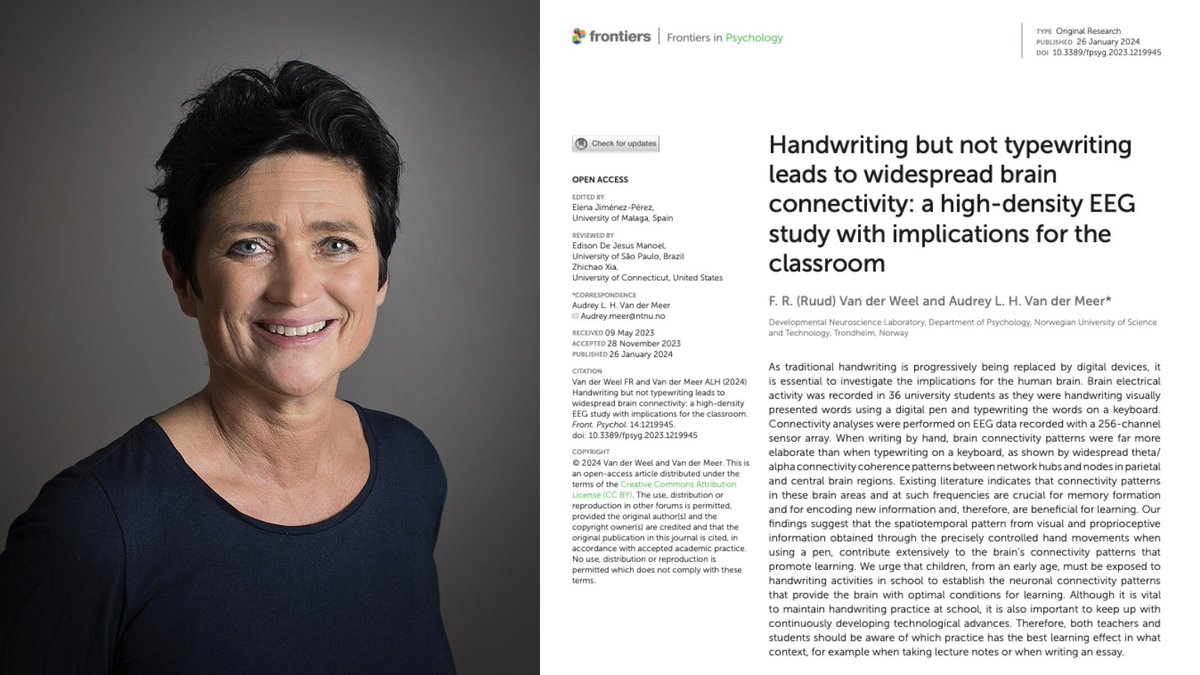
A Norwegian neuroscientist spent 20 years proving that the act of writing by hand changes the human brain in ways typing physically cannot, and almost nobody outside her field has read the paper.
Her name is Audrey van der Meer.
She runs a brain research lab in Trondheim, and the paper that closed the argument was published in 2024 in a journal called Frontiers in Psychology. The finding is brutal enough that it should have changed every classroom on Earth.
The experiment was simple. She recruited 36 university students and put each one in a cap with 256 sensors pressed against their scalp to record brain activity. Words flashed on a screen one at a time.
Sometimes the students wrote the word by hand on a touchscreen using a digital pen, and sometimes they typed the same word on a keyboard. Every neural response was recorded for the full five seconds the word stayed on screen.
Then her team looked at the part of the data most researchers had ignored for years, which is how different parts of the brain were communicating with each other during the task.
When the students wrote by hand, the brain lit up everywhere at once.
The regions responsible for memory, sensory integration, and the encoding of new information were all firing together in a coordinated pattern that spread across the entire cortex. The whole network was awake and connected.
When the same students typed the same word, that pattern collapsed almost completely.
Most of the brain went quiet, and the connections between regions that had been alive seconds earlier were nowhere to be found on the EEG.
Same word, same brain, same person, and two completely different neurological events.
The reason turned out to be something nobody had really paid attention to before her work. Writing by hand is not one motion but a sequence of thousands of tiny micro-movements coordinated with your eyes in real time, where each letter is a different shape that requires the brain to solve a slightly different spatial problem.
Your fingers, wrist, vision, and the parts of your brain that track position in space are all working together to produce one letter, then the next, then the next.
Typing throws all of that away. Every key on a keyboard requires the exact same finger motion regardless of which letter you are pressing, which means the brain has almost nothing to integrate and almost no problem to solve.
Van der Meer said it plainly in her interviews.
Pressing the same key with the same finger over and over does not stimulate the brain in any meaningful way, and she pointed out something that should scare every parent who handed their kid an iPad.
Children who learn to read and write on tablets often cannot tell letters like b and d apart, because they have never physically felt with their bodies what it takes to actually produce those letters on a page.
A decade before her, two researchers at Princeton ran the same fight using a completely different method and ended up at the same answer. Pam Mueller and Daniel Oppenheimer tested 327 students across three experiments, where half took notes on laptops with the internet disabled and half took notes by hand, before testing everyone on what they actually understood from the lectures they had watched.
The handwriting group won by a wide margin on every question that required real understanding rather than surface recall.
The reason was hiding in the transcripts of what the two groups had actually written down.
The laptop students typed almost word for word, capturing more total content but processing almost none of it as they went, while the handwriting students physically could not write fast enough to transcribe a lecture in real time, which forced them to listen carefully, decide what actually mattered, and put it in their own words on the page.
That single act of choosing what to keep was the learning itself, and the keyboard had quietly skipped the choosing and skipped the learning along with it.
Two studies. Two countries. Same answer.
Handwriting makes the brain work. Typing lets it coast.
Every note you have ever typed instead of written went into your brain through a thinner pipe. Every meeting, every book highlight, every idea you captured on your phone instead of on paper was processed at half depth.
You did not forget those things because your memory is bad. You forgot them because typing never woke the part of the brain that would have made them stick.
The fix is the thing your grandmother already knew.
Pick up a pen. Write the thing down. The slower road is the faster one.
A staff member for Elon Musk’s Department of Government Efficiency, who was in charge of flagging grants for “DEI,” struggled to define the term during a lawsuit deposition.
Justin Fox was assigned to the National Endowment for the Humanities (NEH) and described his role as highlighting any projects that would be disqualified for federal funding because they promoted “diversity, equity and inclusion,” as defined by Donald Trump’s executive order of January 2025.
Click the link in bio for more 🔗
@Independent Too stupid to remember? Too spineless to answer? Regardless, he's proof of the MAGA world inversion of DEI where mediocre white yes-men get the job.
@lilyslynch Thanks for the reminder. I was in Timisoara on my first big story during the short Romanian Revolution and remember watching the court trial & execution of Ceaucescu on TV on Christmas day. Or better put, watched the Romanians watch it over and over.
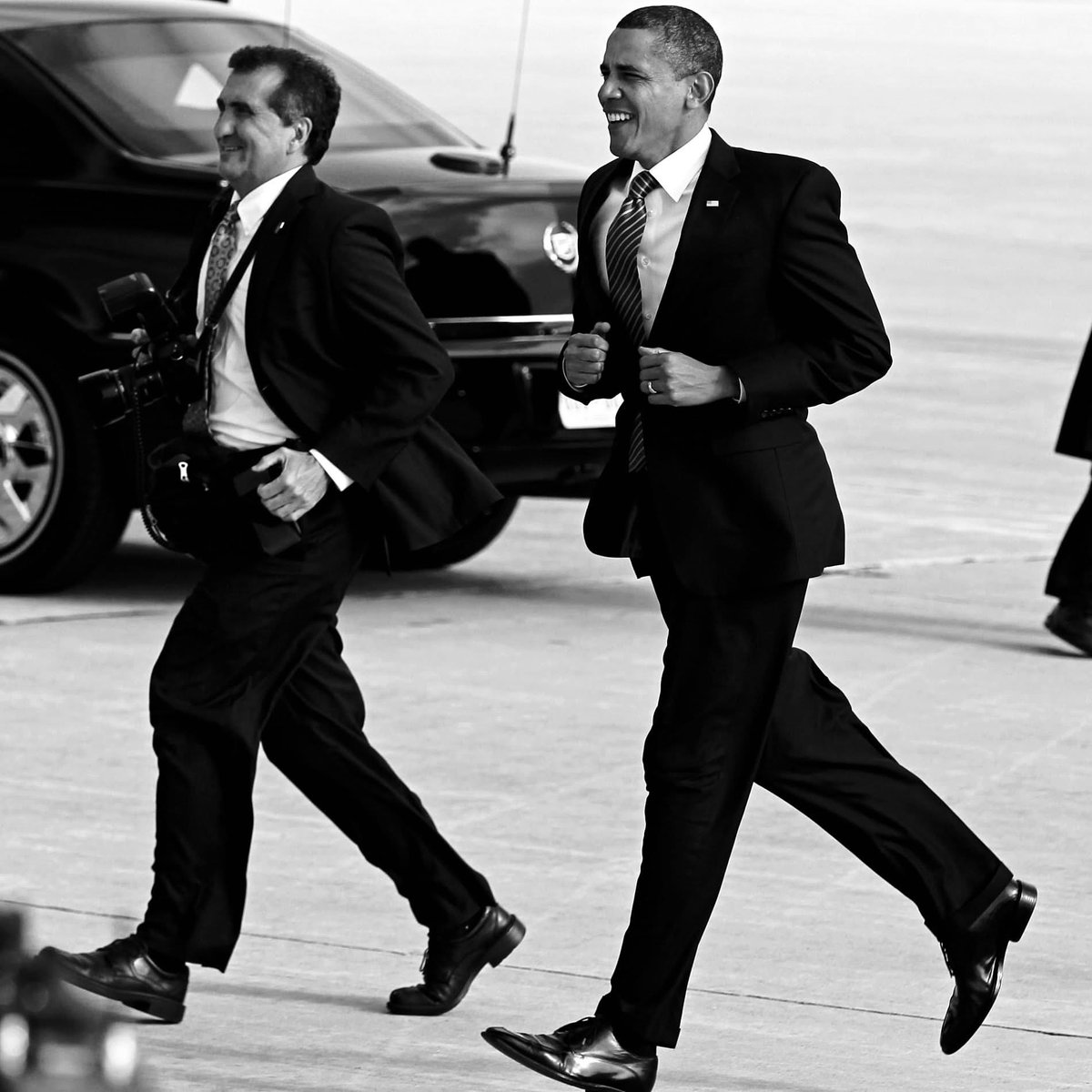
The history books quietly bypassed is that Barack Obama, during the most pressure-saturated nights of his presidency, would retreat alone to the Treaty Room on the second floor of the White House residence — not to strategize, not to take calls, but to handwrite personal letters to ten ordinary American citizens every single night, a practice he maintained with almost monastic devotion across all eight years, selecting the letters himself from the 40,000 that arrived daily at the White House, and his longtime correspondence director Fiona Reese confirmed that Obama would often weep privately while reading certain letters, folding them carefully before writing responses so personally detailed and emotionally present that recipients frequently described the experience of receiving them as the most significant moment of their lives, with one Ohio steelworker writing back to say that Obama's letter had physically stopped him from making a decision that would have permanently altered his family's future. What makes this practice almost unbearably moving is the detail that surfaced later — Obama never used a computer for these letters, always a black felt-tip pen, always legal yellow paper first as a draft, always rewritten onto White House stationery by hand a second time, because he believed, as he told historian Doris Kearns Goodwin in a rare private conversation later recounted in her 2018 work, that the physical act of pressing pen to paper forced a quality of attention that typing simply could not replicate, a philosophy rooted in his years as a constitutional law professor at the University of Chicago from 1992 to 2004 where he developed the conviction that democracy only functions when its leaders remain genuinely, uncomfortably close to the specific gravity of individual human suffering rather than processing it from behind the insulating distance of institutions and screens."
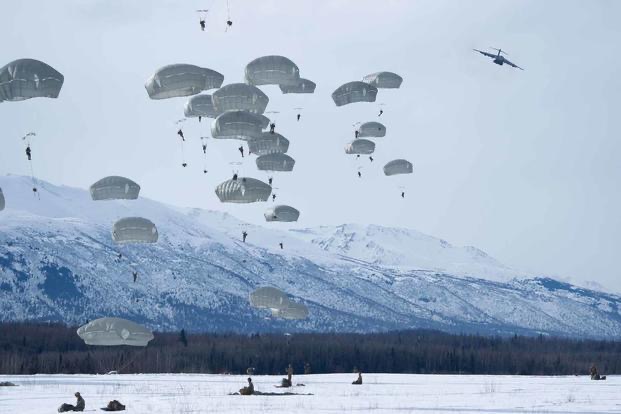
#Greenland ALERT: Multiple news sources in DC and Alaska are reporting the 11th Airborne Brigade has alerted two battalions, 1,500 troops, to be ready to move to "Minnesota." This is a really bad attempt at Strategic Deception.
I warned several times this year that alerting this specific unit for deployment is a High confidence, UNAMBIGUOUS indicator of a Greenland invasion.
This also means SOF units are very likely quietly training and mobilizing for the mission to seize Greenland by force.
Hang on. Let's see if exposure makes Trump back down.