Statement Regarding the Keeta Security Incident
To the party responsible for the recent attack against Keeta:
Our investigation has progressed substantially, and we have collected evidence identifying the party responsible for the attack.
This includes IP addresses associated with your internet connection and infrastructure used during the attack, including VPN and VPS services; the user agent and technical environment used to make unauthorized requests; email addresses associated with the activity; software and infrastructure providers used in carrying out the attack; and additional identifying information that we are not disclosing publicly at this time. All relevant evidence has been preserved and is being provided to the appropriate parties.
We are offering you an opportunity to resolve this matter directly.
Return all funds obtained as a result of the Keeta attack within 72 hours of this statement. We will accept repayment in KTA, ETH, or USDC. Funds can be returned to the following address on Base:
0xc439eba7E79496F42e996F7EbD5835934f56bec6
Upon the complete return of the funds, we are willing to discuss an appropriate bug bounty in recognition of identifying the vulnerability and work toward resolving the matter without pursuing further legal action.
You may contact [email protected] to discuss the bug bounty and coordinate the return of funds.
This offer is conditioned on the full return of the funds and cooperation necessary to verify that the matter has been resolved.
If the funds are not returned within the 72-hour period, we reserve all rights and will continue pursuing available legal and recovery measures.
We encourage you to use this opportunity to resolve the matter constructively.
Standing firmly with @schenkty and the entire @KeetaNetwork team. $KTA
Really appreciate the clear, timely updates and the transparency so far, it means a lot.
Please keep going further: ship that comprehensive report soon, lock in the extra safeguards and make every impacted participant whole.
We’ve got your back. Hope the network will come back stronger.
Keeta Security Incident Update:
We have identified the root cause of the security incident and are currently testing a patch. Importantly, we have confirmed that the root cause was an isolated issue within the affected component and does not impact Keeta’s anchor systems or any externally connected systems. All KTA on Base remains unaffected.
In parallel, we are evaluating additional precautionary safeguards that can be implemented to further protect the network and prevent a similar incident from occurring in the future.
We are preparing a comprehensive technical report that will detail the exact issue, timeline of events, our response, and the measures being implemented moving forward. We will publish this report as soon as we have completed our investigation and verified all relevant information.
Keeta Mainnet will remain in its current read-only state while this work is completed. We intend to return Mainnet to full operation once the patch has been thoroughly tested and the appropriate additional safeguards are in place.
We are also actively evaluating the best approach to fully reimburse all impacted participants. There are technical and logistical complexities associated with each option, and we want to ensure the process is secure, accurate, and comprehensive.
Our focus remains on ensuring the network is secure, returning to full operation, making all impacted participants whole, and being fully transparent about what occurred and the steps we’re taking moving forward.
We appreciate the community’s continued patience and support as we work through this process.
We’ve built an extensive and rapidly growing pipeline of fintechs, financial institutions, and businesses looking to integrate Keeta and optimize their financial flows using commercial money, stablecoins, cryptocurrencies, and other assets.
Over the past 45 days, we’ve transitioned internally from building the foundation to facilitating usage. The entire core and extended team is now focused on enabling participants who are ready to contribute to and consume services on Keeta and drive meaningful volume through the network.
Timing ultimately depends on third parties managing their own roadmaps, but the pipeline continues to expand and demand has kept us incredibly busy. That’s also why we’ve been relatively quiet publicly. As each integration progresses, it will be announced :) keeta:native
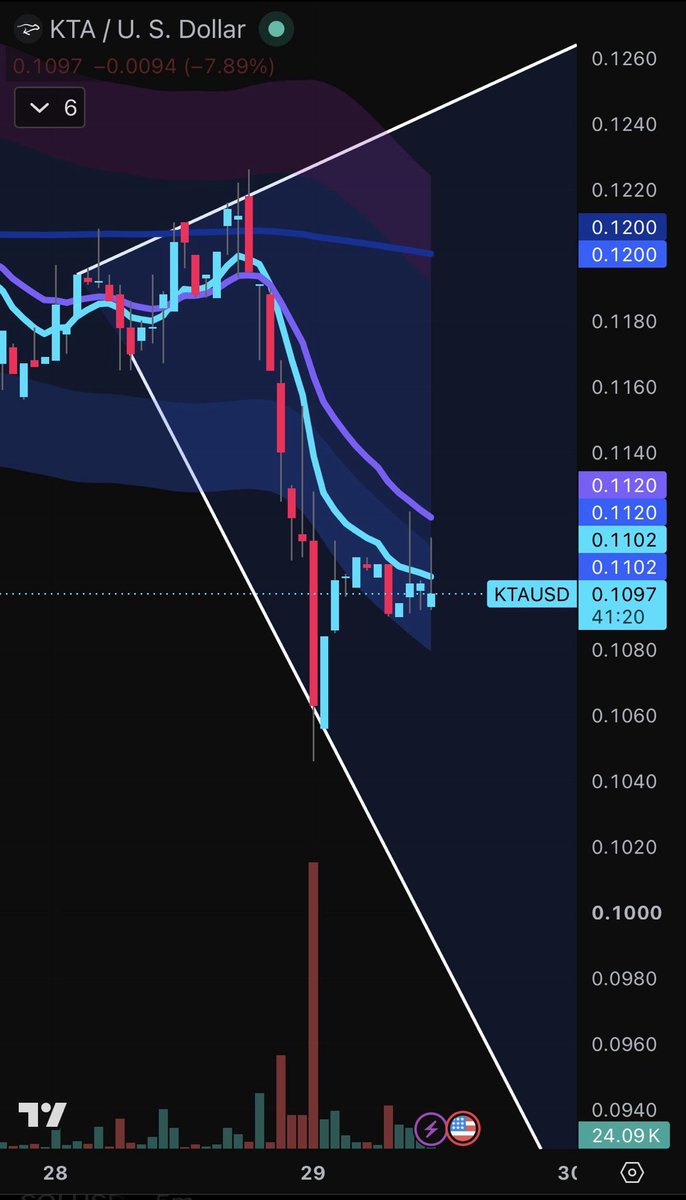
An early whale dumped a huge amount of KTA last night.
So what?
If I’m driving to Florida and the car next to me takes an exit in Kentucky, it doesn’t change where I’m going.
Someone else deciding to exit their position doesn’t change the fundamentals of the project.
The banking infrastructure is still there.
The regulated digital fiat is still there.
The LayerZero integration is still being built.
The ASK Group partnership is still there.
The seller changed their plans.
I haven’t.
@KeetaNetwork $KTA
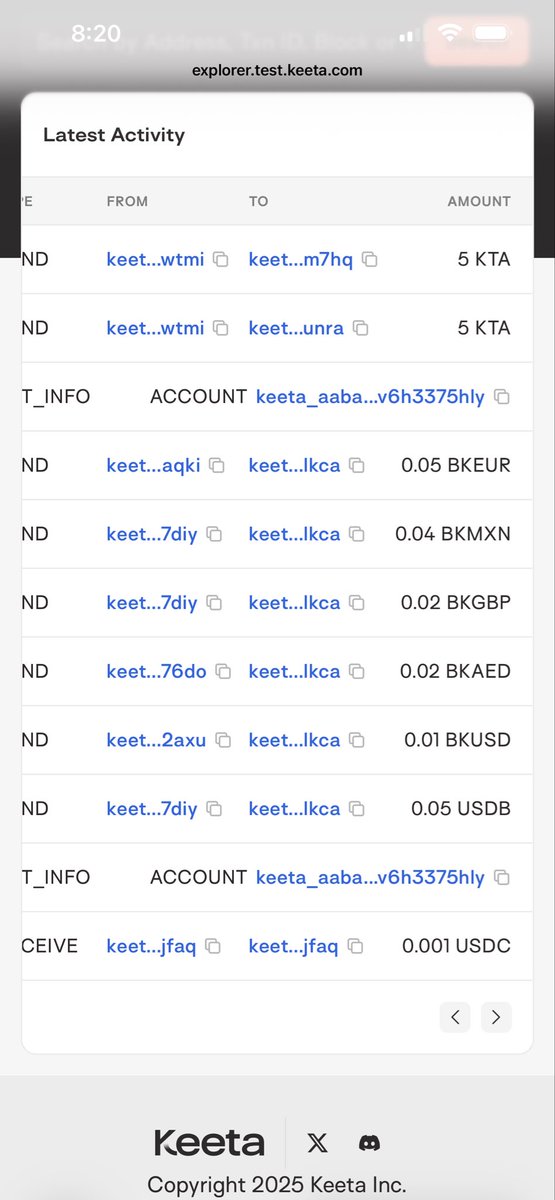
Keeta testnet activity is up 520% today and is sitting at the top of Chainspect’s activity leaderboard.
Before anyone gets too excited, testnet activity by itself doesn’t mean adoption. Transactions are free, so the number alone doesn’t tell us much.
I was more interested in what was actually happening.
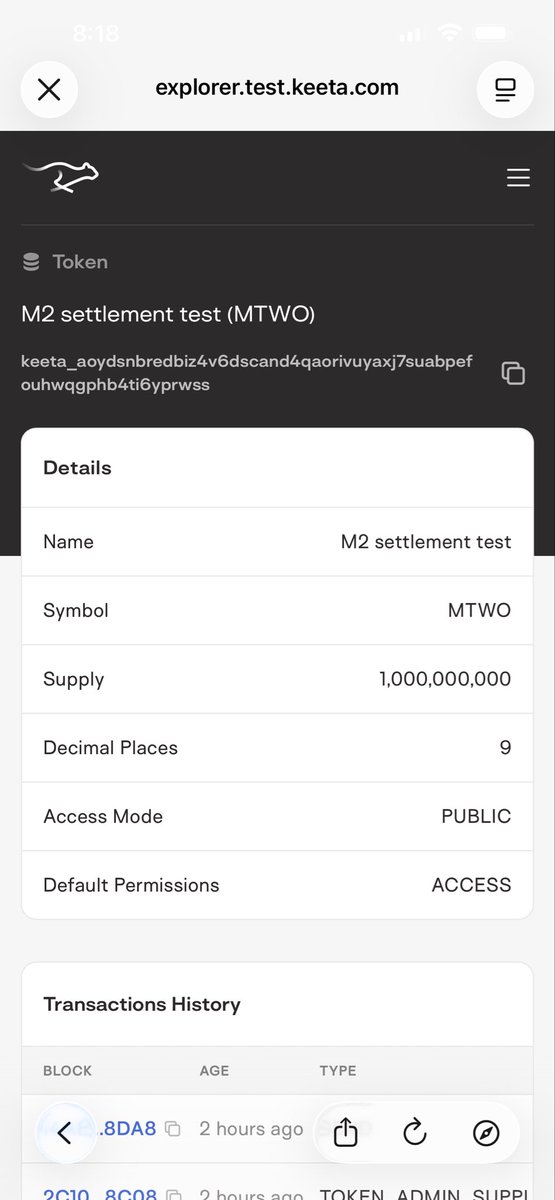
A new token called M2 settlement test (MTWO) was created a couple hours ago with a 1 billion supply. Shortly after, 793.1 million MTWO was transferred into a storage account, followed by permission updates.
At the same time, we’re seeing multiple BK currencies including BKUSD, BKEUR, BKGBP, BKMXN, and BKAED moving around testnet.
What’s interesting is those BK-prefixed currencies aren’t random anymore. They ended up being the Keeta/Bivo stablecoins announced for the LayerZero integration. Seeing them continue to move around testnet makes it look like the team is actively working on getting that integration ready for use.
Does this prove anything? No.
But it’s another data point that the team is continuing to ship and test in public.
The name “M2” could just be an internal test name. M2 is also the economics term for broad money, but whether that’s intentional or just a coincidence is impossible to know.
Either way, I’d rather spend my time watching what they’re shipping than arguing over the daily price chart.
@KeetaNetwork $KTA
Think about where most blockchain projects are about a year after launch.
Most have a white paper, a roadmap, and a Discord talking about what they’re going to build.
Keeta already has live payment rail infrastructure with regulated banking, built-in KYC and AML, digital fiat in nine currencies, and now with LayerZero connects into the broader Web3 ecosystem.
On July 9, in their blog post, they explained how network fees work, including how a portion of resolver fees is intended to be used for KTA burns.
Now Ty has confirmed that revenue generated from KUSD’s reserves will support KTA buyback mechanisms rather than paying yield directly to customers.
That’s now two separate value accrual mechanisms for KTA.
One tied to network activity.
One tied to stablecoin reserves.
It’s hard not to notice this seems intentional. While one of the biggest debates around the CLARITY Act has been stablecoin yield, Keeta’s design routes reserve revenue toward KTA buybacks rather than paying yield directly to holders.
The tokenomics just keep getting stronger.
At this point, I’m beginning to wonder what else they have up their sleeve.
@KeetaNetwork $KTA
https://t.co/EsqM3X3rfT
KUSD, and our broader fiat infrastructure, is built for regulated financial movement where many Web3-focused stablecoins have fallen short. Compliance isn’t optional for the institutions we work with. We’ve heard firsthand from our partners that capabilities like built-in KYC are essential for their real-world adoption.
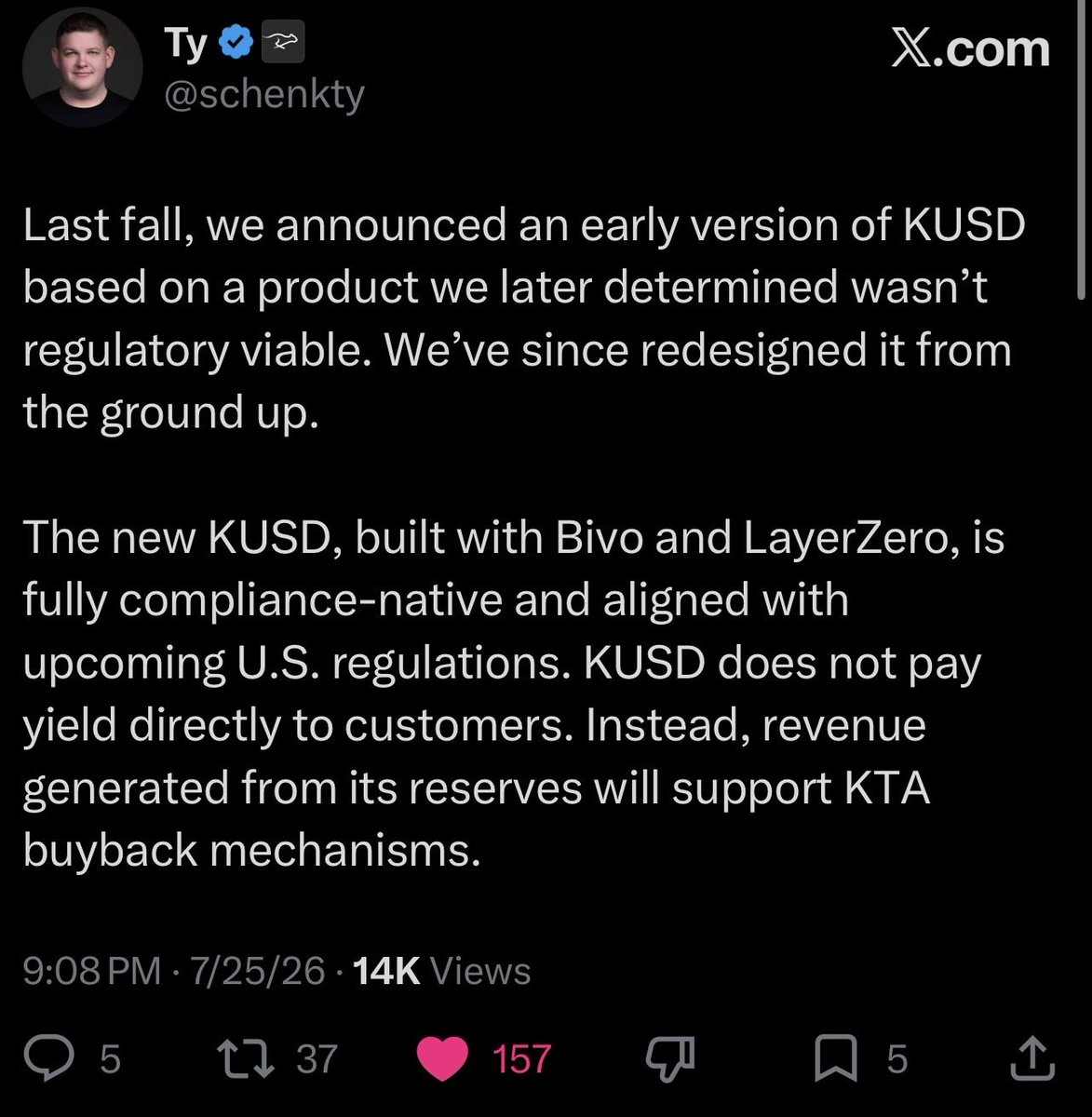
Last fall, we announced an early version of KUSD based on a product we later determined wasn’t regulatory viable. We’ve since redesigned it from the ground up.
The new KUSD, built with Bivo and LayerZero, is fully compliance-native and aligned with upcoming U.S. regulations. KUSD does not pay yield directly to customers. Instead, revenue generated from its reserves will support KTA buyback mechanisms.
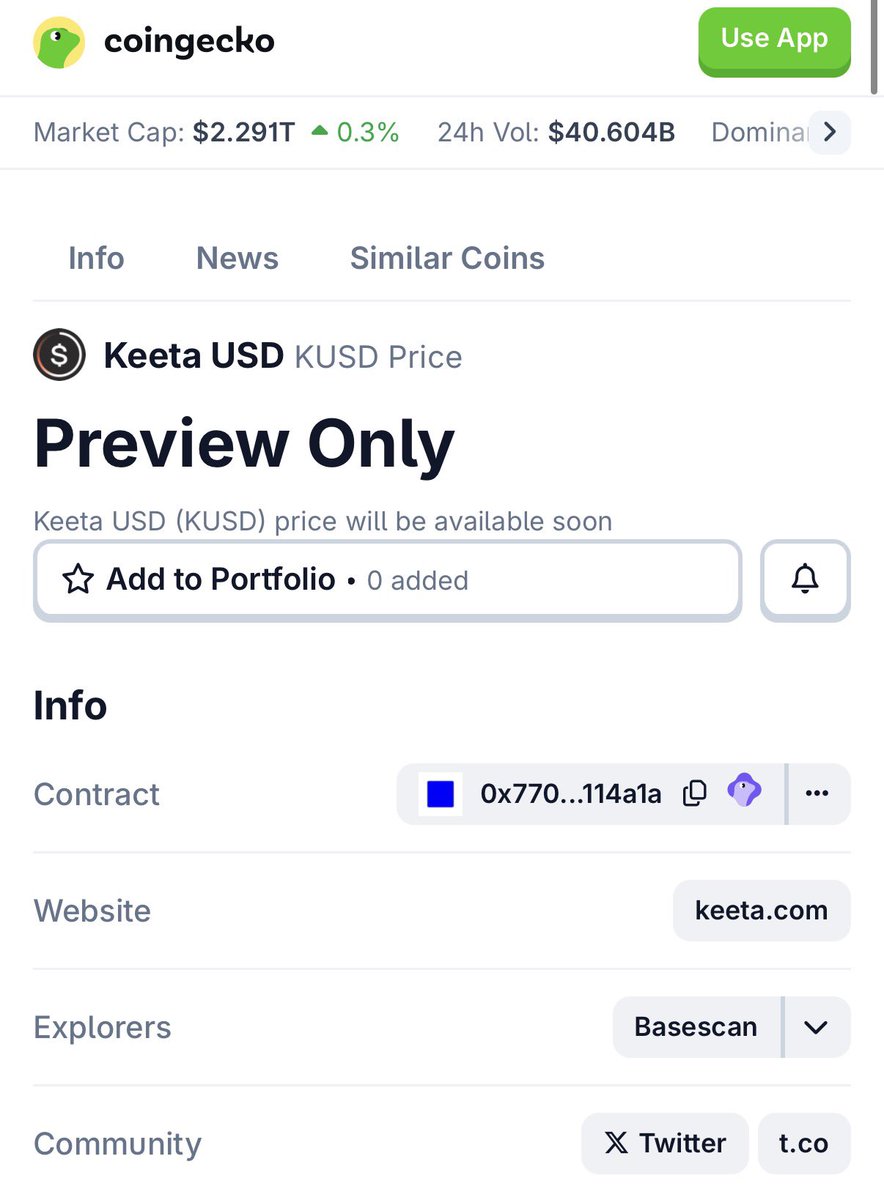
Following @GeckoTerminal’s Keeta $KTA integration, CoinGecko is already listing 9 of the upcoming “K” stablecoins. The assets, released in collaboration with @LayerZero_Core, have no activity so far – but this may signal a faster release timeline than previously expected.
The LayerZero news is getting read as a stablecoin partnership and I think that undersells what happened.
Pushback I keep seeing is that LayerZero already connects 150+ chains, so being one more of them means nothing. True, if that's what this was. But the direction is reversed. LayerZero is coming in as an anchor inside Keeta, not Keeta showing up as just another endpoint on LayerZero.
That matters because OFT is transport, and transport is the commoditized part. The scarce part is issuance. Minting tokenized commercial bank deposits, backed through a licensed money transmitter, needs identity and compliance sitting at the protocol layer instead of bolted on afterwards. Almost none of those 150 chains can originate that.
The part many seem to forget however. Anchors are discovered through the Globetrot Resolver, and every official Keeta product is required to route through it. Globetrot puts a basis-point fee on FX and asset-movement volume through the Resolver, payable in KTA, with a portion of that revenue used to buy and permanently burn KTA.
So two weeks after building a fee-burn-mechanism around anchor volume, the team announces an anchor whose entire job is moving multi-currency bank money across chains.
Currency list says the same thing. USD, EUR, JPY, CNY, GBP, CAD, MXN, AED, HKD. Nobody trades MXN or AED pairs on a DEX. Those are trade and remittance corridors, and AED lines up with the ASK Group JV for Gulf oil, gold and copper, because commodities settle in something.
Burns only matter if volume actually shows up. But the ordering hasn't looked accidental for a while.
$KTA
I need you to stop scrolling right now.
Because what just dropped between @KeetaNetwork and @LayerZero is not just another partnership announcement.
This is the moment regulated money goes omnichain. Forever.
Let me break it down. 👇
[CARD 1 The Partnership]
A month ago, I sat here and asked a hypothetical.
What would a LayerZero x Keeta partnership actually look like?
I reasoned through it. Settlement layer. Distribution layer. Two pieces of the same puzzle.
Yesterday @KeetaNetwork and @LayerZero made it official.
The exact words they used?
"Where Keeta operates as the Layer 1 of record for regulated, fiat-backed assets, LayerZero operates as the connective tissue across blockchains."
And what comes next is bigger than most people realise.
Here's why this is a watershed moment for the entire crypto industry.
@LayerZero isn't some mid-tier bridging protocol. These people are the actual plumbing of Web3.
61% of ALL stablecoins run through LayerZero infrastructure.
Let that land for a second.
Not some stablecoins. Not most stablecoins. 61% of every single stablecoin that moves cross-chain.
And they own 85% of the entire cross-chain transaction market after acquiring Stargate Finance earlier this year.
[CARD 2 The Volume Numbers]
Look at that growth curve on Card 2.
$0 to $10 billion took 430 days.
$100 billion to $150 billion took 134 days.
The flywheel isn't spinning up. It's already at full speed.
And Keeta just got added to the engine.
$260 BILLION in total volume. 170+ blockchains. 830+ tokens.
@KeetaNetwork is now among them.
Now here's where it gets really interesting. Because what Keeta is launching isn't just another token bridge.
They've created something the market has never seen before.
Keeta Stablecoins.
Not USDC. Not USDT.
Those are stablecoins backed by treasury bills and cash reserves. Fine products. But not what institutions actually need at the treasury level.
Keeta Stablecoins are tokenised commercial bank money.
Actual bank deposits. 1:1. Held through Bivo, a US licensed money transmitter (NMLS #2572288).
That's the difference between a receipt for money and actual money.
[CARD 3 What Keeta Stablecoins Actually Are]
And because they're built on LayerZero's OFT standard there's no wrapping. No bridge. No synthetic version sitting on a different chain.
One canonical supply. Moving natively across Keeta, Ethereum, Solana and Base.
The same regulated bank money wherever institutions operate.
In 9 currencies by end of this month.
🇺🇸 USD 🇪🇺 EUR 🇬🇧 GBP 🇯🇵 JPY 🇨🇳 CNY 🇨🇦 CAD 🇲🇽 MXN 🇦🇪 AED 🇭🇰 HKD
That's not a crypto product. That's institutional FX treasury management on public rails.
Now let me tell you why all of this is enormous for $KTA specifically.
Follow this logic because this is the mechanism that matters.
Right now a consortium of major US banks is building a tokenised deposit network.
You know what it is?
Closed. Banks only. Walled garden.
Same instruments. Same idea. But you only get access if you're in the club.
@KeetaNetwork and @LayerZero just built the open alternative.
Same institutional grade instruments. Available today. On public chains. To anyone.
If you're a bank, a payments company, a fintech, a sovereign wealth fund and you want open rails rather than a closed banking cartel there is now one clear answer.
And every transaction that flows through those rails generates KTA fees.
[CARD 4 The KTA Mechanism: Volume → Fees → Burns → Value]
Volume flows in from LayerZero's $260B+ network.
Every settlement on Keeta's L1 generates transaction fees paid in KTA.
A portion of those fees get burned. Permanently removed from the fixed 1 billion KTA max supply.
More institutional volume.
Fewer KTA in existence.
Fixed supply. Growing demand.
You don't need me to finish that sentence.
I want to be real with you as well because this account doesn't do hype without honesty.
The exact burn ratio isn't formally confirmed in Keeta's official documentation yet. Watch for that update.
And no specific bank names have been disclosed as live partners at this stage. Institutional adoption takes time to confirm publicly.
But here's what IS confirmed.
✅ @LayerZero co-announced this. Not a rumour. Not a leak.
✅ Keeta Stablecoins are live and deploying this month.
✅ Backed by Bivo, a licensed US money transmitter.
✅ 9 currencies across Ethereum, Solana, Base and Keeta L1.
✅ OFT standard. No bridge risk. One canonical supply.
✅ Both teams confirmed. More developments between Keeta and LayerZero are coming soon.
This is card 1 of a much bigger story.
One month ago I was reasoning through a hypothetical.
Yesterday it became real.
I've been covering $KTA since the beginning. The Visa Direct integration. The Google Cloud partnership. The ASK Group UAE commodities deal. The Keeta Personal super-app.
Every single piece has been building toward the same thing.
A single, compliant, high-speed settlement layer connected to everything.
This is what that looks like.
@KeetaNetwork × @LayerZero
Regulated bank money. Available everywhere.
The infrastructure of global finance just went omnichain.
Are you paying attention?
🔁 Retweet this thread so your timeline doesn't sleep on the biggest institutional blockchain partnership of 2026.
Follow @XCryptozc for Keeta Decoded. The only account breaking down $KTA with cards, data and no noise. @schenkty
#KTA #Keeta #LayerZero #RWA #Crypto #Web3 #KeetaDecoded
Stablecoins and commercial bank money are fundamentally different both in how they're backed and the nature of the liability.
Genius-ready stablecoins are fully reserve-backed 1:1 by US treasuries, cash, and other authorized liquid instruments. USDC, e.g., is a liability of Circle (historically not a bank, though this is evolving with their recent OCC approval to establish a bank).
Keeta Stablecoins are different in that they are a liability of the issuing institution (commercial bank, corporate treasury), backed by bank deposits held within the banking system via Bivo's infrastructure.
To be clear, deposits and private bank money power 95%+ of daily transactions in most advanced economies, so they are not only prevalent but critical for commerce.
Babe wake up, new partnership just dropped 😌
Currently handling roughly $5–8 billion in value transferred monthly, @LayerZero_Core securely connects different blockchains so tokens, can move between them natively with one unified supply.
More details below 👇
I don’t think most people realize how unique this announcement actually is.
This phrase from the LayerZero team pretty much sums it up:
“Commercial bank money goes omnichain for the first time ever.”
This isn’t just another project integrating with LayerZero.
According to today’s announcement, Keeta Stablecoins are backed 1:1 by actual commercial bank deposits held through Bivo, a U.S.-licensed financial technology platform with access to U.S. payment rails and a partner-bank network.
This isn’t just another USD stablecoin.
It’s regulated commercial bank money built for institutions that fits within existing KYC and AML requirements while still being able to move across blockchain ecosystems.
It’s also not just one currency. Keeta launched with nine tokenized fiat currencies: USD, CAD, EUR, GBP, AED, HKD, JPY, MXN, and CNY.
That means you’re not just tokenizing dollars. You’re creating the foundation for institutions to move, settle, and eventually exchange multiple regulated fiat currencies onchain. It creates a bridge between traditional finance and blockchain, where regulated Web2 financial infrastructure can interact with Web3 ecosystems instead of existing separately.
Think about what that could mean.
Say a bank deposits $500 million into Keeta. That becomes tokenized commercial bank money. Through LayerZero, those funds could move into an ecosystem like Ondo to purchase tokenized securities. When they’re done, the proceeds could flow back through LayerZero to Keeta and settle back into commercial bank deposits.
Then think about the ASK Group joint venture.
Before this, tokenized real-world assets from that partnership would’ve mostly lived on Keeta. Now imagine tokenized oil, gold, silver, copper, and other real-world assets issued on Keeta becoming accessible across Ethereum, Solana, Base, Arbitrum, Avalanche, BNB Chain, and the rest of the LayerZero ecosystem.
To me, that’s the real story.
LayerZero didn’t just add another chain for Keeta.
It potentially gave regulated commercial bank money, tokenized real-world assets, tokenized securities, and a multi-currency financial network access to one of the largest interoperable ecosystems in crypto.
That’s the kind of infrastructure institutions have actually been waiting for.
@KeetaNetwork $KTA @LayerZero_Core





![XCryptozc's tweet photo. I need you to stop scrolling right now.
Because what just dropped between @KeetaNetwork and @LayerZero is not just another partnership announcement.
This is the moment regulated money goes omnichain. Forever.
Let me break it down. 👇
[CARD 1 The Partnership]
A month ago, I sat here and asked a hypothetical.
What would a LayerZero x Keeta partnership actually look like?
I reasoned through it. Settlement layer. Distribution layer. Two pieces of the same puzzle.
Yesterday @KeetaNetwork and @LayerZero made it official.
The exact words they used?
"Where Keeta operates as the Layer 1 of record for regulated, fiat-backed assets, LayerZero operates as the connective tissue across blockchains."
And what comes next is bigger than most people realise.
Here's why this is a watershed moment for the entire crypto industry.
@LayerZero isn't some mid-tier bridging protocol. These people are the actual plumbing of Web3.
61% of ALL stablecoins run through LayerZero infrastructure.
Let that land for a second.
Not some stablecoins. Not most stablecoins. 61% of every single stablecoin that moves cross-chain.
And they own 85% of the entire cross-chain transaction market after acquiring Stargate Finance earlier this year.
[CARD 2 The Volume Numbers]
Look at that growth curve on Card 2.
$0 to $10 billion took 430 days.
$100 billion to $150 billion took 134 days.
The flywheel isn't spinning up. It's already at full speed.
And Keeta just got added to the engine.
$260 BILLION in total volume. 170+ blockchains. 830+ tokens.
@KeetaNetwork is now among them.
Now here's where it gets really interesting. Because what Keeta is launching isn't just another token bridge.
They've created something the market has never seen before.
Keeta Stablecoins.
Not USDC. Not USDT.
Those are stablecoins backed by treasury bills and cash reserves. Fine products. But not what institutions actually need at the treasury level.
Keeta Stablecoins are tokenised commercial bank money.
Actual bank deposits. 1:1. Held through Bivo, a US licensed money transmitter (NMLS #2572288).
That's the difference between a receipt for money and actual money.
[CARD 3 What Keeta Stablecoins Actually Are]
And because they're built on LayerZero's OFT standard there's no wrapping. No bridge. No synthetic version sitting on a different chain.
One canonical supply. Moving natively across Keeta, Ethereum, Solana and Base.
The same regulated bank money wherever institutions operate.
In 9 currencies by end of this month.
🇺🇸 USD 🇪🇺 EUR 🇬🇧 GBP 🇯🇵 JPY 🇨🇳 CNY 🇨🇦 CAD 🇲🇽 MXN 🇦🇪 AED 🇭🇰 HKD
That's not a crypto product. That's institutional FX treasury management on public rails.
Now let me tell you why all of this is enormous for $KTA specifically.
Follow this logic because this is the mechanism that matters.
Right now a consortium of major US banks is building a tokenised deposit network.
You know what it is?
Closed. Banks only. Walled garden.
Same instruments. Same idea. But you only get access if you're in the club.
@KeetaNetwork and @LayerZero just built the open alternative.
Same institutional grade instruments. Available today. On public chains. To anyone.
If you're a bank, a payments company, a fintech, a sovereign wealth fund and you want open rails rather than a closed banking cartel there is now one clear answer.
And every transaction that flows through those rails generates KTA fees.
[CARD 4 The KTA Mechanism: Volume → Fees → Burns → Value]
Volume flows in from LayerZero's $260B+ network.
Every settlement on Keeta's L1 generates transaction fees paid in KTA.
A portion of those fees get burned. Permanently removed from the fixed 1 billion KTA max supply.
More institutional volume.
Fewer KTA in existence.
Fixed supply. Growing demand.
You don't need me to finish that sentence.
I want to be real with you as well because this account doesn't do hype without honesty.
The exact burn ratio isn't formally confirmed in Keeta's official documentation yet. Watch for that update.
And no specific bank names have been disclosed as live partners at this stage. Institutional adoption takes time to confirm publicly.
But here's what IS confirmed.
✅ @LayerZero co-announced this. Not a rumour. Not a leak.
✅ Keeta Stablecoins are live and deploying this month.
✅ Backed by Bivo, a licensed US money transmitter.
✅ 9 currencies across Ethereum, Solana, Base and Keeta L1.
✅ OFT standard. No bridge risk. One canonical supply.
✅ Both teams confirmed. More developments between Keeta and LayerZero are coming soon.
This is card 1 of a much bigger story.
One month ago I was reasoning through a hypothetical.
Yesterday it became real.
I've been covering $KTA since the beginning. The Visa Direct integration. The Google Cloud partnership. The ASK Group UAE commodities deal. The Keeta Personal super-app.
Every single piece has been building toward the same thing.
A single, compliant, high-speed settlement layer connected to everything.
This is what that looks like.
@KeetaNetwork × @LayerZero
Regulated bank money. Available everywhere.
The infrastructure of global finance just went omnichain.
Are you paying attention?
🔁 Retweet this thread so your timeline doesn't sleep on the biggest institutional blockchain partnership of 2026.
Follow @XCryptozc for Keeta Decoded. The only account breaking down $KTA with cards, data and no noise. @schenkty
#KTA #Keeta #LayerZero #RWA #Crypto #Web3 #KeetaDecoded](https://pbs.twimg.com/media/HN9JopkWIAAj-qq.jpg)
![XCryptozc's tweet photo. I need you to stop scrolling right now.
Because what just dropped between @KeetaNetwork and @LayerZero is not just another partnership announcement.
This is the moment regulated money goes omnichain. Forever.
Let me break it down. 👇
[CARD 1 The Partnership]
A month ago, I sat here and asked a hypothetical.
What would a LayerZero x Keeta partnership actually look like?
I reasoned through it. Settlement layer. Distribution layer. Two pieces of the same puzzle.
Yesterday @KeetaNetwork and @LayerZero made it official.
The exact words they used?
"Where Keeta operates as the Layer 1 of record for regulated, fiat-backed assets, LayerZero operates as the connective tissue across blockchains."
And what comes next is bigger than most people realise.
Here's why this is a watershed moment for the entire crypto industry.
@LayerZero isn't some mid-tier bridging protocol. These people are the actual plumbing of Web3.
61% of ALL stablecoins run through LayerZero infrastructure.
Let that land for a second.
Not some stablecoins. Not most stablecoins. 61% of every single stablecoin that moves cross-chain.
And they own 85% of the entire cross-chain transaction market after acquiring Stargate Finance earlier this year.
[CARD 2 The Volume Numbers]
Look at that growth curve on Card 2.
$0 to $10 billion took 430 days.
$100 billion to $150 billion took 134 days.
The flywheel isn't spinning up. It's already at full speed.
And Keeta just got added to the engine.
$260 BILLION in total volume. 170+ blockchains. 830+ tokens.
@KeetaNetwork is now among them.
Now here's where it gets really interesting. Because what Keeta is launching isn't just another token bridge.
They've created something the market has never seen before.
Keeta Stablecoins.
Not USDC. Not USDT.
Those are stablecoins backed by treasury bills and cash reserves. Fine products. But not what institutions actually need at the treasury level.
Keeta Stablecoins are tokenised commercial bank money.
Actual bank deposits. 1:1. Held through Bivo, a US licensed money transmitter (NMLS #2572288).
That's the difference between a receipt for money and actual money.
[CARD 3 What Keeta Stablecoins Actually Are]
And because they're built on LayerZero's OFT standard there's no wrapping. No bridge. No synthetic version sitting on a different chain.
One canonical supply. Moving natively across Keeta, Ethereum, Solana and Base.
The same regulated bank money wherever institutions operate.
In 9 currencies by end of this month.
🇺🇸 USD 🇪🇺 EUR 🇬🇧 GBP 🇯🇵 JPY 🇨🇳 CNY 🇨🇦 CAD 🇲🇽 MXN 🇦🇪 AED 🇭🇰 HKD
That's not a crypto product. That's institutional FX treasury management on public rails.
Now let me tell you why all of this is enormous for $KTA specifically.
Follow this logic because this is the mechanism that matters.
Right now a consortium of major US banks is building a tokenised deposit network.
You know what it is?
Closed. Banks only. Walled garden.
Same instruments. Same idea. But you only get access if you're in the club.
@KeetaNetwork and @LayerZero just built the open alternative.
Same institutional grade instruments. Available today. On public chains. To anyone.
If you're a bank, a payments company, a fintech, a sovereign wealth fund and you want open rails rather than a closed banking cartel there is now one clear answer.
And every transaction that flows through those rails generates KTA fees.
[CARD 4 The KTA Mechanism: Volume → Fees → Burns → Value]
Volume flows in from LayerZero's $260B+ network.
Every settlement on Keeta's L1 generates transaction fees paid in KTA.
A portion of those fees get burned. Permanently removed from the fixed 1 billion KTA max supply.
More institutional volume.
Fewer KTA in existence.
Fixed supply. Growing demand.
You don't need me to finish that sentence.
I want to be real with you as well because this account doesn't do hype without honesty.
The exact burn ratio isn't formally confirmed in Keeta's official documentation yet. Watch for that update.
And no specific bank names have been disclosed as live partners at this stage. Institutional adoption takes time to confirm publicly.
But here's what IS confirmed.
✅ @LayerZero co-announced this. Not a rumour. Not a leak.
✅ Keeta Stablecoins are live and deploying this month.
✅ Backed by Bivo, a licensed US money transmitter.
✅ 9 currencies across Ethereum, Solana, Base and Keeta L1.
✅ OFT standard. No bridge risk. One canonical supply.
✅ Both teams confirmed. More developments between Keeta and LayerZero are coming soon.
This is card 1 of a much bigger story.
One month ago I was reasoning through a hypothetical.
Yesterday it became real.
I've been covering $KTA since the beginning. The Visa Direct integration. The Google Cloud partnership. The ASK Group UAE commodities deal. The Keeta Personal super-app.
Every single piece has been building toward the same thing.
A single, compliant, high-speed settlement layer connected to everything.
This is what that looks like.
@KeetaNetwork × @LayerZero
Regulated bank money. Available everywhere.
The infrastructure of global finance just went omnichain.
Are you paying attention?
🔁 Retweet this thread so your timeline doesn't sleep on the biggest institutional blockchain partnership of 2026.
Follow @XCryptozc for Keeta Decoded. The only account breaking down $KTA with cards, data and no noise. @schenkty
#KTA #Keeta #LayerZero #RWA #Crypto #Web3 #KeetaDecoded](https://pbs.twimg.com/media/HN9JopiXAAAB-nC.jpg)
![XCryptozc's tweet photo. I need you to stop scrolling right now.
Because what just dropped between @KeetaNetwork and @LayerZero is not just another partnership announcement.
This is the moment regulated money goes omnichain. Forever.
Let me break it down. 👇
[CARD 1 The Partnership]
A month ago, I sat here and asked a hypothetical.
What would a LayerZero x Keeta partnership actually look like?
I reasoned through it. Settlement layer. Distribution layer. Two pieces of the same puzzle.
Yesterday @KeetaNetwork and @LayerZero made it official.
The exact words they used?
"Where Keeta operates as the Layer 1 of record for regulated, fiat-backed assets, LayerZero operates as the connective tissue across blockchains."
And what comes next is bigger than most people realise.
Here's why this is a watershed moment for the entire crypto industry.
@LayerZero isn't some mid-tier bridging protocol. These people are the actual plumbing of Web3.
61% of ALL stablecoins run through LayerZero infrastructure.
Let that land for a second.
Not some stablecoins. Not most stablecoins. 61% of every single stablecoin that moves cross-chain.
And they own 85% of the entire cross-chain transaction market after acquiring Stargate Finance earlier this year.
[CARD 2 The Volume Numbers]
Look at that growth curve on Card 2.
$0 to $10 billion took 430 days.
$100 billion to $150 billion took 134 days.
The flywheel isn't spinning up. It's already at full speed.
And Keeta just got added to the engine.
$260 BILLION in total volume. 170+ blockchains. 830+ tokens.
@KeetaNetwork is now among them.
Now here's where it gets really interesting. Because what Keeta is launching isn't just another token bridge.
They've created something the market has never seen before.
Keeta Stablecoins.
Not USDC. Not USDT.
Those are stablecoins backed by treasury bills and cash reserves. Fine products. But not what institutions actually need at the treasury level.
Keeta Stablecoins are tokenised commercial bank money.
Actual bank deposits. 1:1. Held through Bivo, a US licensed money transmitter (NMLS #2572288).
That's the difference between a receipt for money and actual money.
[CARD 3 What Keeta Stablecoins Actually Are]
And because they're built on LayerZero's OFT standard there's no wrapping. No bridge. No synthetic version sitting on a different chain.
One canonical supply. Moving natively across Keeta, Ethereum, Solana and Base.
The same regulated bank money wherever institutions operate.
In 9 currencies by end of this month.
🇺🇸 USD 🇪🇺 EUR 🇬🇧 GBP 🇯🇵 JPY 🇨🇳 CNY 🇨🇦 CAD 🇲🇽 MXN 🇦🇪 AED 🇭🇰 HKD
That's not a crypto product. That's institutional FX treasury management on public rails.
Now let me tell you why all of this is enormous for $KTA specifically.
Follow this logic because this is the mechanism that matters.
Right now a consortium of major US banks is building a tokenised deposit network.
You know what it is?
Closed. Banks only. Walled garden.
Same instruments. Same idea. But you only get access if you're in the club.
@KeetaNetwork and @LayerZero just built the open alternative.
Same institutional grade instruments. Available today. On public chains. To anyone.
If you're a bank, a payments company, a fintech, a sovereign wealth fund and you want open rails rather than a closed banking cartel there is now one clear answer.
And every transaction that flows through those rails generates KTA fees.
[CARD 4 The KTA Mechanism: Volume → Fees → Burns → Value]
Volume flows in from LayerZero's $260B+ network.
Every settlement on Keeta's L1 generates transaction fees paid in KTA.
A portion of those fees get burned. Permanently removed from the fixed 1 billion KTA max supply.
More institutional volume.
Fewer KTA in existence.
Fixed supply. Growing demand.
You don't need me to finish that sentence.
I want to be real with you as well because this account doesn't do hype without honesty.
The exact burn ratio isn't formally confirmed in Keeta's official documentation yet. Watch for that update.
And no specific bank names have been disclosed as live partners at this stage. Institutional adoption takes time to confirm publicly.
But here's what IS confirmed.
✅ @LayerZero co-announced this. Not a rumour. Not a leak.
✅ Keeta Stablecoins are live and deploying this month.
✅ Backed by Bivo, a licensed US money transmitter.
✅ 9 currencies across Ethereum, Solana, Base and Keeta L1.
✅ OFT standard. No bridge risk. One canonical supply.
✅ Both teams confirmed. More developments between Keeta and LayerZero are coming soon.
This is card 1 of a much bigger story.
One month ago I was reasoning through a hypothetical.
Yesterday it became real.
I've been covering $KTA since the beginning. The Visa Direct integration. The Google Cloud partnership. The ASK Group UAE commodities deal. The Keeta Personal super-app.
Every single piece has been building toward the same thing.
A single, compliant, high-speed settlement layer connected to everything.
This is what that looks like.
@KeetaNetwork × @LayerZero
Regulated bank money. Available everywhere.
The infrastructure of global finance just went omnichain.
Are you paying attention?
🔁 Retweet this thread so your timeline doesn't sleep on the biggest institutional blockchain partnership of 2026.
Follow @XCryptozc for Keeta Decoded. The only account breaking down $KTA with cards, data and no noise. @schenkty
#KTA #Keeta #LayerZero #RWA #Crypto #Web3 #KeetaDecoded](https://pbs.twimg.com/media/HN9JopaWEAAGBht.jpg)






![XCryptozc's tweet photo. I need you to stop scrolling right now.
Because what just dropped between @KeetaNetwork and @LayerZero is not just another partnership announcement.
This is the moment regulated money goes omnichain. Forever.
Let me break it down. 👇
[CARD 1 The Partnership]
A month ago, I sat here and asked a hypothetical.
What would a LayerZero x Keeta partnership actually look like?
I reasoned through it. Settlement layer. Distribution layer. Two pieces of the same puzzle.
Yesterday @KeetaNetwork and @LayerZero made it official.
The exact words they used?
"Where Keeta operates as the Layer 1 of record for regulated, fiat-backed assets, LayerZero operates as the connective tissue across blockchains."
And what comes next is bigger than most people realise.
Here's why this is a watershed moment for the entire crypto industry.
@LayerZero isn't some mid-tier bridging protocol. These people are the actual plumbing of Web3.
61% of ALL stablecoins run through LayerZero infrastructure.
Let that land for a second.
Not some stablecoins. Not most stablecoins. 61% of every single stablecoin that moves cross-chain.
And they own 85% of the entire cross-chain transaction market after acquiring Stargate Finance earlier this year.
[CARD 2 The Volume Numbers]
Look at that growth curve on Card 2.
$0 to $10 billion took 430 days.
$100 billion to $150 billion took 134 days.
The flywheel isn't spinning up. It's already at full speed.
And Keeta just got added to the engine.
$260 BILLION in total volume. 170+ blockchains. 830+ tokens.
@KeetaNetwork is now among them.
Now here's where it gets really interesting. Because what Keeta is launching isn't just another token bridge.
They've created something the market has never seen before.
Keeta Stablecoins.
Not USDC. Not USDT.
Those are stablecoins backed by treasury bills and cash reserves. Fine products. But not what institutions actually need at the treasury level.
Keeta Stablecoins are tokenised commercial bank money.
Actual bank deposits. 1:1. Held through Bivo, a US licensed money transmitter (NMLS #2572288).
That's the difference between a receipt for money and actual money.
[CARD 3 What Keeta Stablecoins Actually Are]
And because they're built on LayerZero's OFT standard there's no wrapping. No bridge. No synthetic version sitting on a different chain.
One canonical supply. Moving natively across Keeta, Ethereum, Solana and Base.
The same regulated bank money wherever institutions operate.
In 9 currencies by end of this month.
🇺🇸 USD 🇪🇺 EUR 🇬🇧 GBP 🇯🇵 JPY 🇨🇳 CNY 🇨🇦 CAD 🇲🇽 MXN 🇦🇪 AED 🇭🇰 HKD
That's not a crypto product. That's institutional FX treasury management on public rails.
Now let me tell you why all of this is enormous for $KTA specifically.
Follow this logic because this is the mechanism that matters.
Right now a consortium of major US banks is building a tokenised deposit network.
You know what it is?
Closed. Banks only. Walled garden.
Same instruments. Same idea. But you only get access if you're in the club.
@KeetaNetwork and @LayerZero just built the open alternative.
Same institutional grade instruments. Available today. On public chains. To anyone.
If you're a bank, a payments company, a fintech, a sovereign wealth fund and you want open rails rather than a closed banking cartel there is now one clear answer.
And every transaction that flows through those rails generates KTA fees.
[CARD 4 The KTA Mechanism: Volume → Fees → Burns → Value]
Volume flows in from LayerZero's $260B+ network.
Every settlement on Keeta's L1 generates transaction fees paid in KTA.
A portion of those fees get burned. Permanently removed from the fixed 1 billion KTA max supply.
More institutional volume.
Fewer KTA in existence.
Fixed supply. Growing demand.
You don't need me to finish that sentence.
I want to be real with you as well because this account doesn't do hype without honesty.
The exact burn ratio isn't formally confirmed in Keeta's official documentation yet. Watch for that update.
And no specific bank names have been disclosed as live partners at this stage. Institutional adoption takes time to confirm publicly.
But here's what IS confirmed.
✅ @LayerZero co-announced this. Not a rumour. Not a leak.
✅ Keeta Stablecoins are live and deploying this month.
✅ Backed by Bivo, a licensed US money transmitter.
✅ 9 currencies across Ethereum, Solana, Base and Keeta L1.
✅ OFT standard. No bridge risk. One canonical supply.
✅ Both teams confirmed. More developments between Keeta and LayerZero are coming soon.
This is card 1 of a much bigger story.
One month ago I was reasoning through a hypothetical.
Yesterday it became real.
I've been covering $KTA since the beginning. The Visa Direct integration. The Google Cloud partnership. The ASK Group UAE commodities deal. The Keeta Personal super-app.
Every single piece has been building toward the same thing.
A single, compliant, high-speed settlement layer connected to everything.
This is what that looks like.
@KeetaNetwork × @LayerZero
Regulated bank money. Available everywhere.
The infrastructure of global finance just went omnichain.
Are you paying attention?
🔁 Retweet this thread so your timeline doesn't sleep on the biggest institutional blockchain partnership of 2026.
Follow @XCryptozc for Keeta Decoded. The only account breaking down $KTA with cards, data and no noise. @schenkty
#KTA #Keeta #LayerZero #RWA #Crypto #Web3 #KeetaDecoded](https://pbs.twimg.com/media/HN9JoplXUAET7GC.jpg)


