Join us for Spaces W/ Faces at 12pm EST this Friday!
We’re doing a full Karate Combat rundown, speaking to past winners & more!
We’re giving away a Panda LIVE! To enter Like, RT & Tag 3 people!
https://t.co/QXu2q80aiy
⑦/⑦
Let's start the year off with giving away a @KanpaiPandas and $500 in $rst . I've always been a believer that you get back what you put out so let's start on a positive note. Rt, tag 3 people , follow myself, @KanpaiPandas , @raini_coin to enter. Will pick a winner Friday.
An entire MBA fits on one page.
But you better know the math cold.
Like & comment if you want the excel.
6 topics:
*1) Unit economics*
This builds from product-level unit economics to company financials.
Quantity per unit, growth in units.
Price per unit, growth in pricing.
Cost per unit, marketing spend per unit.
Get you return on ad spend (ROAS), customer acquisition cost (CAC), LTV/CAC, gross margins, unit contribution margins, and more.
This model sets up two diverging products:
A higher gross margin (GM), higher marking cost, low pricing power, low growth product.
Against a lower GM, better pricing power, better growing, lower unit market cost product.
To show how the dynamics of the two play out over time.
*2) Accounting*
Unit drivers flow into revenue, variable COGS, and variable SG&A.
Then to EBITDA, EBIT, EBT, Net income & EPS.
Simple cash flow statements & balance sheets reconcile D&A to inflation-adjusted replacement CapEx, debt levels, & GAAP PP&E.
You have to be fluent in accounting to look at public companies.
Not because accounting itself matters.
But because accounting can obscure what matters.
And your task it to translate GAAP into meaningful business logic.
*3) Operating ratios*
Unit drivers output financials, financials output overall business ratios.
Revenue growth, EBITDA growth, EBITDA margins.
Contribution margins (= change in profit over change in revenue).
Net debt-to-EBITDA, net debt % of EV.
*4) Valuation*
You can drive valuation on multiples or a DCF.
Which are equivalent:
The discount rate minus the growth rate determines the 'terminal multiple.'
Using a P/E instead of a DCF simply uses next year as the terminal value.
This model drives value from the DCF, and maps that to the multiples to show how they connect.
*5) Corporate finance & DCFs*
DCF math attached using the CAPM.
The summary is a beta from historical returns, add the cost of debt.
To get the WACC - the theoretically correct discount rate.
DCFs are extremely assumption laden - you can get out almost whatever you want.
But realistically.
Your banker (or analyst) will make the math work out to a 7-13% discount rate.
Depending on the risks, industry, markets - and what they want to achieve.
*6) Sensitivities & the hard part*
The last section sensitizes the equity value and multiples to unit and price growth.
Bringing unit drivers full circle to valuation outcomes.
Ultimately, the hard part isn't the math.
You have to be fluent in the math, its nuances and its limitations.
If not, you will lose out to those who are.
But once you are, you also have to shift focus.
To the hard part.
Which is always in filling in the numbers.
If you're investing, that means thoughtful views on unit drivers; on how, when, and why they shift.
And if you're building, it means making the numbers on the page happen.
That's all for now.
Like & comment if you want the excel.
For better understanding, we will use Apple’s latest Annual Report.
An Annual Report consists of 4 parts.
We will focus on the most important parts:
1. Business
2. Risk Factors
3. MD&A
4. Financial Statements (+Notes)
ChatGPT is overhyped.
That's what I told myself after 2 weeks of trying (and failing) to use it well.
Turns out, I was just a poor prompt writer.
But after spending hundreds of hours tinkering, I've finally cracked it.
And now, it's my personal writing assistant.
Here's how:
I have an MBA and work as a Professional Investor.
Being able to read an income statement is CRUCIAL to make good investment decisions.
I'll teach you how to analyze an income statement in less than 5 minutes:
🏦📉 SVB Crash Explained📉🏦
Silicon Valley Bank—#16 largest US bank with $212B — just crashed 60% in 1 day & fell 22% post-close. Stock halted now.
@BillAckman is calling a US gov bailout.
@peterthiel is calling a bank run.
JPM, BAC, WFC all dropped 6%.
What's next?
Is this (a) Lehman moment or (b) overblown?
Are depositors screwed or just equity investors?
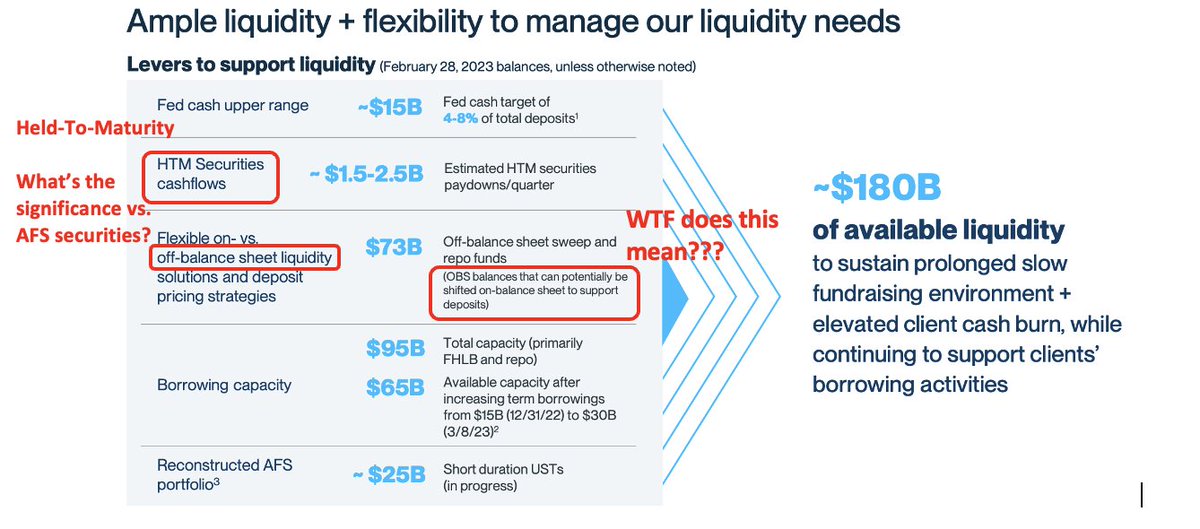
And what do the terms "AFS", "HTM", "NII", & "FDIC Insurance" actually mean?
👇THREAD ON SVB
🧵/
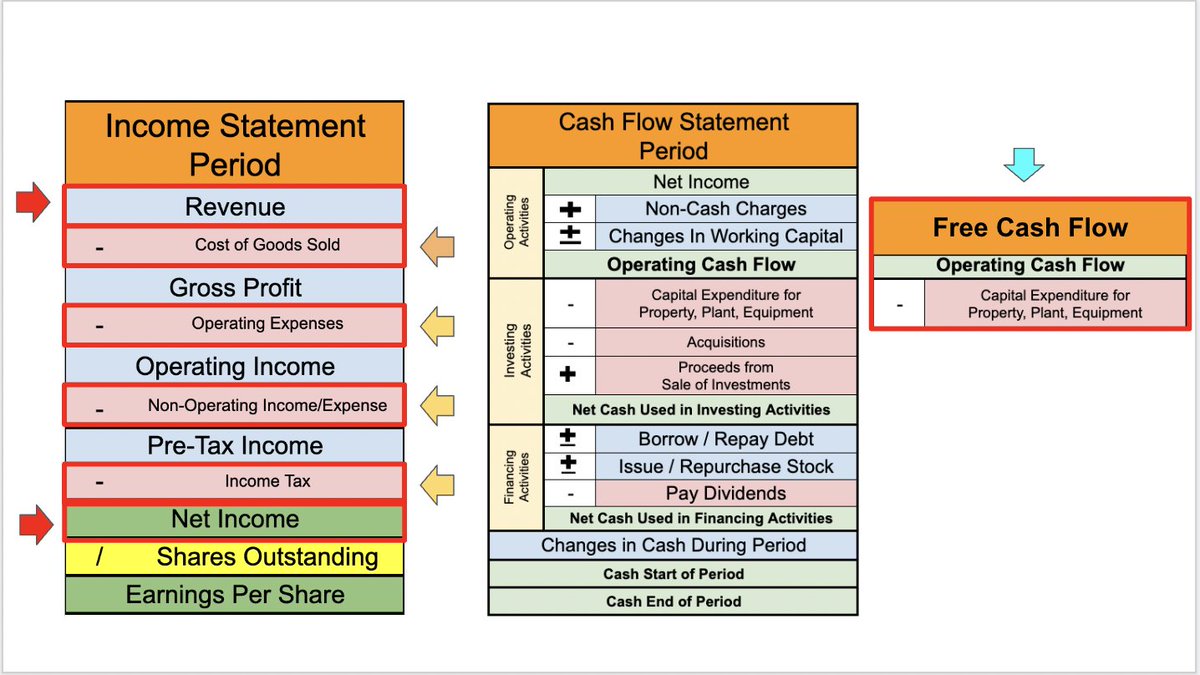
Revenue and income are NOT the same.
Costs and expenses are NOT the same.
Net income and free cash flow are NOT the same.
Confused? Here's a quick breakdown:
🤖 I asked AI to make a video on how to become a digital nomad
AI script written by @openAI ChatGPT
Video edited by @pictoryAI
AI video and voice by @synthesiaIO
Put together with @veedstudio
Took ~5 minutes!
Introducing Bird SQL, a Twitter search interface that is powered by Perplexity’s structured search engine. It uses OpenAI Codex to translate natural language into SQL, giving everyone the ability to navigate large datasets like Twitter.
https://t.co/N1BtF47JYu
I wrote an article about trading psychology a year ago.
I'd change and add a couple of things, but overall it's still pretty decent and worth revisiting.
https://t.co/DSpEtoPvHj