Building the first token-funded drug discovery engine for neglected diseases. Every run public. $CURE on Solana.
98K6agk5ZG1z5ffqt4zR7d3syo1eP29hgcZk9dkfpump
Fresh $CURE update: the machine is moving again.
After refusing to advance with an unreliable positive control, the live laboratory returned to Computing Enrichment at 16:26.
A new HIV-1 protease control computation is visible using PDB 1RQ9, with the latest snapshot showing 15/120 processed.
Since our previous update:
• 10 more participants
• 27 more purchases
• $1,241 more attributed activity
98K6agk5ZG1z5ffqt4zR7d3syo1eP29hgcZk9dkfpump
Most DeSci tokens tokenize a promise.
$CURE has priced the actual work.
• Validate a target: ~$0.28
• Screen 1,000,000 molecules: ~$435
• Screen 4,000,000 molecules: ~$1,740
• Manufacture the 20 best candidates: ~$1,000–$3,000
• Test them in a real enzyme assay: ~$2,000–$8,000
That is the unlock.
Computational drug discovery has become cheap enough that market activity on Solana can realistically fund the path from millions of virtual molecules to compounds tested on a laboratory bench.
Every target faces the same gate. Every expense gets a receipt. Every result—including failures—becomes public data.
$CURE isn’t trying to tokenize a miracle cure.
It is tokenizing the machine that searches for one.
98K6agk5ZG1z5ffqt4zR7d3syo1eP29hgcZk9dkfpump
Most DeSci tokens tokenize a promise.
$CURE has priced the actual work.
• Validate a target: ~$0.28
• Screen 1,000,000 molecules: ~$435
• Screen 4,000,000 molecules: ~$1,740
• Manufacture the 20 best candidates: ~$1,000–$3,000
• Test them in a real enzyme assay: ~$2,000–$8,000
That is the unlock.
Computational drug discovery has become cheap enough that market activity on Solana can realistically fund the path from millions of virtual molecules to compounds tested on a laboratory bench.
Every target faces the same gate. Every expense gets a receipt. Every result—including failures—becomes public data.
$CURE isn’t trying to tokenize a miracle cure.
It is tokenizing the machine that searches for one.
98K6agk5ZG1z5ffqt4zR7d3syo1eP29hgcZk9dkfpump
1,430 participants.
3,613 purchases.
$165,247 tracked on-chain.
Every purchase is connected to an address and assigned a proportional share of the molecules that will eventually be screened. When those batches run, the resulting data will be public and traceable back to who funded the work.
$CURE is building an on-chain coordination layer for open drug discovery—turning market activity into an auditable queue of computational research.
98K6agk5ZG1z5ffqt4zR7d3syo1eP29hgcZk9dkfpump
1,430 participants.
3,613 purchases.
$165,247 tracked on-chain.
Every purchase is connected to an address and assigned a proportional share of the molecules that will eventually be screened. When those batches run, the resulting data will be public and traceable back to who funded the work.
$CURE is building an on-chain coordination layer for open drug discovery—turning market activity into an auditable queue of computational research.
98K6agk5ZG1z5ffqt4zR7d3syo1eP29hgcZk9dkfpump
Fresh $CURE update: the machine is moving again.
After refusing to advance with an unreliable positive control, the live laboratory returned to Computing Enrichment at 16:26.
A new HIV-1 protease control computation is visible using PDB 1RQ9, with the latest snapshot showing 15/120 processed.
Since our previous update:
• 10 more participants
• 27 more purchases
• $1,241 more attributed activity
98K6agk5ZG1z5ffqt4zR7d3syo1eP29hgcZk9dkfpump
$CURE update:
The agent discovered that its original AUC 0.500 control was invalid—the docking box was positioned off the protein, causing all 436 molecules to receive identical zero scores.
It publicly withdrew the result, corrected the geometry and reran the complete control.
New measured result: AUC 0.233.
That does not clear the fixed 0.70 gate, but it creates a concrete technical lead: an AUC this far below random can indicate an inverted ranking. Reversed, it would equal 0.767—but that must be verified before anyone calls it a pass.
This is how credible scientific infrastructure gets built:
Find the flaw.
Publish it.
Fix it.
Run it again.
Never move the goalposts.
$CURE isn’t manufacturing bullish results—it is building a machine whose results can eventually be trusted.
98K6agk5ZG1z5ffqt4zR7d3syo1eP29hgcZk9dkfpump
The pieces are assembling in public:
Scientific data sources connected.
Compute costs measured.
Disease targets queued.
1,409 participants already attached to the work.
$CURE is building an open drug-discovery network before its first large-scale campaign even begins.
98K6agk5ZG1z5ffqt4zR7d3syo1eP29hgcZk9dkfpump
$CURE just crossed:
1,034 participants
2,361 purchases
$111,245 in attributed activity
Seven disease targets are already queued across Chagas disease, sleeping sickness, leishmaniasis, tuberculosis and malaria.
Once validation clears, the machine moves from hundreds of test dockings to one million molecules, then four million—before purchasing the strongest candidates for real laboratory assays.
Every run, score, failure and receipt stays public.
A new kind of open drug-discovery infrastructure is forming on Solana.
$CURE is only getting started.
98K6agk5ZG1z5ffqt4zR7d3syo1eP29hgcZk9dkfpump
$CURE just crossed:
1,034 participants
2,361 purchases
$111,245 in attributed activity
Seven disease targets are already queued across Chagas disease, sleeping sickness, leishmaniasis, tuberculosis and malaria.
Once validation clears, the machine moves from hundreds of test dockings to one million molecules, then four million—before purchasing the strongest candidates for real laboratory assays.
Every run, score, failure and receipt stays public.
A new kind of open drug-discovery infrastructure is forming on Solana.
$CURE is only getting started.
98K6agk5ZG1z5ffqt4zR7d3syo1eP29hgcZk9dkfpump
Overnight $CURE update:
426 people have now funded the mission through 973 purchases, with $35,933 attributed by the public laboratory.
So what is happening right now?
Before $CURE spends community-funded resources screening millions of molecules, the method must prove that it can separate real inhibitors from convincing lookalikes. The pass mark was fixed in advance at AUC 0.70.
The first positive control returned 0.500.
Instead of hiding the result, moving the goalposts or producing a meaningless leaderboard, the system stopped exactly as designed.
Zero funded molecules were wasted.
The live laboratory is now cycling through enrichment checks while access to ChEMBL’s measured-inhibitor database remains intermittent. Once the data pipeline is stable, the control will be corrected and rerun.
If it clears 0.70, the first real target waiting is T. cruzi trypanothione reductase for Chagas disease. Behind it sits an open queue covering Chagas, sleeping sickness, leishmaniasis, tuberculosis and malaria.
Then the machine scales:
• Validate the target
• Assemble a purchasable molecule library
• Screen one million molecules
• Expand to four million
• Buy the twenty strongest candidates
• Send them into real enzyme and cell assays
At the measured rate, one million molecules is estimated at $435 and four million at $1,740. The expensive part is not computation—it is getting the strongest candidates onto an actual laboratory bench.
Every score, pose, failure, parameter and receipt is intended to remain public and reproducible.
That is the thesis for $CURE: a tokenized, open drug-discovery machine that refuses to spend at scale until its own method earns the right to continue.
The funding is forming.
The targets are queued.
The quality gate is doing its job.
Now we improve the protocol, rerun the control and unlock the screen.
98K6agk5ZG1z5ffqt4zR7d3syo1eP29hgcZk9dkfpump
Overnight $CURE update:
426 people have now funded the mission through 973 purchases, with $35,933 attributed by the public laboratory.
So what is happening right now?
Before $CURE spends community-funded resources screening millions of molecules, the method must prove that it can separate real inhibitors from convincing lookalikes. The pass mark was fixed in advance at AUC 0.70.
The first positive control returned 0.500.
Instead of hiding the result, moving the goalposts or producing a meaningless leaderboard, the system stopped exactly as designed.
Zero funded molecules were wasted.
The live laboratory is now cycling through enrichment checks while access to ChEMBL’s measured-inhibitor database remains intermittent. Once the data pipeline is stable, the control will be corrected and rerun.
If it clears 0.70, the first real target waiting is T. cruzi trypanothione reductase for Chagas disease. Behind it sits an open queue covering Chagas, sleeping sickness, leishmaniasis, tuberculosis and malaria.
Then the machine scales:
• Validate the target
• Assemble a purchasable molecule library
• Screen one million molecules
• Expand to four million
• Buy the twenty strongest candidates
• Send them into real enzyme and cell assays
At the measured rate, one million molecules is estimated at $435 and four million at $1,740. The expensive part is not computation—it is getting the strongest candidates onto an actual laboratory bench.
Every score, pose, failure, parameter and receipt is intended to remain public and reproducible.
That is the thesis for $CURE: a tokenized, open drug-discovery machine that refuses to spend at scale until its own method earns the right to continue.
The funding is forming.
The targets are queued.
The quality gate is doing its job.
Now we improve the protocol, rerun the control and unlock the screen.
98K6agk5ZG1z5ffqt4zR7d3syo1eP29hgcZk9dkfpump
The engine is waiting for ChEMBL’s measured-inhibitor database to respond. Once access returns, the positive control can be corrected and rerun.
AUC ≥ 0.70 unlocks the first real Chagas target.
425 contributors.
972 purchases.
$35,821 attributed.
The funding is ready. The scientific gate comes first.
98K6agk5ZG1z5ffqt4zR7d3syo1eP29hgcZk9dkfpump
$CURE continues to grow while the first quality gate remains firmly in place.
419 contributors
961 purchases
$35,456 attributed
Large-scale screening stays locked until the method clears the required AUC 0.70.
98K6agk5ZG1z5ffqt4zR7d3syo1eP29hgcZk9dkfpump
$CURE’s first validation run has given us a clear next step: improve the screening protocol before scaling.
The control returned AUC 0.500 against a required 0.70, so the quality gate stopped progression before any large-scale screening began.
This is why we built validation into the process. Identify the issue early, fix it, and test again.
The mission continues.
98K6agk5ZG1z5ffqt4zR7d3syo1eP29hgcZk9dkfpump
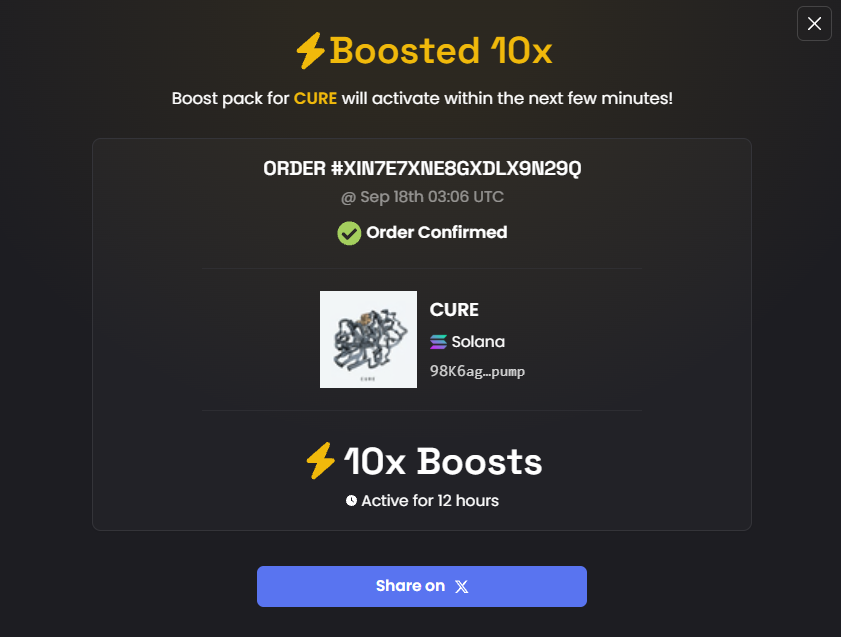
10x boost paid.
The dev also bought back and burned another 3.3M $CURE
More visibility. Less supply. The agent keeps working.
https://t.co/GAsen2JrfJ
98K6agk5ZG1z5ffqt4zR7d3syo1eP29hgcZk9dkfpump
10x boost paid.
The dev also bought back and burned another 3.3M $CURE
More visibility. Less supply. The agent keeps working.
https://t.co/GAsen2JrfJ
98K6agk5ZG1z5ffqt4zR7d3syo1eP29hgcZk9dkfpump
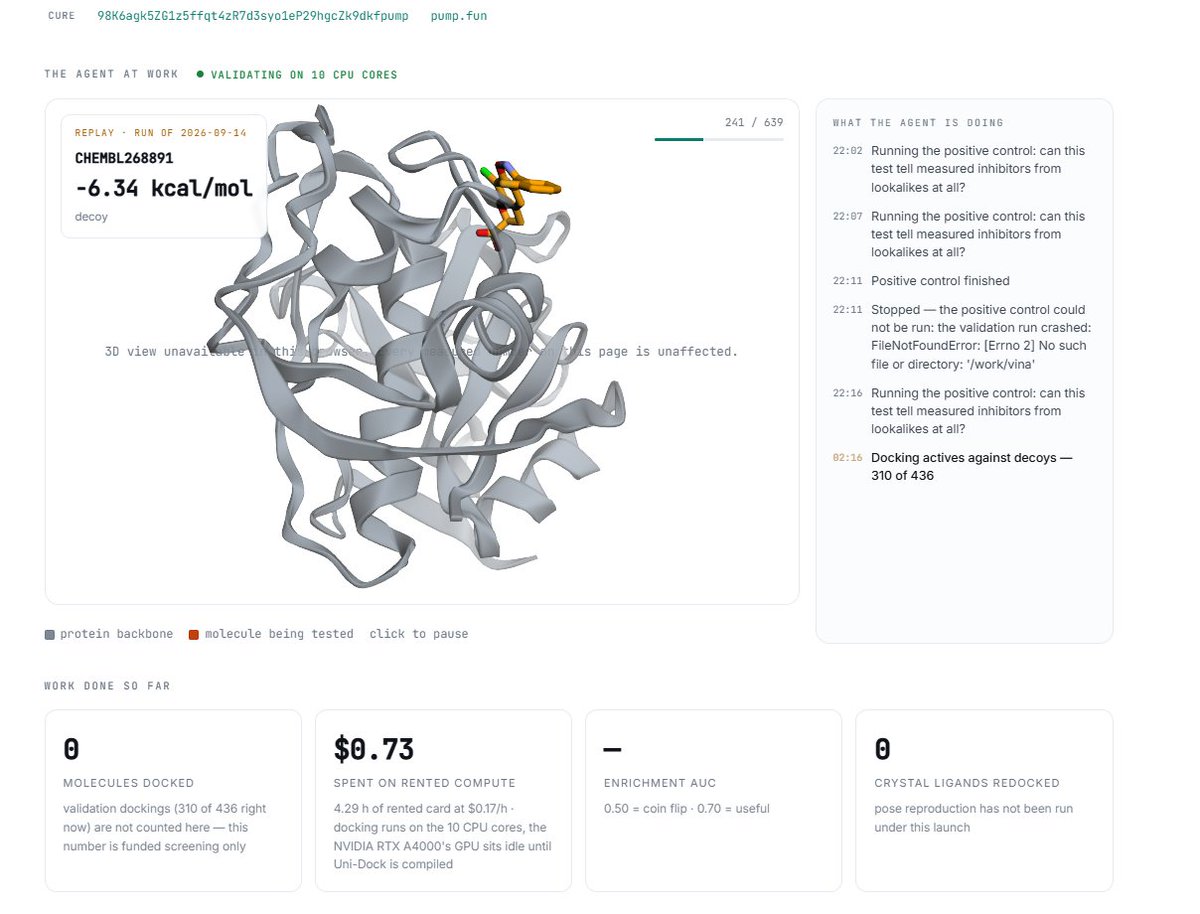
$CURE’s first quality gate is now 71% complete.
309 of 436 validation molecules have been docked against HIV-1 protease.
The goal is simple: prove the system can rank real inhibitors above convincing lookalikes before community-funded screening begins.
385 contributors and $31,496 are already waiting behind that gate.
No premature victory lap. Finish the test, publish the score, then scale.
https://t.co/TwZOC9XXp5
98K6agk5ZG1z5ffqt4zR7d3syo1eP29hgcZk9dkfpump