That's the series. One idea across six essays: the best ways your people work with AI are your firm's real edge, and right now they leak away.
The firms that get this right started in one place and let it compound.
Go capture one thing that worked this week.
Whatever you capture, make sure it isn't trapped in one tool or tied to one model.
Models change. Tools come and go. If a provider switch wipes out your accumulated way of working, you never owned it.
The asset you want survives the swap.
The part almost everyone skips: keep the judgment, not just the output.
A saved output is a template. Capture the reasoning alongside it, even a line, and you've saved something a colleague can learn from, not just copy.
Sequoia's playbook for AI companies: start with the task that's already outsourced. Budget exists, scope is clear, the buyer already pays for an outcome.
Flip it: it's a playbook for adopting AI too. Start where the work is already shaped like a handoff, then expand into the judgment-heavy core.
Documentation fails because it asks people to stop working to write things down.
So don't run a documentation project. Catch the good stuff as it happens: the prompt that finally worked, the chain someone strung together.
If capture takes more than a few seconds, no one will do it.
Start with one workflow, not the firm.
The instinct is to map everything. Don't. Pick one piece of work that repeats and matters, and get just that one compounding.
One good workflow the whole team reuses beats a grand programme that never ships.
Three months of the habit, held: a diligence playbook run a dozen times, a little better each pass, instead of twelve people quietly solving the same problem in private.
None of that needs a platform. It needs the habit.
A single-player tool gives you a hundred people getting individually faster.
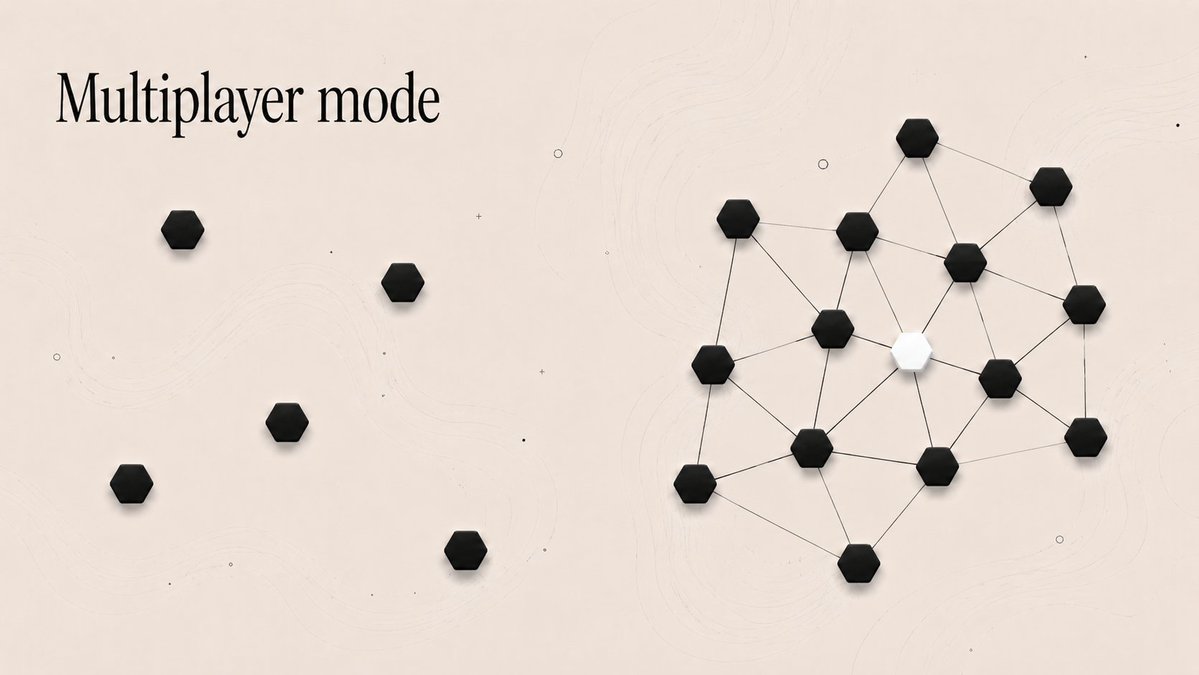
Multiplayer gives you a team that gets collectively smarter, and keeps what it learns.
How does a firm actually start, without a six-month rollout? Final post of the series, tomorrow.
A shared output without the thinking behind it is a template.
A shared playbook with the judgment in it is how a team levels up.
That's the difference between knowing what someone did and knowing how to do it well. It's also what should separate your agents from everyone else's.
The labs are all shipping "multiplayer" AI. Look closely and each is multiplayer in bounded rooms: shared inside its own corner, locked to its own model and surface.
The thing that runs across the tools, holding the context and the judgment, still isn't there.
The precedent only runs one way.
Google Docs took the ground from Word. Figma from Sketch. Notion from Evernote.
Every single-player tool eventually loses to its multiplayer version. AI is next, and the signals keep stacking up.
The simplest test of whether your firm's knowledge compounds:
When a new joiner arrives, do they start from a blank page, or from the best your team has worked out so far?
Every blank page is the firm paying for the same lessons twice.
Most teams use AI in single-player mode.
One person lives in ChatGPT, another in Claude, a third in Cursor. Enormous capability across the team. Almost none of it shared.
One person's breakthrough stays theirs, until they leave and it goes with them.
Real multiplayer: one person cracks a sharper way to run diligence, the next person starts from that and improves it. The playbooks the team runs are the ones the agents run.
A hundred people individually faster, or a team collectively smarter. The difference compounds.