Privatization of things like education, health care, and transportation is giving more power and control in society to the wealthy. Limiting access to these things is only benefiting the 1%. 10.2/10 #SOC308#SocialTheory
The Power Elite is just as relevant today as it was when I wrote it in 1956–some might even say more relevant. The 1% is creating a power divide in the United States, and taking away power form the middle class. 10.1/10 #SOC308#SocialTheory
It is important that we understand who and what groups have power in a society in order to create social change. Those with knowledge are the ones who can create change! 8.2/10 #SOC308#SocialTheory
It is the job of all social scientists to connect individual problems with greater social issues. How else will we inspire change and solve problems? We need to be aware of ourselves and the world around us. 8.1/10 #SOC308#SocialTheory
It is the job of all social scientists to connect individual problems with greater social issues. How else will we inspire change and solve problems? We need to be aware of ourselves and the world around us. 9/10 #SOC308#SocialTheory
As a social theorist, I was very interested in how social power and structures operate and thrive in our society, and how they add to social inequalities. This research made me begin to wonder about how people’s behavior is shaped by the societal context. 7/10 #SOC308#SocTheory
Everyone seems to know that I created the Sociological Imagination, but did you know that I am also credited with coining the term ‘New Left’? 6.2/10 #SOC308#SocialTheory
My most famous idea is by far the #SociologicalImagination. Learn how to see and understand connections between individuals, their lives, and society and its sources as a whole. Personal troubles can be public issues, too. 6.1/10 #SOC308#SocialTheory
Because of my love for philosophy, I will always credit Hans Gerth as an influencer of my life, too. During my time at UW-Madison, he introduced me to concepts and ideas that I was able to carry over into my career in sociology. 5.3/10 #SOC308#SocialTheory
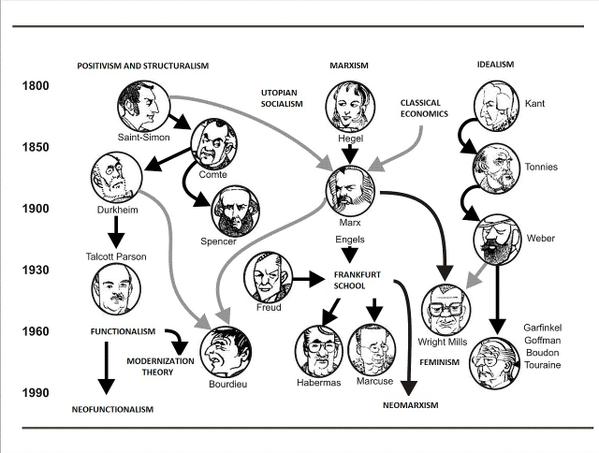
As a student of Weber, I was able to better understand rationalization and use it as a guide for my own research. I have also drawn on his research when analyzing topics like historical change, social structure, and sociological analysis. 5.2/10 #SOC308#SocialTheory
Mead, Pierce, and Dewy have all played large roles in my social research because I have always been drawn to pragmatism. That being said, it would be silly to think that Weber and Marx had nothing to do with my passion for social theory. 5.1/10 #SOC308#SocialTheory
The Sociological Imagination is a contemporary framework or quality of mind that has been allowing sociologists to grasp micro in macro and macro in micro since 1959. Space exploration was also taking off in 1959. Coincidence? Probably not. 4/10 #SOC308#SocialTheory
If not, feel free to check out The Power Elite (1956) to understand the interests of society’s leaders or White Collar (1951) to read about social alienation and capitalism–an issue that played a large role in my life growing up. 3.2/10 #SOC308#SocialTheory
You can find plenty of #WednesdayWisdom in one of my most famous works, #TheSociologicalImagination, where I explain the connections between the individual & society. Some even say that I restructured what it means to be an individual in society. 3.1/10 #SOC308#SocialTheory