Canadian centrist. Allergic to partisan bullshit. Facts before narratives, evidence before outrage. I’ll criticize my own side too. Common sense still matters.
Already given? Then this should be easy.
Please point us to the government’s complete explanation of what was on the table, what Canada offered, what the U.S. offered, exactly which provisions killed the deal, and when the strategy shifted from negotiating a deal to providing taxpayer support “designed to last longer than the current U.S. administration.���
We’ve learned pieces of that story over time, often from people other than Carney. That’s not the same thing as the government giving Canadians a full accounting.
Change the tune? I’d settle for hearing the whole song first.
There are really three separate claims here, and they shouldn’t be treated as though proving one automatically proves the others.
The Canada Research Chairs program explicitly incorporates demographic objectives into hiring. That’s not really debatable. The program’s own rules establish equity targets and consequences for institutions that fail to meet them.
Those incentives can create a tradeoff between representation and merit. That’s a legitimate concern. Once demographic outcomes become an institutional objective, the competition is no longer based solely on identifying the strongest researcher. Whether that tradeoff actually occurs, and how often, is the important question.
EDI has therefore reduced Canadian research excellence by 12% and wastes $36 million annually. That’s where this article gets ahead of its evidence. Differences in h-index between demographic groups are interesting and deserve investigation, but they don’t by themselves prove that less-qualified candidates displaced better-qualified ones because of EDI. Converting those differences into a precise dollar figure for “waste” requires even more assumptions.
The strongest argument against demographic hiring doesn’t require overstating the evidence: public research funding should select the best researchers and research, regardless of race or sex. Remove discriminatory barriers to competition, absolutely. But don’t predetermine what the demographic outcome of a merit competition is supposed to look like.
Ironically, overselling the evidence here makes a legitimate criticism of the CRC’s EDI system easier to dismiss.
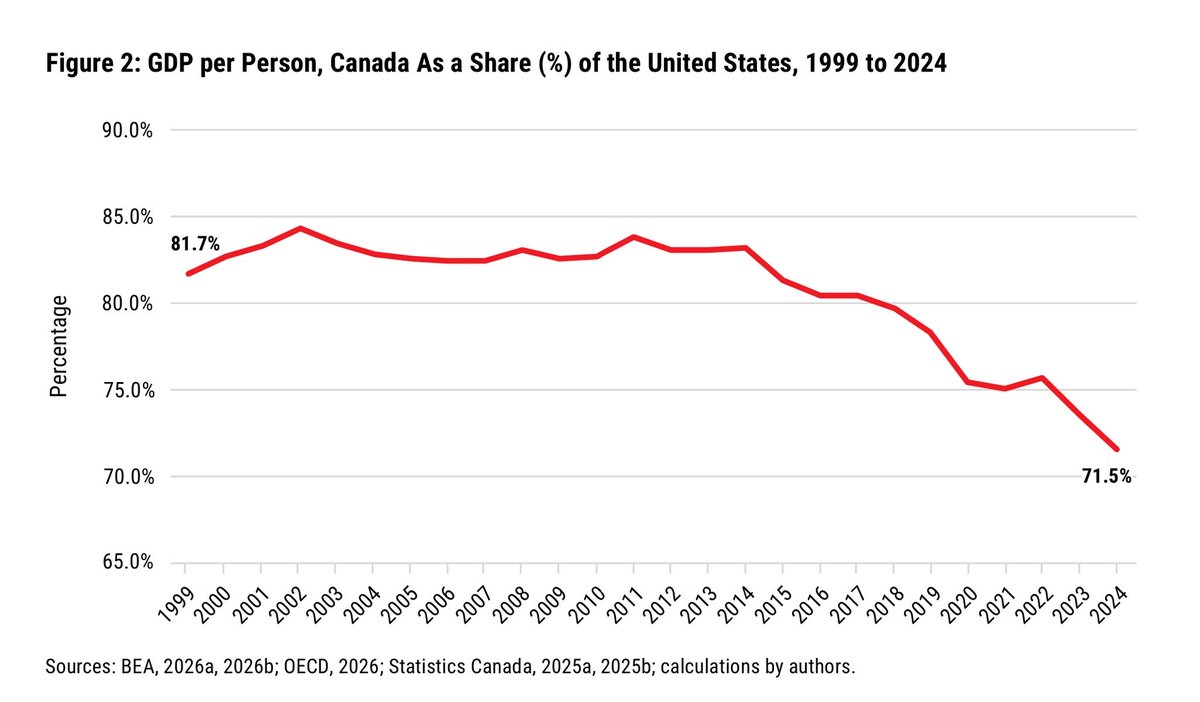
I stumbled across this graph. It shows a number that actually indicates how an economy is doing. Although the graph stops in 2024 the OECD’s 2026 assessment isn’t exactly showering us with participation trophies either. It says Canada’s GDP per capita remains below top-performing economies and identifies sluggish productivity, weak investment and relatively low capital stock per worker as important problems.
Can someone explain to me why the elbows-up crowd gets their info from memes while ignoring context and real facts?
The 3.3% number is actually correct. StatsCan reports Q2 real GDP grew 0.8%, which annualizes to 3.3%. Canada had a genuinely strong quarter.
But you’re using one quarter to dismiss concerns about Canada’s broader economic performance. That’s no more intellectually honest than using one bad quarter to declare the economy a disaster.
If you want to know how Canada is actually doing, look at multi-year real GDP per capita, productivity and real income trends, not one annualized quarterly figure.
The statistic is factual. The conclusion you’re drawing from it isn’t.
“A rapid, just phase-out of fossil fuels.”
Rapid? Based on what reality?
Fossil fuels still underpin transportation, aviation, shipping, agriculture, heavy industry, heating and much of the world’s energy supply. You don’t rapidly phase that out by issuing declarations from a UN podium. You do it by first building reliable, affordable, scalable alternatives.
And naturally CTV pairs the story with a wall of flames, because apparently reporting that the 1.5°C target is likely to be missed wasn’t sufficiently terrifying on its own.
The timing is interesting too. Maybe it’s coincidence, maybe it isn’t. But Canadian media suddenly returning to maximum-volume climate alarmism deserves some scrutiny.
Pretending the global energy system can be rapidly dismantled without enormous economic and human consequences isn’t a solution. It’s fantasy dressed up as policy.
Calling someone ignorant and then explaining away a GDP-per-capita comparison with “population differences” is quite the opening move.
The oil-price collapse absolutely hurt Canada, and nobody serious would attribute the entire Canada-U.S. divergence to one government. But it doesn’t explain a productivity and per-capita growth gap that persisted and widened long after oil prices recovered.
Tax and regulatory policy, weak business investment, declining capital per worker and poor productivity growth are all legitimate parts of that discussion.
Barlow’s conclusion is partisan. Your rebuttal isn’t a rebuttal. It’s two variables followed by “etc.” and a declaration of victory.
“He’s experienced and educated” isn’t evidence that he’s “nailing it.” It’s a résumé.
Growing the economy? Show the per-capita numbers. Creating jobs? Show them relative to population and labour-force growth. Rebuilding the military? Announcing spending plans isn’t rebuilding anything until the capability actually exists. Protecting sovereignty? From what, exactly?
And claiming Carney’s popularity “ain’t because of Trump” is particularly hilarious. Trump and the Canada-U.S. crisis dominated the election, and Carney was explicitly sold as the experienced economic heavyweight best equipped to deal with him.
You’ve basically listed campaign slogans, declared them accomplished facts, and called it analysis. The pom-poms were implied.
“Since 2018” is doing an awful lot of work there, Doug. Ontario’s population has also grown by millions over that period, so quoting a raw cumulative job number without population, labour-force or per-capita context tells us very little.
And “$235 billion in new investment” sounds impressive, but how much is private capital actually committed and deployed, and how much depends on taxpayer subsidies and government incentives?
Governments love taking credit for every job created while mysteriously developing amnesia whenever one disappears. Give us the net numbers and the context, not the victory-lap headline.
Calling Canada an “energy superpower” requires more than producing lower-carbon barrels. It requires infrastructure, market access, investment certainty and the ability to actually get Canadian energy to global customers.
And “lower-carbon barrels” is particularly rich after a decade in which Ottawa often seemed embarrassed that Canada produced barrels at all. Build the infrastructure and open the markets. Then we can talk about being an energy superpower.
Attention elbozos, a government handout doesn’t make groceries more affordable. It gives you taxpayer money to help pay for groceries that are still unaffordable.
If the liberal solution to the cost-of-living problem is to keep subsidizing people so they can afford higher prices, they haven’t solved the affordability problem. They have admitted the problem exists, have no idea how to fix it, and have transferred the bill to taxpayers.
But apparently people are now wandering grocery aisles looking for the Finance Minister so they can thank him. Sure, François. 😂
$7.5 billion in taxpayer-funded support isn’t an economic strategy. It’s a very expensive holding pattern.
What’s the actual plan, Mark?
Evan Solomon let slip that the support is “designed to last longer than the current U.S. administration.” If the strategy is now to subsidize affected businesses and workers with public money while waiting out Trump, then say so plainly.
And the bigger question is: are Canadians willing and able to carry that burden for another two years?
You were elected in large part on your credentials as the strong negotiator and economic expert uniquely equipped to deal with Trump. Where is that guy now?
Keeping companies afloat with taxpayer money may be necessary in the short term. It is not a substitute for an economic or trade strategy.
What happened to the Star? It used to print news; now it's a propaganda rag.
This article crosses the line from opinion into partisan fan fiction.
The claim that Trump has a “master plan” to economically bludgeon Canada into annexation or Puerto Rico-style territorial status is extraordinary. Where is the evidence for that? Trump’s ridiculous 51st-state rhetoric is real. Turning it into a detailed annexation strategy and presenting that strategy as fact is something else entirely.
Then we’re told Canada’s economy is “growing stronger” because of one quarter of 3.3% annualized GDP growth. Perhaps before declaring economic victory we should look at GDP per capita, productivity, investment, employment and the enormous amount of taxpayer money now being committed to cushioning tariff-exposed industries.
And finally we arrive at the increasingly familiar Liberal-friendly narrative: don’t worry, Canada can simply absorb the damage and outlast Trump.
Interesting, considering Evan Solomon just said government support was “designed to last longer than the current U.S. administration.”
Carney campaigned on his ability to deal with Trump and negotiate a new economic relationship. If the strategy has now become subsidize affected industries with billions of taxpayer dollars and wait two years for Trump to leave, Canadians deserve to be told that plainly.
Calling something an “opinion” doesn’t magically turn unsupported assertions and government talking points into serious journalism.
That assumes “Plan B” wasn’t Plan A all along.
None of us sitting outside government knows the full strategy, and I’m not going to pretend I do. But Carney was hired largely because of his experience navigating economic crises, markets and international finance. It would be rather extraordinary if his government were simply reacting to Trump one announcement at a time with no longer-term strategy.
Maybe the objective was never just “get Trump to sign a deal.” Maybe it was also to use this mess to reduce Canada’s dependence on the U.S., diversify our trade, build domestic capacity and prepare for a relationship with America that may remain unstable long after Trump is gone.
That doesn’t mean Carney gets a free pass. Judge the strategy by the results. But assuming everything we can see publicly is everything the government is doing behind the scenes seems every bit as speculative as assuming Carney has some brilliant master plan.
For now, I’m watching what they actually do.
Buying Canadian when the quality and price make sense? Absolutely. Supporting Canadian businesses is something I’ve always tried to do.
But there’s an interesting contradiction here. We criticize “Buy American” protectionism while celebrating essentially the same instinct when we practise it ourselves.
And when Egyptian oranges or Chinese pears are preferable to American produce simply because they’re not American, we’ve moved beyond “Buy Canadian.” That’s a boycott.
That’s anyone’s right as a consumer, but let’s call it what it is.
The most revealing part of this column may actually be the discussion of agency. Buying Canadian makes people feel like they’re doing something about a situation over which they otherwise have virtually no control. That’s understandable.
What it isn’t is an economic strategy.
I keep seeing “release the deal.” There probably isn’t a completed deal to release. What Carney should release, or at least clearly explain, are the substantive U.S. demands that caused Canada to walk away.
A week ago it was sovereignty, language, culture and our ability to trade independently. As more details emerge, some of those supposed red lines appear to be disappearing or were negotiable after all.
Now we’re being told the U.S. wants to “wipe out” Canadian industries or turn them into subsidiaries.
Maybe that’s true. If it is, show Canadians what the demands were.
You don’t get to invoke an existential threat to the country while simultaneously telling the country it can’t know what the threat actually is
Interesting. I’ve basically arrived at the same place by following the breadcrumbs as they’ve emerged. None of this proves Carney deliberately walked away intending to wait out Trump, but there are increasingly visible chinks in the armour of the story we were originally given.
The sovereignty red lines keep getting softer as more details emerge, and Evan Solomon’s admission that support was “designed” to outlast the current U.S. administration adds another piece to the puzzle.
Maybe there was an entirely defensible reason to walk away. But if so, tell Canadians what it was. Carney was elected largely on his claim that he was the guy who could deal with Trump and secure an agreement. With this much of our economy at stake, Canadians deserve facts, not carefully rationed breadcrumbs and political theatre.