How England’s vulnerable children became a gold mine for investors via @FT
Excellent piece by @smyth_chris on private children’s homes now charging up to £3m a year to house children in care. https://t.co/zOTn5wf1tf
So where do these children go? They can’t go home. The state won’t provide appropriate housing for children in care. But once again it is the fault of the social workers.
Surrogacy - the basics. Changes in society often resonate first in the family courts. Important to think of wider contexts and concept of legal parents.
The concept of parenthood is dynamic. Legal parenthood relates to 2 people only. Parental responsibility very different.
In the matter of X and Y (Children: Adoption Order: Setting Aside) [2026] UKSC 13: Appeal by adoptive mother against decision that the court has no power to set aside a validly made adoption order, other than by way of appeal. Appeal dismissed. https://t.co/BIqhZwrhnW
It is not of course the issue of unregulated experts that caused these cases to go badly awry - but it can’t have helped. 77 of us wrote in protest about their use in 2019 - we were ignored.
Parental Alienation: The Modern Way https://t.co/3SLbPHXQm4
But I do wonder what would have happened if my open letter had been taken seriously in 2019. Perhaps it would have helped in this case and the others cited, to prevent them going so firmly off the rails and the impacts of those court decisions reverberating through many years. My only reassurance in this is that my instincts are sound. Any person who ought to be subject to external regulation but refuses, is someone to treat with extreme caution, and certainly not someone who should ever be paid to provide reports to the Family Court.
I wrote about this in 2019, sent an open letter to the president signed by May others. We were ignored.
No unregulated expert should be any where near a family court.
https://t.co/c6CM6OvPKq
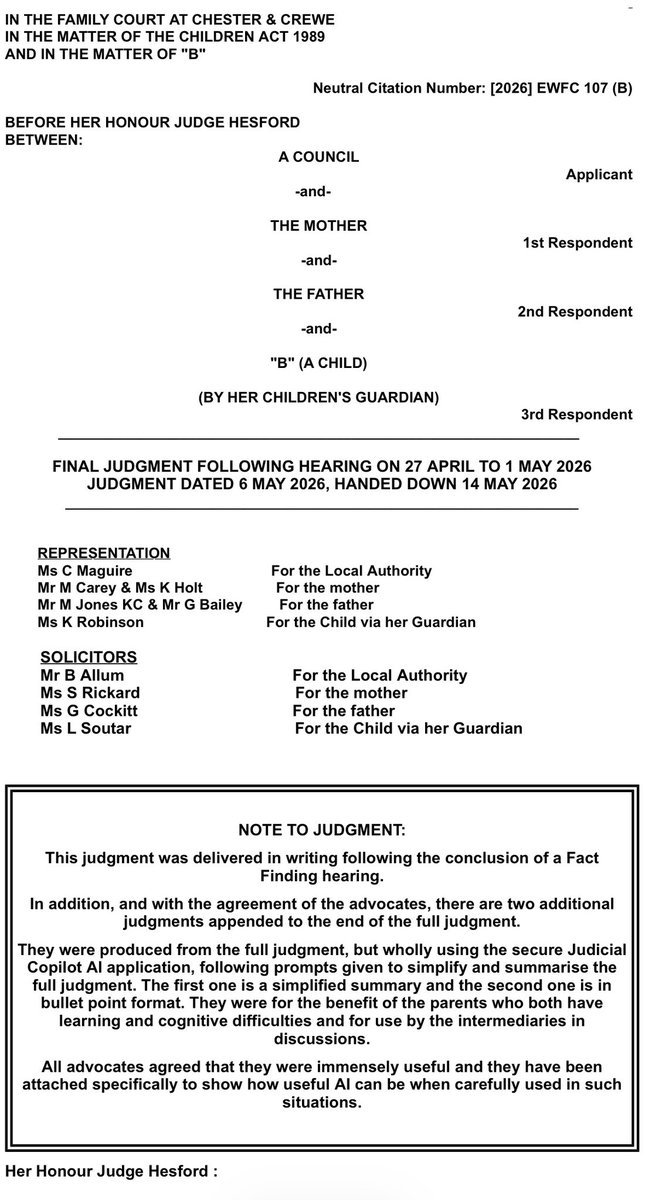
Important Judgment in a Family Case - from the most senior judge. https://t.co/sHJF8ELe7g He says it's "about the failure of the whole process... undertaken in a manner which is now to be seen as fundamentally unsound" .
Important decision by the most senior judge in the Family Court - a teenage boy is allowed to return to his mother, overturning a "draconian" decision made by lower court 6 years before. A psychologist claimed the mother had alienated the children from their father. They then had to live with him....https://t.co/Uw84XitI26
How can adoption survive when most adopted children will have suffered significant harm and loss, and there are limited resources to support adoptive parents? The legal fiction is no longer sustainable.
The UKSC decision in X v Y will be interesting.
The death of adoption | Child Protection Resource https://t.co/nVmyXc0fRq
This writer - like so many others - shows she knows nothing of childhood. Odd considering that she has had ‘lived experience’ of this state. As do we all.
To suggest that giving children ‘genuine agency’ in contested proceedings between their parents is a solution (or when deciding whether to sterilise themselves) is as cruel, stupid and pointless as demanding my dog cook me a roast dinner.
But I agree that court isn’t the place for frightened or angry parents. But where else do they go, once their ‘agency’ has been overwhelmed by emotion?
Once post adoption direct contact with birth families was admitted, the status of adoption as an unassailable legal fiction crumbles. And many would agree that’s the right outcome. https://t.co/50QLKdZ2wH
Jessica Bradley v CM & Ors Neutral Citation Number[2026] EWHC 125 (Fam): Apps by journalist for access to documents on the court file in four private family law cases, and for permission to publish contents of certain documents. Apps largely allowed. https://t.co/EhPdCcXAP9
Poverty gets the blame for society's worst outcomes—but it isn’t the real culprit.
When developmental psychologists examine childhood outcomes—things like graduation rates, substance abuse, drinking and driving, and incarceration—they look closely at what predicts those outcomes later in life.
One variable they often study is childhood harshness, which is essentially growing up in a low-income household. In other words, how poor a family was. What many studies find, however, is that the relationship between family income and those later outcomes is surprisingly weak. In some cases, there is only a small correlation; in others, no meaningful connection at all.
By contrast, researchers also examine a different factor: childhood instability or unpredictability. This is measured through indicators such as how often a child moved homes, how many romantic partners a primary caregiver had, and how much day-to-day uncertainty characterized the child’s life. Here the results are far more consistent. Childhood instability shows a strong association with negative outcomes later in life—effects that are considered large by the standards of this research.
Crucially, even when researchers statistically control for family income, early instability remains a powerful predictor of incarceration, substance abuse, and other adverse outcomes.
In The Australian 🇦🇺 today. ‘“Justice Strum's scathing assessment of the RCH gender clinic's practices and the "misleading" evidence given by the hospital's chief of medicine and former gender service director Michelle Telfer represents a crucial turning point in the debate”.