Trump is now shamelessly 'doing what it takes' to reverse inventory depletions and the consequential catastrophic supply shock. Darn the ideology, printers go burr, full speed ahead.
It's like trying to pull a plane out of a dive.
Roosevelt's 1933 gold order is often portrayed as government theft. In reality, it was an emergency response to a collapsing financial system that was dragging the country deeper into the Great Depression.
By 1933, banks were failing across the United States. Depositors were hoarding gold and currency, credit markets were frozen, prices were falling, and unemployment had reached catastrophic levels. Under the gold standard, every dollar had to maintain a fixed relationship to gold, which severely constrained the government's ability to stabilize the economy. As gold flowed into private hoards, the money supply contracted further, worsening deflation and bankrupting businesses and farmers.
Executive Order 6102 was designed to stop this downward spiral. Citizens exchanged gold for dollars at the official price because policymakers believed restoring spending, lending, and employment was more important than preserving private gold hoards during a national emergency. The subsequent revaluation of gold was not simply a windfall for Washington. It increased the dollar value of the nation's gold reserves and helped expand the money supply at a time when the economy desperately needed liquidity.
The goal was not to eliminate freedom, but to break the deflationary constraints of the gold standard. Under gold, economic recovery depended on maintaining convertibility even if that meant falling wages, falling prices, and mass unemployment. Roosevelt chose recovery over orthodoxy.
The results were far from perfect, but abandoning gold gave policymakers greater room to support banks, finance public works, and stabilize incomes. Industrial production, GDP, and employment all recovered substantially during the years following the gold standard's suspension.
The deeper question is whether the right to hold gold should outweigh society's ability to respond to a depression. Roosevelt answered no. Faced with economic collapse, he prioritized restoring jobs, output, and financial stability over preserving a monetary system that many economists believed had become a straitjacket on recovery.
🚨 My new working paper out today
I propose a post-Keynesian, system-dynamics alternative to the New Keynesian DSGE model, one that produces business cycles and financial instability endogenously, without rational expectations or microfoundations.
https://t.co/AixvEgVFhJ
🧵1/8
@Polymarket That is, Iran can get 'the greatest deal in history' if they let Trump save face. That's another way of saying unconditional US surrender with war reparations to Iran in exchange only for flattery. It's a blank check.
This is Iran's golden opportunity.
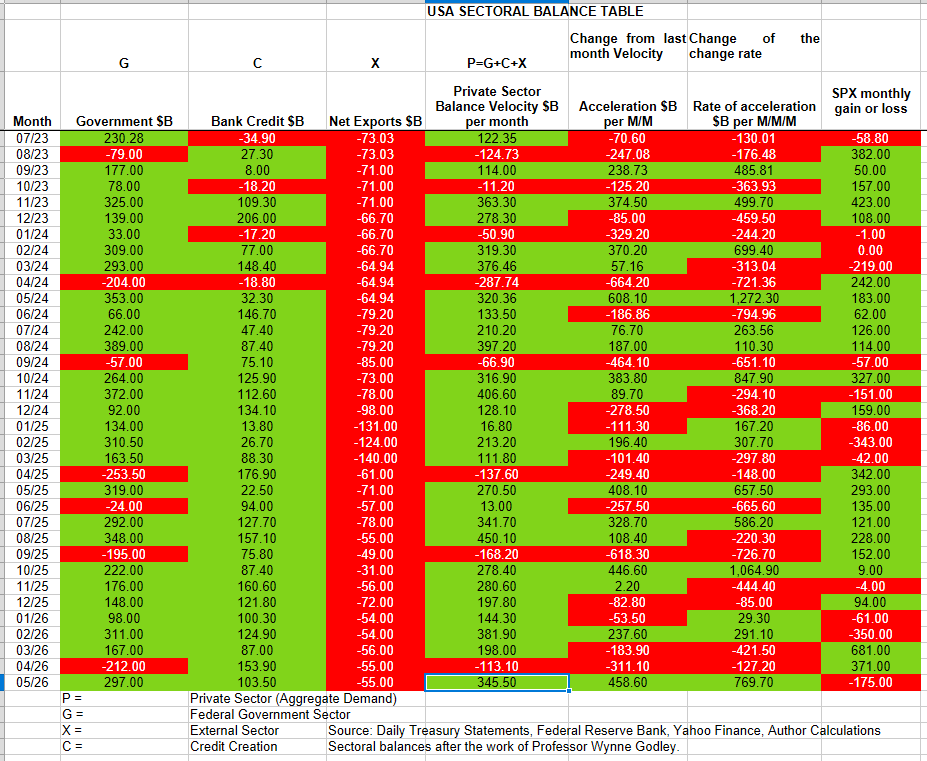
The fiscal flow model is forecasting market end the month higher than they began. The red SPX line follows the green private domestic sector upwards to finish higher.
A large private sector surplus this month. This starts from a negative base so the fiscal impulse has an even stronger impact on markets than it normally would.
MMT threatens that entire story.
It shifts the question from:
“Can we afford it?”
to:
“Who gets resources, who gets protected, who gets sacrificed, and who benefits from pretending the government is powerless?” (4/8)