【Notice】
Most international applicants fail Japanese interviews.
Not because of Japanese ability. But because of strategy.
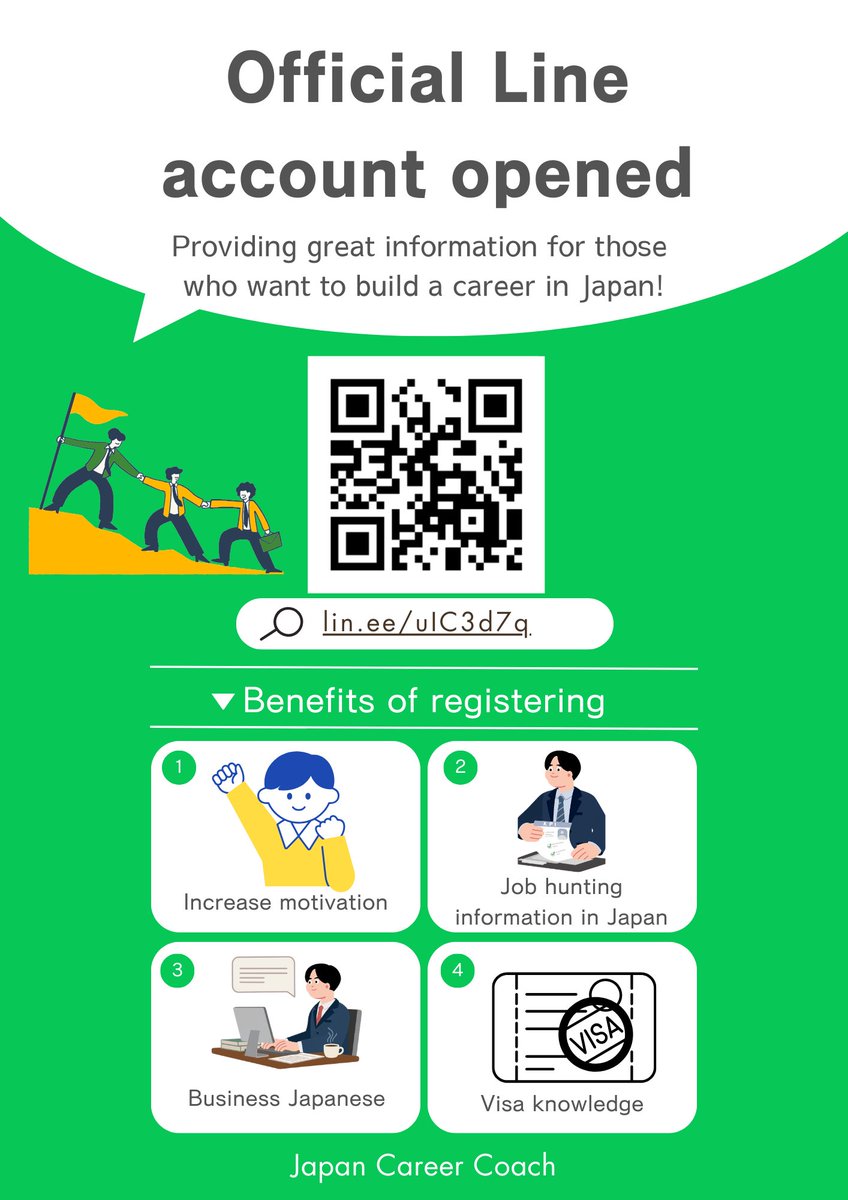
I just opened my official LINE account.
🎁 Free PDF: “5 Reasons International Applicants Fail at Japanese Interviews”
If you're serious about working in Japan, this is for you.
Free Japan Career Assessment available for selected candidates.
If you're interested, please register in the profile section and receive your gift first 🎁
Seven things nobody tells you before you build a career in Japan.
Overtime culture. Salary negotiation. Types of contracts.
Building relationships. Language and career preparation. Side hustles.
All of these have troubled talented and capable foreigners.
It wasn't because they lacked ability.
It was because nobody gave them the roadmap.
What I want to convey here is precisely that roadmap. I will write articles on each topic.
I have a question for you.
What is the biggest challenge in your career plan in Japan right now?
Please write your answer in the comments section.
If a particular topic is frequently mentioned, I plan to write articles on it.
One thing nobody teaches you before working in Japan:
Leaving the office requires a whole ritual.
You say お先に失礼します (osaki ni shitsurei shimasu) — “excuse me for leaving before you” — to everyone still working.
Sounds simple. But the TIMING is stressful.
Do you say it to your immediate team only? The whole floor? Do you stand up and announce it? Walk around individually? Just say it loudly from your desk?
And what if your boss is deep in concentration? Do you interrupt? Just slip out quietly?
Then there’s the pressure of when to leave. Even if your work is done, leaving “too early” feels wrong. You watch the clock. Watch your boss. Calculate the least awkward exit window.
Meanwhile colleagues respond with お疲れ様でした (otsukaresama deshita) without even looking up.
Many Japanese employees, especially younger ones struggle with these issues, but once you've finished your work, just go home!
#WorkingInJapan #OfficeEtiquette #JapaneseWorkCulture #CorporateJapan #NewEmployee #CulturalDifferences
I'm getting a steady stream of online consultation bookings.
I'm aiming for around 4 people per group, so if you're even slightly interested, please join our free consultation session.
I look forward to seeing you! ☺️
There are many free Japanese conversation groups online.
But many learners still feel: “I can study Japanese… but I still can’t communicate naturally.”
Why?
Because real communication needs:
•Feedback
•Practice
•Consistency
•Real-world situations
•A supportive environment
That’s why I’m building a Japanese Communication Community focused on REAL Japanese for work, life, and confidence in Japan.
Not just random conversation. Practical communication that helps you actually live and work in Japan.
Small group sessions. Practical speaking.
It's just 40USD per month for one 60-minute session per week.
DM me if you want to join the first members group 🇯🇵
Can you do side work while employed in Japan?
This one has a lot of grey area. Let’s break it down.
Traditionally, Japanese companies expected total loyalty.
副業 (fukugyou) — side jobs — were often explicitly banned in employment contracts.
That’s changing.
Since 2018, the Japanese government has been actively encouraging companies to allow 副業.
Many startups and foreign-affiliated companies now permit it.
But here’s what foreigners specifically need to know:
Your work visa is tied to your primary employer.
Side income from unauthorized work can create visa complications.
Always check your contract and your visa conditions before starting anything.
The opportunity is real.
The risk of doing it wrong is also real.
Japanese business emails have this phrase that stumps almost every foreigner:
ご査収ください
(go-sashuu kudasai)
Literal translation is“Please examine and receive”
Real meaning is“Please check the attached documents”
You’ll see it constantly:
• After attaching invoices
• Sending contracts
• Submitting reports
• Any email with important documents
It’s basically a formal way of saying “please review what I’ve sent you carefully.”
Other phrases in the same “textbook never taught me this” category:
• お世話になっております
• 取り急ぎご連絡まで
• 何卒よろしくお願いいたします
#BusinessJapanese #JapaneseEmail #WorkingInJapan #Keigo #JapaneseLearning #JLPT
"また今度行きましょう" — learn what this REALLY means.
Literal translation: "Let's go next time!"
Actual meaning: often a soft, permanent no.
Japanese communication avoids direct rejection.
Instead of "I don't want to," they say "maybe later."
And later never comes.
Language is only half of it.
Culture is the other half.
Follow for real Japanese communication explained simply.
#LearnJapanese #JapaneseCulture #WorkInJapan #JLPT #RealJapanese
“I want to work in Japan but my Japanese isn’t ready yet.”
I hear this constantly.
Here’s the thing — waiting until you’re “ready” is the wrong strategy.
Language and career prep aren’t sequential.
They’re parallel.
You can start building your Japan career strategy now — while you’re still studying.
What to work on simultaneously:
📌 Industry vocabulary in Japanese
📌 Keigo for emails and interviews
📌 Understanding Japanese CV format
📌 Researching target companies
The people who move fastest aren’t the most fluent.
They’re the most prepared.
Fluency follows immersion. Immersion starts with commitment.
My Threads followers have now exceeded 2,000.
I primarily share information about Japanese language education, careers in Japan, and Japanese culture on this account, focusing on my area of expertise: international education.
I hope that by connecting with Japan in some way, even just one person's life will be enriched.
I would also love to connect with others who share similar aspirations.
Thank you for your continued support! ☺️
There are many free Japanese conversation groups online.
But many learners still feel: “I can study Japanese… but I still can’t communicate naturally.”
Why?
Because real communication needs:
•Feedback
•Practice
•Consistency
•Real-world situations
•A supportive environment
That’s why I’m building a Japanese Communication Community focused on REAL Japanese for work, life, and confidence in Japan.
Not just random conversation. Practical communication that helps you actually live and work in Japan.
Small group sessions. Practical speaking.
It's just 40USD per month for one 60-minute session per week.
DM me if you want to join the first members group 🇯🇵
"Continuously using positive words in your daily life"
It's simple, but incredibly effective.
Everyone unconsciously tends to act based on the words they speak, which can be biased.
So, instead of uttering negative words even if you think them, simply replace them with positive words.
Start with these words
↓
You can do it! 💪
Japanese business emails have this phrase that confuses foreigners every time:
取り急ぎご連絡まで
(tori isogi gorenraku made)
Literal translation: “For now, just a quick notice”
It basically means: “I’m letting you know but details/next steps will follow later”
You’ll see it when:
• Someone confirms they received your email
• A quick heads-up before a full explanation comes
• “I don’t have the answer yet but didn’t want to leave you waiting”
The funny part? It often appears at the end of a fairly long email 😂
“Here’s a 300-word explanation of the situation…取り急ぎご連絡まで”
It’s not actually urgent. It’s just polite Japanese for “FYI for now.”
Once you understand it’s essentially a humble closing phrase, it stops being confusing.
#BusinessJapanese #JapaneseEmail #WorkingInJapan #Keigo #JapaneseLearning #OfficeLife
Want to actually thrive in a Japanese workplace?
Skills matter. But relationships matter more.
In Japan, trust isn’t built in meetings.
It’s built before and after meetings.
At lunch. At the coffee time. At 飲み会 (nomikai).
This isn’t small talk. It’s 関係構築 (kankei kouchiku) — relationship building.
And in Japan, it’s a professional skill.
The foreigners who get promoted aren’t always the most talented.
They’re the ones who became part of the fabric of the team.
It affects everything.
正社員 (seishain) — Full-time permanent employee.
The gold standard. Benefits, stability, long-term trajectory.
Also the hardest to get as a foreigner starting out.
契約社員 (keiyaku shain) — Fixed-term contract employee.
Renewable, but no guarantee.
Often used as a “trial period” before going permanent.
派遣社員 (haken shain) — Temp/agency worker.
You’re employed by a staffing agency, placed at a company.
Flexible — but limited career progression.
None of these is automatically bad.
But going in without understanding the difference?
That’s how people end up stuck.
N2 passed. Clients thought they were ready for a Japanese workplace.
They weren’t.
One of my students got zero response after a big presentation. Kept wondering what went wrong. Turned out his boss had said “検討します” three times across two weeks.
That’s not “I’m thinking about it.”
That’s a no.
This is what I call the N2 wall. Your grammar is solid. Your vocab is solid. But nobody teaches you that:
→ “少し難しいですね” = hard no
→ “なるほど” in a meeting = “noted, next topic”
→ Silence after your idea = they hated it but won’t say so
Japanese communication runs on 空気を読む — reading the atmosphere. It’s invisible. It’s unwritten. And it trips up even advanced learners every single time.
The textbook gets you in the door.
What happens inside is a different game entirely.
This is exactly why I started coaching. Not to teach Japanese — but to teach how Japanese actually works in real professional settings.
If you’ve hit this wall, I’d love to hear your story 👇
#JapaneseCoaching #LearnJapanese #JapaneseWorkplace #JLPTN2 #WorkingInJapan #BusinessJapanese #日本語学習 #日本で働く
“I want to work in Japan but my Japanese isn’t ready yet.”
I hear this constantly.
Here’s the thing — waiting until you’re “ready” is the wrong strategy.
Language and career prep aren’t sequential.
They’re parallel.
You can start building your Japan career strategy now — while you’re still studying.
What to work on simultaneously:
📌 Industry vocabulary in Japanese
📌 Keigo for emails and interviews
📌 Understanding Japanese CV format
📌 Researching target companies
The people who move fastest aren’t the most fluent.
They’re the most prepared.
Fluency follows immersion. Immersion starts with commitment.
“Can I negotiate salary in Japan?”
Short answer is Yes.
But not the way you’re thinking.
In Japan, pushing back too hard on salary can make you seem like a bad cultural fit before you’ve even started.
That doesn’t mean you accept whatever they offer.
It means you negotiate differently.
Tone matters. Timing matters. The words you use matter enormously.
The best approach in Japan
Frame it around fit, not demand.
“I’m very interested in this role. Could we discuss whether there’s any flexibility on the base salary?”
Humble. Specific. Non-confrontational.
Done right, it works.
Done wrong, it costs you the offer.
N2 passed. Felt confident. Then the office phone rang.
“もしもし、株式会社〇〇の△△と申しますが…”
Wait, what company? What name? They’re talking so fast. Background noise. Keigo I’ve never heard. Panic mode activated.
“少々お待ちください” is all I managed before running to find someone else.
JLPT listening is clear audio, predictable questions, time to think.
Real phone calls is bad connection, fast talkers, zero context, immediate response required.
Many N2 holders avoid answering the phone for monthr because it’s genuinely the hardest listening skill.
The only way through? Reps. Answer scared. Mess up. Apologize. Try again.
Eventually your brain adjusts. But yeah, phone anxiety is real for Japanese learners at work.
But don't worry. Even Japanese people are not good at answering the phone at work, so let's take it slow and get used to it.
I've posted a feed for my Japanese coaching program on Instagram. Since there are many slides, I decided to post it on Instagram this time. I'd be happy if you could check out the content and also follow my Instagram account☺️
https://t.co/vMdDUMk2vs