Bitcoin's next move depends on one important question:
Who's actually buying?
If this rally is mainly driven by liquidated shorts, the buying pressure can fade once those positions are cleared.
If spot buyers keep stepping in after the squeeze, that's a much more interesting signal.
The interesting thing about a Bitcoin rally is that you don't need everyone to turn bullish.
Sometimes you just need enough bears to be wrong at the same time.
Short covering can create a powerful move before sentiment has even changed.
Bitcoin is moving, and the bears may be helping fuel the rally.
When BTC starts climbing, short sellers have to make a decision: take the loss or wait and risk liquidation.
Some are forced to buy back their positions, pushing the price higher and squeezing out more shorts.
This is the start of something bigger or just a relief rally.
1hr Bitcoin chart:
This is the DMI indicator, one of my favourites, created by the same inventor of the RSI, but hardly used because it is complicated and many don't understand it. But if you know where to look it is highly useful...
Look at that blue line. That symbolizes the BULL strength. It was going lower and sidelined by the bears (orange line).
Yesterday Bitcoin tried pumping up but the blue line (bulls) was still engulfed by the bears (orange) but look at it today, the blue line is poin
Now look at the blue line closely, now it is pointing up, barely but it is obvious. It's like a monster is awakening.
Bears & fear mongering influencers will tell you that we are at a macro top. But this is not true. If were at the top the red line on the indicator, which shows momentum, would be exhausted way above the 40 or 50 level. But instead it is sitting idly near the 20 point which is like a reset for this indicator.
The blue line (bulls) now has a clear upper direction (bulls waking up). Now all we need is for the momentum (red line) to follow upwards for Bitcoin to continue rising further.
Bears (orange) are already subdued and out of selling power.
Bitcoin has been holding up quite good and refused to go down during stressful geopolitical events and tensions that took down stocks, nasdaq100 and all risk-on assets. This was an obvious sign an upward ripoff was about to happen. Spoke about this yesterday...
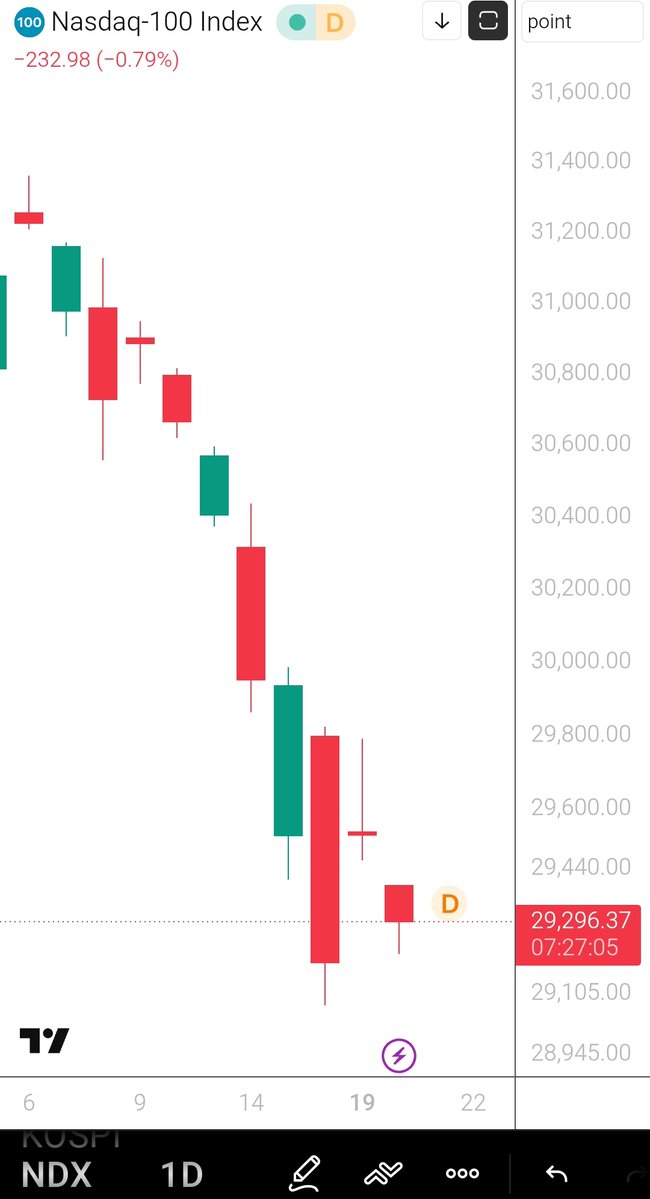
Last week, Bitcoin fell 1.3%
The Nasdaq100 fell 5.5%
Watch what happens when markets sell off.
If Bitcoin starts holding up better during periods of stress, that deserves attention. If it falls just as hard when conditions worsen, that tells you something too.
BITCOIN IS FINALLY FIGHTING BACK! ₿🔥
After weeks of pressure, the market is showing why you never count Bitcoin out.
Every dip tests conviction. Every recovery reminds the world that BTC is still one of the most closely watched assets on the planet.
40 Million dollars in leveraged shorts LIQUIDATED, just in the past hour,
I did tell all bears to close their shorts yesterday. Did they listen? Nope
Did they get rekt and many of them are receiving margin calls? Yes
Last Monday's massive ETF inflow was a clear indication bulls were about to regain control. I hate to say it (well maybe sometimes I enjoy saying it)... So here goes... I told you so.
Bears get REKT
BITCOIN CONSOLIDATION
Nobody panic sells after buying $665 million in a single day.
Yesterday BlackRock bought $665M of Bitcoin. Today ETFs added another $23M. Quietly. No fanfare. Bitcoin is at $82,800.
This is called follow-through.
The two-week October selloff drained $1.2 billion from Bitcoin ETFs. BlackRock reversed a huge chunk of that in 24 hours. Today confirmed it was not a one-day trade.
When institutions buy at scale they do not flip the next morning. They accumulate. They are patient. The $665M day was the statement. The $23M day is the proof.
The line on that chart above has stopped going down.
Three green days out of the last four. Bitcoin up $1,800 from the October lows. The floor at $81,000 was tested repeatedly and held every single time.
The people who sold at $81,000 to institutions buying $665M in one day are going to remember this moment.
Bitcoin attacking the Sell Wall again earlier than market open. We will get a further boost as soon as the US market opens as well. Today will be the day...
I’ve been reading nonsense about a PHP exploit all day on X, so let’s separate facts from panic.
PHP is a programming language used by millions of websites, including WordPress sites. The current security scare concerns critical vulnerabilities that could potentially let attackers execute malicious code on vulnerable servers.
Should you panic? No
Should website owners take it seriously? Absolutely
If you are a website owner: Here’s what you can do to reduce your risk:
• Keep PHP, WordPress, plugins and themes updated.
• Remove outdated or unused plugins.
• Use strong, unique passwords and enable 2FA.
• Keep regular, tested backups.
• If you run a website, ask your hosting provider whether your server is patched.
If you’re simply browsing the internet, there’s no need to panic or change all your passwords just because you read about PHP and someone on X tells you.
The real issue is whether systems are vulnerable, whether patches are applied, and whether attackers are exploiting them.
Less fearmongering, more facts please X, I expect better from you
First sentence uttered in this movie:
"Money as we know it is dead. One day the world will only buy and sell products with bitcoins. It’s like a complicated math
equation."
Dope (2015) made actual cinema history by becoming the first movie ever to accept Bitcoin for ticket purchases at major U.S. box offices during its theatrical run in June 2015.
At the time, one adult movie ticket cost about 0.0491 BTC around $12.
Unfortunately I cannot rewatch the entire movie, because at the time I first went to see it I remember having to leave the theater at the scene in which he opened Mt.Gox accounts and started depositing bitcoin in the exchange, just a few months before Mt. Gox was hacked and it brings me back PTSD if I rewatch it all!
Because movies take months to write, shoot, and edit, the script for Dope was written back when Mt. Gox was still the largest and most functional Bitcoin hub on the planet, I assume it was written before the major hack occured.
Bitcoin attacking the Sell Wall again earlier than market open. We will get a further boost as soon as the US market opens as well. Today will be the day...
As you probably know I live in 🇲🇹Malta , the Original Blockchain Island. I believe in hodling Bitcoin and not investing in anything else. I obviously rent here, but have been monitoring the Real Estate market on this island for some time because this market is very interesting here and is unlike Real Estate in other countries.
My observations:
Malta’s property prices rose 6.9% year-on-year in Q2 2026. 🇲🇹
A booming economy, population growth driven by foreign workers, strong tourism and a very limited supply of land.
For foreign investors, Malta offers EU membership, English as an official language, political stability, a Mediterranean lifestyle and an international business hub.
Can Maltese property become a safe haven for wealth? Perhaps, but no asset is risk-free. High prices, rental yields, liquidity and the island’s dependence on continued economic growth all matter.
Take a look at the chart showing the Malta property price index: Severe property crashes after the 2008 financial crisis, with European and US housing prices falling roughly 30% from their 2007 peak to the 2012 trough. Malta’s market proved more resilient during that period, and instead of dropping drastically it just kept holding still with no increase / decrease in prices for a few years.
No clear direction, no momentum yet for Bitcoin
The DMI indicator, one of my favourites, created by the same inventor of the RSI, is signalling that neither bulls (blue line) nor bears (orange) have the upper hand. Neither is there any particular momentum (red line).
This is a classic consolidation which has been going on for the past 10 days.
When the momentum and volatility are so low, Bitcoin compresses and we are to expect the next move very soon... Usually an explosive one.