I build AI agents that hold up in production: evidence-grounded workflows, agent memory, K8s-native runtimes. 15 yrs running large-scale systems. Here I share what breaks in real AI deployments: agents, infra, GPU economics. Follow if you ship AI to production.
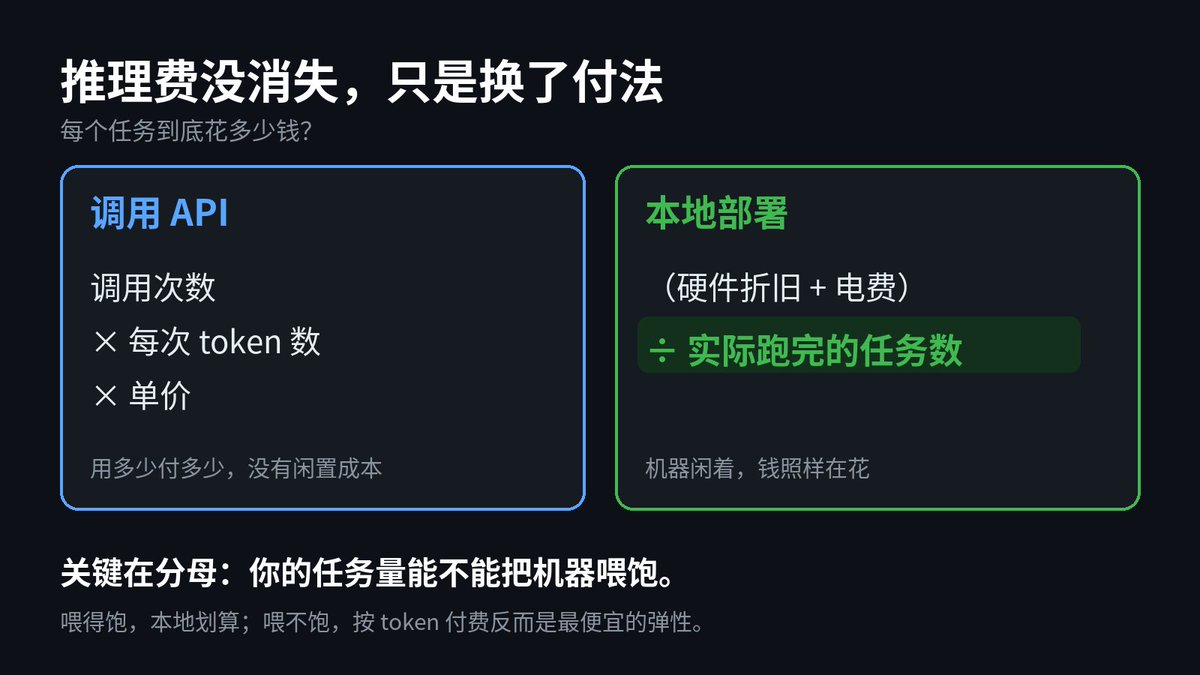
Reportedly Meta's 816B open-weight model runs on two high-memory Mac Studios. "Inference cost is going to zero"?
Not quite. It just changes how you pay:
API: cost/task = calls × tokens × price
Local: cost/task = (depreciation + power) ÷ tasks actually completed
The denominator decides it. Light workloads make local pricier than API, and long-context agents hit KV-cache memory limits before they saturate compute. If you can't keep the box busy, pay-per-token is the cheapest elasticity you'll get.
@pauliusztin_@zenml_io Caching tool outputs is what makes replay safe. I'd key the cache on the exact tool-call arguments, so when a fix changes what the agent asks for, you get a visible cache miss instead of silently replaying an old answer.
@OfficialINDIAai@IndianCERT The "agents under evaluation" part is the sharp one. Eval runs often get broader access than production because nobody treats them as real users. Short-lived, task-scoped credentials per eval run, plus a log of every tool call, closes most of that gap.
@Sanemavcil Fewer tokens at the same solve rate is the right metric. The thing I'd check is index freshness: if the agent edits files mid-task and the index lags, it pulls stale code with full confidence.
@Mr_Salio Per-token price is only half the story. For agent work I'd compare cost per completed task: a model that's 30x cheaper per token still wins big, but retries and longer outputs eat into that gap faster than the headline suggests.
Useful FAQ.
One nuance from the MOFCOM Q&A: on-prem deployment of a restricted model overseas counts as an export, while API/SaaS serving doesn't.
So for builders abroad, the practical question is less "can I still call Qwen" and more "will a vendor be allowed to ship private on-prem weights of the next release."
The peak/off-peak split is the underrated part. Batch agent work (evals, backfills, overnight refactors) can be scheduled into the cheap window, so effective cost depends on when you run as much as on which model. For long agent loops, the cached-input price will matter even more than the headline numbers.
@leviqiao Good catch. I'd pin a canonical order per session on the client side (first-seen order, new tools appended), and log a hash of the tool block, so a cache-miss spike after a reconnect is easy to trace.
Gemini 4 Argon's intro price doubles on Dec 1 — same model, new sheet.
That's a reminder for agent cost models: sticker $/MTok is not $/task. Cache-hit rate and whether your system prompt stays byte-stable decide if the discount is real.
If your forecasts assume intro rates and 95% cache reads, stress-test them against the post-Nov-30 sheet before the cliff.
h/t @demian_ai
China just proposed adding 23 AI technologies (LLMs, agents, compute clusters, information processing) to its export-control list. Comments close Nov 15, but pre-export registration applies starting now.
What matters for anyone shipping models across borders:
Serving a restricted model via API, app, web or SaaS, or a lightweight on-device deployment: not a tech export.
Deploying a restricted model on-prem overseas: is an export. On your own overseas cloud, an automatic license applies.
Already open-sourced or published: out of scope.
The line is drawn at transferring the technology, not at selling access to it.