@BEBischof@CalAldred I literally generated the first hundred or so, if anyone is curious. This is for both even and odd fiber degree: https://t.co/okEIRcwuqy
Coming soon from the machine gods: the infinite ladder is just one row of a two-parameter factory of Jacobian counterexamples. The original map sits at (1,1), and every mapping degree from 3 onward appears.
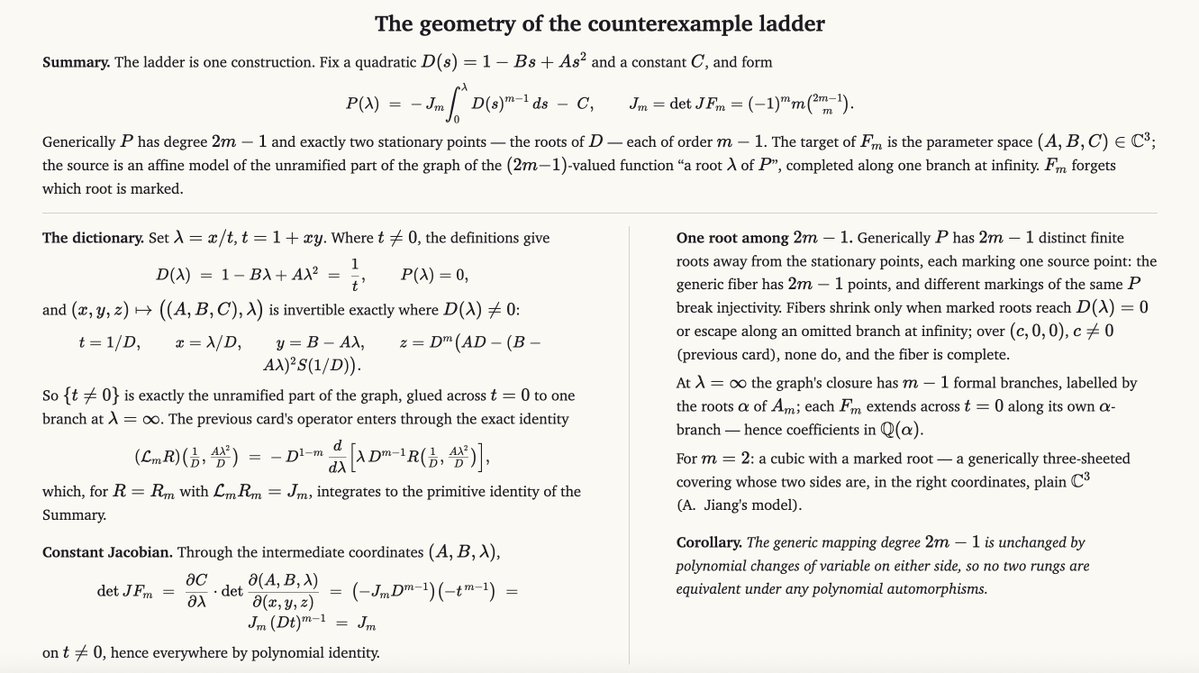
There's an infinite ladder of this geometric construction too, per GPT 5.6 Sol and Fable 5! Integrate D^{m−1} for a quadratic D, mark a root of the primitive, forget the mark. Generically 2m−1 sheets, so no two rungs are polynomially equivalent.
hello there the jacobian conjecture is false thanx to my close friend akhil for asking about it and my other close friend fable for working during the world cup final
((1+xy)^3 z + y^2 (1+xy) (4+3xy), y + 3 x (1+xy)^2 z + 3 x y^2 (4+3xy), 2 x - 3 x^2 y - x^3 z): \C^3\to \C^3, has jacobian determinant -2, and sends (0, 0, -1/4), (1, -3/2, 13/2), and (-1, 3/2, 13/2) to (-1/4, 0, 0)
There's an infinite ladder of this geometric construction too, per GPT 5.6 Sol and Fable 5! Integrate D^{m−1} for a quadratic D, mark a root of the primitive, forget the mark. Generically 2m−1 sheets, so no two rungs are polynomially equivalent.
@littmath@__alpoge__ GPT:
Take π: P¹ × Sym²(P¹) → Sym³(P¹), (p, {q,r}) ↦ {p,q,r}.
R be its ramification divisor;
H ⊂ Sym³(P¹) ≅ P³ be hyperplane tangent but not osculating to the small diagonal;
X := (P¹ × Sym²(P¹)) \ (R ∪ π⁻¹(H)) ≅ A³;
Y := Sym³(P¹) \ H ≅ A³.
π|X: X → Y is counterexample
@alz_zyd_ Seems simple, from symmetry you know each player must have 1/3 chance to win no matter the number they choose and that all 3 players must have the same strategy. You can chain the results up from the choose 1 case which is (1-p1)^2 + p1^2 = 1/3, p1 = 0.5