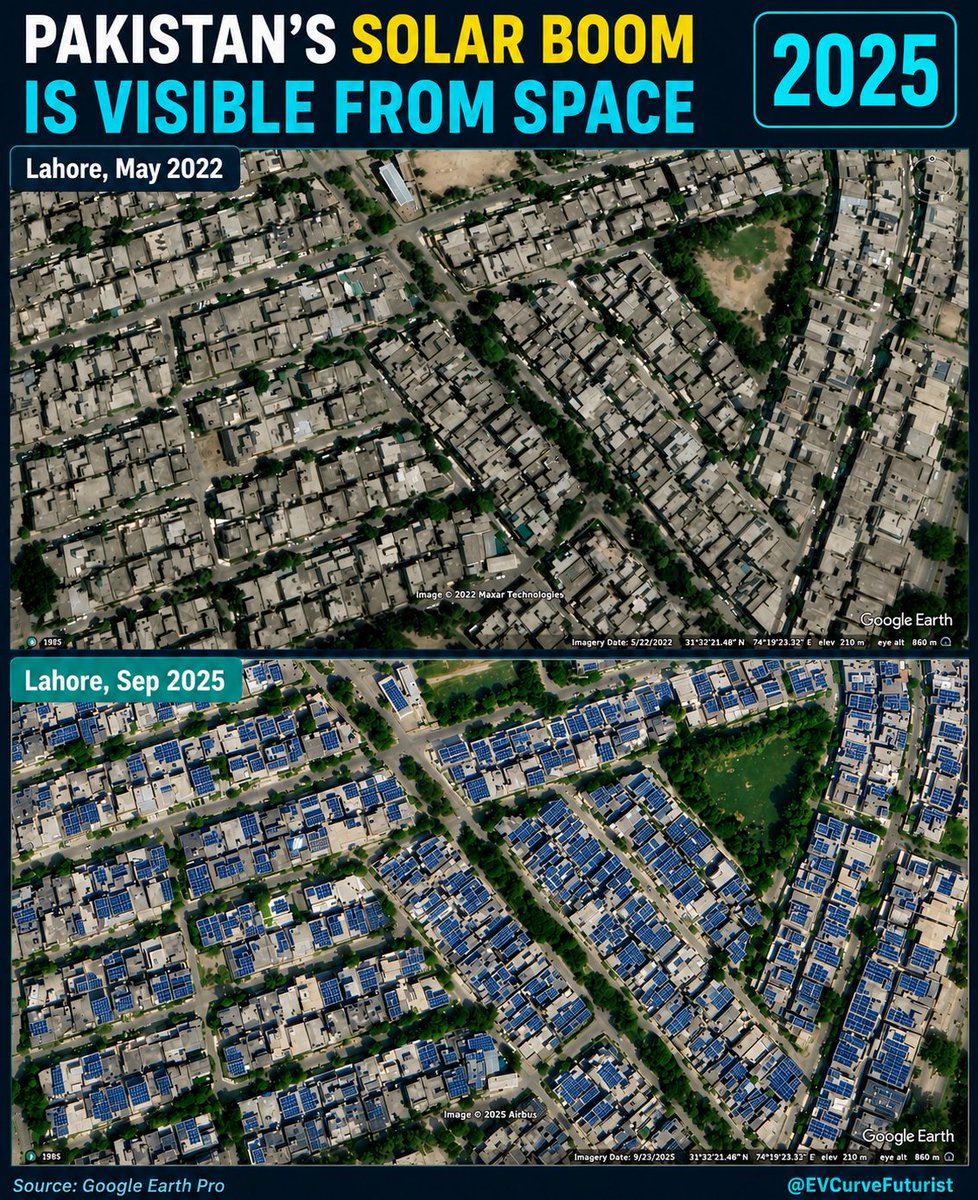
Pakistan may be accidentally building one of the world’s first decentralised #solar economies. The craziest part? Real scale barely shows in official stats. Imported 51.5 GW solar panels by late 2025—nearly = entire grid. Yet registered net-metered rooftop solar just 5.3–6.8 GW.
What makes this story so extraordinary is the speed.
In only a few years, Pakistan appears to have gone from a relatively minor solar market to potentially sourcing around a quarter of its electricity from solar once distributed generation is included.
👉 ~16.6–17 GW solar imports in 2024
👉 ~18 GW solar imports in 2025
👉 ~51.5 GW cumulative imports by late 2025
👉 Rooftop solar: ~1.3 GW → 4.1 GW in 2024
👉 ~5.3–6.8 GW registered rooftop solar in 2025
👉 24+ GW estimated behind-the-meter/off-grid
👉 Solar potentially ~25% of actual electricity use
The massive gap between imported panels and officially registered systems strongly suggests tens of gigawatts are now operating quietly on homes, farms, factories and businesses across the country.
This increasingly looks less like a normal energy transition and more like large-scale consumer-led grid defection.
And economics is driving nearly all of it.
Electricity tariffs surged. Diesel prices climbed. Blackouts remained common. Meanwhile ultra-cheap Chinese solar panels and falling battery prices made self-generation economically irresistible.
So millions effectively made the same calculation:
Generate your own power, or remain trapped inside an expensive and unstable system.
Once solar becomes cheaper than the grid itself, adoption can move faster than governments, utilities and even official statistics can keep up with.
This isn’t gradual transition by any stretch. It may ultimately become a blueprint for how energy-poor nations break free from legacy old-world energy systems dominated by fossil fuels and increasingly expensive centralised power.
It’s decentralisation at escape velocity.
This is #Bettrification.
@fawadchaudhry Do you think there mush difference between Afghanistan and Sindh specially rural Sindh. As the Taliban sponsored by the well know put Afghanistan behind the progress in the same PPP PMLN and either PTI kept the Sindh and the whole of Pakistan a hell for all of us.
Pakistan is standing on the verge of a massive e-Bikes revolution: 🧵🏍️
In 2025, over 2 million e-Bikes were sold in Pakistan, a 40% spike from 2024 which also saw record sales.
In the first quarter of 2026, more than a million e-Bikes have already been sold across Pakistan and the numbers are going up continuously.
Why is it happening?
With the fuel prices increasing in the country, people are choosing to go for e-Bikes as it provides cheaper rides.
While petrol bikes cost around 10 Rs per kilometer, e-Bikes' running cost is around Rs. 1 per KM. That is a game changer for Pakistani commuters.
Over 16 million households in Pakistan have rooftop solar panels, so running cost of e-Bikes gets even more less with the use of solar-power.
Pakistani govt, specially in Pakistan's Punjab region, is promoting e-Bikes by giving subsidies and incentives.
According to a research, within next five years, electric bikes are expected to capture around 70% of two-wheeler market in Pakistan.
As more and more companies enter in the EV market, Pakistan is set to get even more e-Bikes on the roads.
Pakistan's April 2026 CPI print came in at 10.9 percent, back into double digits after eighteen months of disinflation.
The conversation has converged quickly: fuel pass-through, Middle East oil, government levies. All true.
The longer view, read across PBS bulletins from July 2015 to January 2025, suggests a different framing is also worth holding alongside it.
On the data, Pakistan's inflation has been three distinct processes running at three different speeds for the entire decade. April is one moment in that sequence, not outside it.
A thread
Inflation in Pakistan in April was 11% on a year on year basis. Transport prices went up by 30%, housing/water/electricity/gas were up by 17%, and perishable food were more expensive by 10% yoy. More worryingly, perishable food prices were up 15% in just a month. This trend is ominous.
Sensitive price index was up 13% yoy and Wholesale price was up 14% yoy but 5% in just one month. This tells me that high inflation will continue in May and possibly beyond.
This rise in inflation from 7% to 11% is not just the result of global oil price hike but also the result of government policy and errors. Just as citizens will be forced to cut down their consumption due to increased inflation, government should also curtail its expenditure and should not increase taxes or levies or the deficit.
Petrol prices up 56pc in Pakistan, unchanged in India
On February 1, petrol in New Delhi was Indian Rs94.72 per litre. It remains Indian Rs94.72 per litre (approximately Rs280 in Pakistani rupees).
On February 1, petrol in Bangladesh was approximately BDT 130 per litre. It remains largely unchanged.
On the same day, petrol in Pakistan was Pakistani Rs257 per litre. It now stands at Rs399.86 — a 56 percent increase.
Meanwhile, Brent crude oil rose from $68–70 per barrel to $105–$115 — an increase of 54 to 64 percent.
Hard truth: Prices unchanged in India and Bangladesh. Pakistan up 56 percent.
How does India do it? The government cuts taxes, and state-owned oil companies — Indian Oil Corporation (IOCL), Bharat Petroleum (BPCL) and Hindustan Petroleum (HPCL) — absorb the losses. Prices are managed. The consumer is protected while the cost is shifted to company balance sheets.
How does Bangladesh do it? Prices are administered. The government-owned Bangladesh Petroleum Corporation (BPC) absorbs the shock, adjusting prices infrequently. The consumer is protected, while the cost is shifted to the public balance sheet.
Pakistan does it differently. Prices are passed through immediately, petroleum levy is raised, and domestic refineries — Pakistan Refinery Limited (PRL), National Refinery Limited (NRL), Attock Refinery Limited (ARL) and Cnergyico — are paid import parity prices. The consumer absorbs the shock, the government collects the tax, and refineries make billions.
The same pattern holds for diesel. On February 1, diesel in New Delhi was around Indian Rs88 per litre and remains unchanged. In Bangladesh, diesel was approximately BDT 109 per litre and is still at similar levels. In Pakistan, however, diesel has risen from about Rs267 per litre to around Rs399.58 — an increase of 50 percent.
Red alert: Three countries. One oil shock – different choices. The oil price is global. The pain is a policy choice.
Government last night increased the price of petrol by Rs 6.51 and diesel by Rs 19.39. Now the cost of both is about Rs 400 per litre.
In setting the new price, the govt decreased tax (levy) on petrol by Rs 3.88. But it also increased the tax (levy) on diesel by Rs 28.69 per litre.
So now Pakistanis are paying about Rs 120 in custom duties and taxes on every litre of petrol and Rs 60 on every litre of diesel. The Pakistani people will therefore pay, and our govt will earn, Rs 180 bn of duties, taxes and levies on selling petrol and diesel this month.
This sacrifice by the people allows one govt to buy a luxury new jet for billions, another to increase the cost of an unfinished (for 15 years!) water pipeline project from Rs 40 billion to Rs 400 billion and yet another govt to give 25 crore (Rs 43 bn in total) to each govt MNA to spend in his constituency.
The govt will ask you for more sacrifices next month!
Turkey has overtaken Indonesia to become the world's largest Muslim economy.
◾ 10 largest Muslim countries by the size of their GDP
🇹🇷 Turkey — $1.64 trillion
🇮🇩 Indonesia — $1.54 trillion
🇸🇦 Saudi Arabia — $1.39 trillion
🇦🇪 UAE — $622 billion
🇲🇾 Malaysia — $516 billion
🇧🇩 Bangladesh — $511 billion
🇪🇬 Egypt — $430 billion
🇵🇰 Pakistan — $408 billion
🇩🇿 Algeria — $317 billion
🇮🇷 Iran — $300 billion
Are you an English teacher at a college/university in Pakistan? Apply for the 2027 Fulbright FLTA Program to teach Urdu or Pashto and enhance your teaching skills in the U.S.
The application deadline is May 13.
Visit https://t.co/zFqkRkk1t6
Email [email protected]#USEFP#Fulbright
1/5 Bigger dreams need bigger financing limits!
Get up to Rs 10 million financing under the Wazir-e-Azam Apna Ghar Program - Ghar Ho Tu Apna initiative and