@its_bvisness For those of you staying more than just Saturday, I've expanded the food recommendations sheet a bit. If anyone's looking for something specific LMK!
All this graphics stuff has actually been a friend and I studying things together and talking (somewhat infrequently, he's in Australia) about implementations.
But as of ~1 week ago we're now working on a single engine together. He's mostly interested in engine features and architecture. I'm focusing on rendering features.
This may have been a bad idea given that so far my knowledge base is just from reading https://t.co/laAEo663kq, the Kronos Vulkan tutorial: https://t.co/LqQTdCHlMW, and https://t.co/HsDJCMQXZd. But I already had a copy of Real Time Rendering, and I just jumped straight head 10 chapters into shadows.
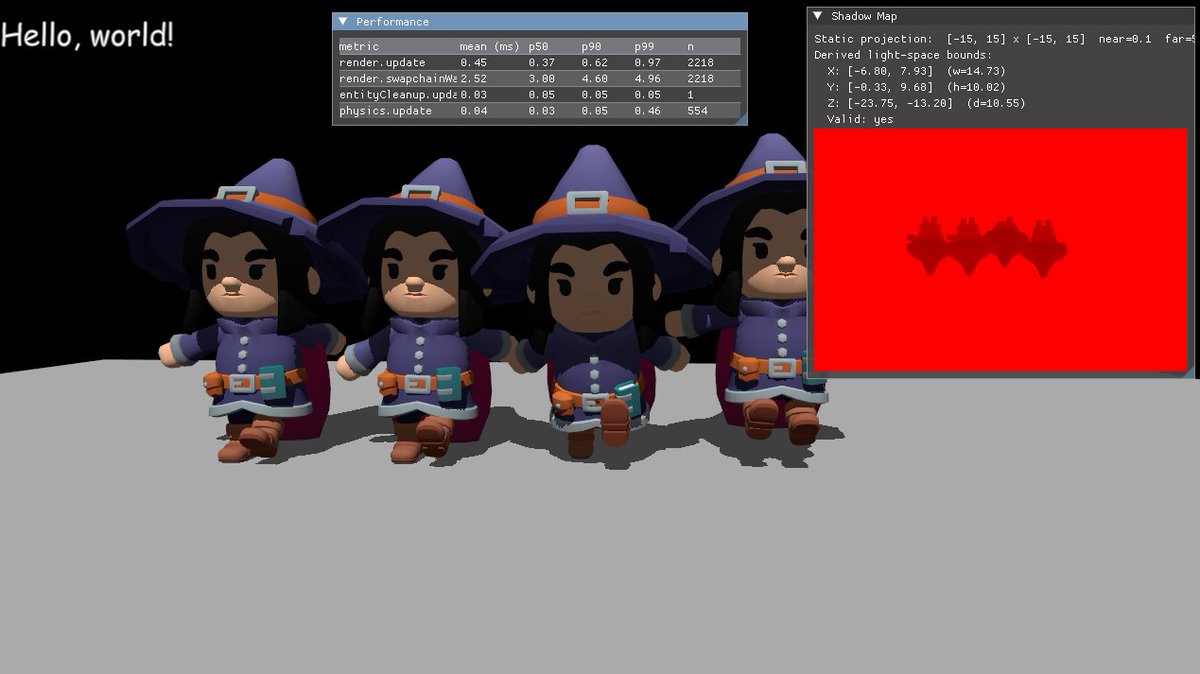
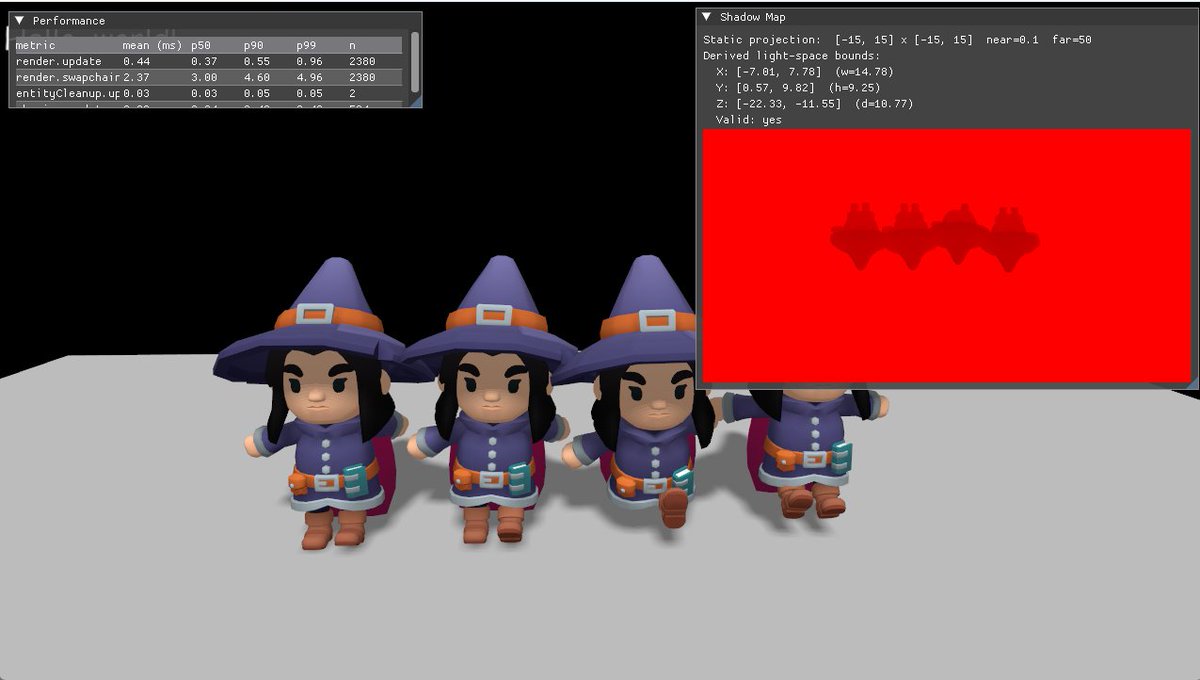
It was a few days of messing up coordinate directions, a renderer that did not yet have additional buffer support, and more, but I finally have shadow mapping with PCF *mostly* working.
I say mostly because a) I still don't understand the nuances of different light types, and so my light view projection and view frustum tightening is not correct and also b) the code is a mess.
But anyways, here's what the shadow mapping looks like without PCF vs with PCF.
If you're applying to an LFX, GSoC, or Outreachy cohort this year:
"A mentorship proposal is not a CV. It's a draft of the conversation we're going to have for the next three months."
spent a few hours reading part of real time renderings section on shadow mapping and then implemented that + borrowed the basic lambertian diffuse from my ray tracer
looks much nicer than the blinn phong shader lighting I'd thrown together before (#2)
@opdroid1234@Dispatch_Graph No, sorry. On Windows, so just a point of reference. @Dispatch_Graph SDL comment could still be the most relevant point though. Unfortunately I'm not able to get any kind of host side memory profiling on windows to give you a sense of what % of my 60ish MB of RAM is used by SDL.
@Dispatch_Graph@opdroid1234 Potentially they're allocating something in heap as well that in reality should be GPU side only? Unless there's something OS specific in SDL. For reference, my Vulkan renderer (currently just loading a single model and playing an animation) uses ~63MB of RAM but ~250MB of VRAM.
Implemented (not 100% accurate PBR) metallic and dielectric materials. Plus some optimizations to speed things up.
I think this is the end of ray tracing for a while, need to read more about light/colour/shadows for a regular rasterized triangle 3d engine now.
@nicbarkeragain@ThePrimeagen I suspect this is true. Fighting with web UI code or Unity’s UI system makes me never want to work on UI feature again. If other low level work enjoyment is any indication, using lower level UI libraries or writing it myself would actually be enjoyable.
People getting angry about early access games having 6-12 hours worth of story content for $30 seem to forget that plenty of single player AAA games have ~24h or less of story content for $80.
You're also knowingly buying a game that's upfront about being incomplete, and then choosing to rush through the currently available story content on day one.
I strongly believe there are entire companies right now under heavy AI psychosis and its impossible to have rational conversations about it with them. I can't name any specific people because they include personal friends I deeply respect, but I worry about how this plays out.
I lived through the great MTBF vs MTTR (mean-time-between-failure vs. mean-time-to-recovery) reckoning of infrastructure during the transition to cloud and cloud automation. All those arguments are rearing their ugly heads again but now its... the whole software development industry (maybe the whole world, really).
It's frightening, because the psychosis folks operate under an almost absolute "MTTR is all you need" mentality: "its fine to ship bugs because the agents will fix them so quickly and at a scale humans can't do!" We learned in infrastructure that MTTR is great but you can't yeet resilient systems entirely.
The main issue is I don't even know how to bring this up to people I know personally, because bringing this topic up leads to immediately dismissals like "no no, it has full test coverage" or "bug reports are going down" or something, which just don't paint the whole picture.
We already learned this lesson once in infrastructure: you can automate yourself into a very resilient catastrophe machine. Systems can appear healthy by local metrics while globally becoming incomprehensible. Bug reports can go down while latent risk explodes. Test coverage can rise while semantic understanding falls. Changes happens so fast that nobody notices the underlying architecture decaying.
I worry.
The penalty is a 1-year ban from arXiv followed by the requirement that subsequent arXiv submissions must first be accepted at a reputable peer-reviewed venue. 4/