Toda tuya
@mariapaularomo , toda tuya.
Siendo tú desgraciadamente ministra de gobierno del miserable @Lenin , yo te lo advertí aquí que estaban empezando a reclutar niños y más a niños vulnerables, vendedores de agua, carameleros, niños pobres.
YO TE LO ADVERTI MISERABLE VENDEDORA DE HOSPITALES.
Y lo hice porque lo vi y escuche a 2 metros de mi, en Ventanas,
un joven hablando con ellos y convenciendolos para que vayan a las reuniones",
Que les darían comida,
para vacilar y les iban a enseñar a disparar.
Te lo dije aquí varias veces.
Longa corrupta.
Pero andabas atrás de las bolsas enanas de Granda paseando en helicóptero.
Ah, pero la culpa es de Correa.
Y quien libero a Rasquiña?
Hijos de puta.
Nunca salvaron al país ni verga.
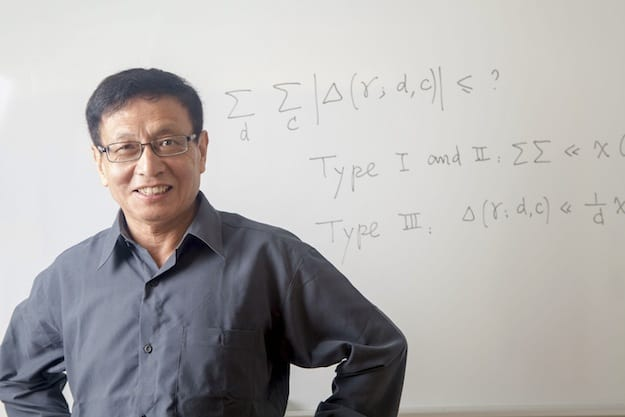
A Chinese mathematician spent 7 years making sandwiches at Subway after his PhD, and at 58 solved a 150-year-old math problem nobody thought was solvable.
His name is Yitang Zhang. The problem is called the Twin Prime Conjecture.
He was born in Shanghai in 1955 and knew he wanted to spend his life on mathematics by the time he was nine years old. That year he found his own proof of the Pythagorean theorem. Nobody taught it to him. He just worked it out.
Then the Cultural Revolution arrived and took everything.
The Chinese government closed the schools. Zhang's father had political troubles with the Communist Party, so Zhang was sent to the countryside with his mother to work in the fields. He spent 10 years as a farm laborer. No high school. No classroom. No teacher.
He read math books in the fields when he could find them.
When the revolution ended, Zhang was 23. He sat the university entrance exam and got into Peking University, one of the most competitive mathematics programs in China. He finished his bachelor's degree, then a master's. The president of Peking University personally recommended him for a full scholarship at Purdue University in the United States.
He arrived at Purdue in 1985. He earned his PhD in 1991.
Then the second wall hit.
His relationship with his doctoral advisor collapsed. The advisor did not write him letters of recommendation. Without those letters, the academic job market was closed. Zhang applied. Nothing came back. He spent the years after his PhD working as an accountant, doing delivery work, sleeping in his car during the stretches when nothing else was available.
A friend eventually opened a Subway sandwich restaurant in Kentucky and offered him a job. Zhang took it. He kept the books and made sandwiches. A man with a PhD in mathematics from Purdue, working a Subway counter because the academic world had no place for him.
He did this for seven years.
He was finally hired as a lecturer at the University of New Hampshire in 1999. Not a professor. A lecturer. The lowest rung of the academic ladder, with no research funding, no graduate students, and no institutional support. He taught calculus to undergraduates and worked on mathematics alone in whatever time was left.
Most people would have stopped believing by then.
Zhang did not stop.
The Twin Prime Conjecture is one of the oldest unsolved problems in number theory. Twin primes are pairs of prime numbers separated by exactly two: 5 and 7, 17 and 19, 41 and 43. The conjecture predicts that these pairs never stop appearing no matter how far you go along the number line. Mathematicians had believed this for over 150 years. Nobody had been able to prove it.
The deeper version of the problem asks something slightly different. Not whether twin primes are infinite, but whether there is any finite gap between prime numbers that appears infinitely often. This is called the bounded gap problem. The best mathematicians in analytic number theory had been attacking it for decades. A landmark 2005 paper by three researchers came agonizingly close and still could not close it.
Zhang worked on it alone. No collaborators. No funding. No department seminars where he could road-test his ideas. He once said he would go to a friend's house and think in the garden for hours.
In 2012, during a visit to a friend's home in Colorado, something unlocked.
He submitted his paper to the Annals of Mathematics in April 2013. The Annals is the most prestigious mathematics journal in the world. Papers sit in review for months, sometimes years. The editors read Zhang's submission and immediately knew something was different. They sent it to the leading experts in analytic number theory for review.
It was accepted in three weeks.
The paper proved that there are infinitely many pairs of prime numbers separated by a gap of less than 70 million. Not two. Not the twin prime gap specifically. But a finite gap. For the first time in history, someone had proved that prime numbers keep coming back together, that the universe of numbers never lets them drift apart forever.
Peter Sarnak, one of the most respected mathematicians at the Institute for Advanced Study, said: "He is not a fellow who had done much before. Nobody knew him. His result was spectacular."
Zhang was 58 years old.
Within a year he had the MacArthur Fellowship, the Cole Prize, the Rolf Schock Prize, and a full professorship at UC Santa Barbara. The man who spent seven years at Subway was now one of the most celebrated mathematicians alive.
He said in an interview: "I was not lucky. Maybe it is more important for a person to make himself known to the public. But that was not so easy for me."
He was not complaining. He was just being precise.
The mathematics establishment has a quiet belief that great work happens young. The Fields Medal cuts off at 40. Most mathematicians who change the field do it in their thirties. Zhang proved his most important theorem at 58, after a decade of farm labor, seven years of sandwiches, and a decade of teaching calculus to freshmen with no one watching.
He did not beat the deadline.
He proved there was no deadline to beat.
At 35 I was diagnosed with metastatic breast cancer.
80% of my tumor shows neuroendocrine differentiation. The Ga-68 scan lit up like a Christmas tree, clear proof of high somatostatin receptor expression.
The World Health Organization classified this as a distinct subtype back in 2019. American and European guidelines already have specific treatment pathways… but in Spain we still don’t. So I’m being treated as standard breast cancer by default.
That gap could cost me access to therapies that science already knows may work for my exact molecular profile.
Time is not on my side with metastasis. I can’t wait years for the system to catch up.
My oncology team is fighting hard for me within the current protocols, they are not the problem. The guidelines are.
I’ve put all my molecular data, imaging and case details on https://t.co/mcFTTsZ3S5 so other patients and researchers can use it.
If you share this video, you’re helping me get the right treatments faster… and you might be saving someone else’s life too.
Please watch until the end and share if you can.
Together we can push for change. 💪🎗️
In 1889, Henri Poincaré won a prestigious mathematics competition celebrating the King of Sweden’s birthday. He submitted a proof demonstrating that the three-body problem (calculating the gravitational orbits of three celestial bodies, like the Earth, Sun, and Moon) was completely stable.
Right before the journal went to print, an editor found a logical gap in Poincaré’s equations.
Poincaré realized his proof was fundamentally wrong. He frantically recalled all distributed copies of the journal, paid for the printing costs out of his own pocket, and re-worked the math.
In fixing his error, Poincaré discovered that tiny changes in initial conditions could lead to radically different, unpredictable outcomes.
This error accidentally birthed modern chaos theory and the concept of the “Butterfly Effect.”
Demis Hassabis reaccionando en directo al momentazo del documental The Thinking Game cuando toman la decisión de usar AlphaFold para liberar todas las estructuras de las proteínas conocidas.
Piel de gallina ❤️
Did you know CT imaging exists because of the Beatles?!
The inventor of CT is Godfrey Hounsfield, a British electrical engineer who worked on radar systems at EMI.
EMI was The Beatles' record label company. Because they were flush with profits due to The Beatles' recent success, they were willing to provide funds for Hounsfield's experimental idea of creating an image of an object with sliced X-ray imaging back in 1967.
By 1969, Hounsfield built a prototype head scanner and tested it first on a preserved human brain.
On October 1, 1971, the first live patient was successfully examined with a CT scanner: a woman with a suspected brain tumor.
It's amazing how disparate events can come together (pun intended :)) to change the world and save lives!
📸 Children's shoes.
"There were SS officers on the ramp, some with dogs, and many with staffs and clubs in their hands. While the groups were being arranged, people were beaten and had dogs set at them. At the time I was 11, but my father made me say I was 16. I didn’t understand why I was supposed to lie, but I said I was 16 when asked. I was quite a big boy and could pass for a 16-year-old. In this way I found myself with the group of men. (…) People were scared and terrorised. When we were ordered to undress, when our hair was shaved, and we got dressed in the camp rags from striped material – nobody asked about anything anymore, they were happy just to be alive."
(Hungarian Jewish Survivor Geza Schein)
---
Photo: https://t.co/sx0Vngehkc
Children at Auschwitz
📖 Lesson: https://t.co/q0qSVrI097
🎧 Podcast: https://t.co/NaEgs65cjE
„Ich bin hingegangen, ich habe das Video gesehen.
Jeder einzelne Terrorist von Hamas, als er das Massaker beging, hat nie den Slogan „free Palestine“ benutzt.
Sie haben nie „freies Palästina“ skandiert. Sie haben nie das Wort „free Al-Aqsa“ gesagt. Nein.
Sie haben nicht einmal „vom Fluss bis zum Meer wird Palästina frei“ gesagt.
Das einzige Wort, das ich aus ihrem Mund erlebt habe, von jedem Einzelnen von den Terroristen, während sie Kinder mordeten, während sie Kugeln in die Intimbereiche der Frauen schossen oder während sie vergewaltigten, das einzige Wort, das aus ihrem Mund kam, war „Allahu Akbar‘““
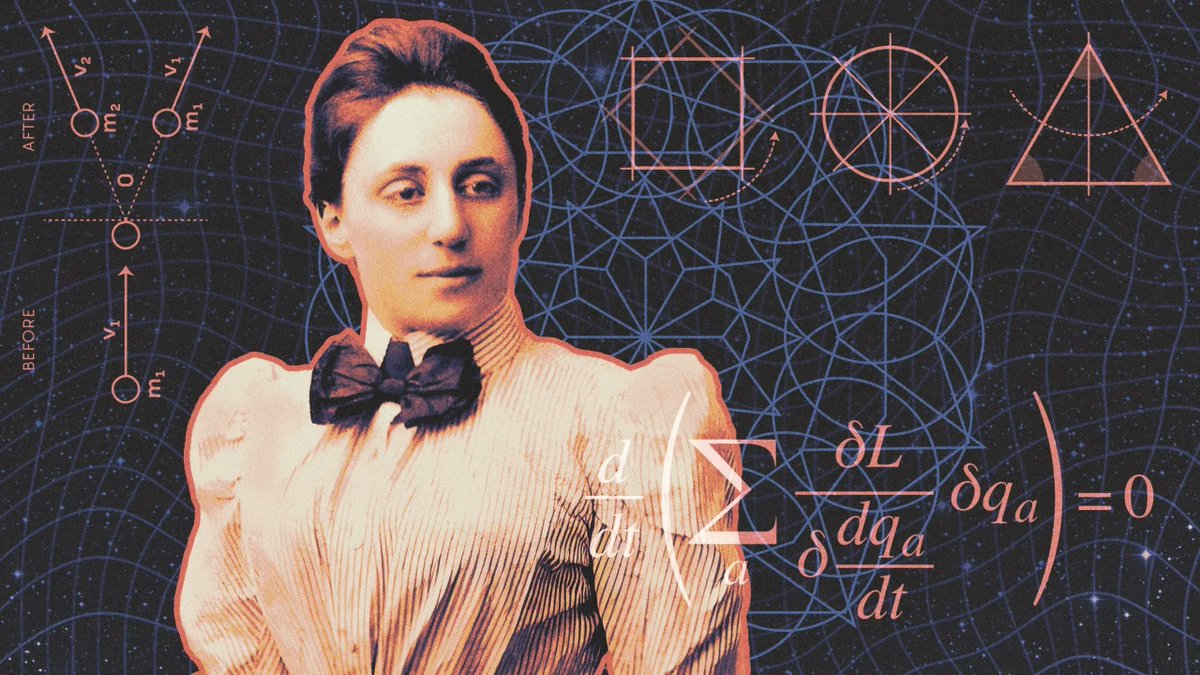
A German woman proved a single theorem in 1915 that quietly became the foundation of every law of physics on Earth. She taught for seven years without pay because the University of Göttingen refused to hire a woman. Then she fled the Nazis and died in Pennsylvania at 53.
I started reading about her and could not believe how much of modern physics traces back to one woman the world refused to pay for her work.
Her name was Emmy Noether. The theorem is called Noether's theorem.
Every law of physics ever discovered. Conservation of energy. Conservation of momentum. The Standard Model. General relativity. Quantum field theory. All of them are direct consequences of a single mathematical insight she proved 110 years ago. And most physics students will graduate without ever hearing her name once.
Emmy Noether was born in 1882 in Erlangen, Germany. Her father was a respected mathematician at the local university. The university would not allow women to enroll as students. So she audited classes from the back of the room and was not allowed to receive credit for anything she learned. She finished her PhD anyway in 1907.
Then she could not get a job.
For seven years she worked at the Mathematical Institute in Erlangen without a single paycheck. She supervised students. She published papers. She filled in for her aging father when he was too sick to teach. She did the work of a full professor and was paid nothing. There was no policy preventing her payment. There was simply no precedent for paying a woman.
In 1915 David Hilbert and Felix Klein invited her to Göttingen, the most important mathematics department in the world. Hilbert wanted her there because he was working on Einstein's new general relativity and there was a problem nobody could solve. The philosophy faculty blocked her hiring.
They argued returning soldiers should not learn from a woman. Hilbert stood up in the faculty meeting and said the line that has echoed for a century. He did not see how the sex of the candidate could be an argument against her admission, because the university senate was not a bathing establishment.
She still was not hired. So Hilbert listed her courses under his own name on the official schedule. She taught them under his title. This is how the most important mathematician of the 20th century was forced to operate for years inside one of the most prestigious universities in the world.
That same year she solved Hilbert and Einstein's problem.
The puzzle was technical. In general relativity, energy did not seem to be conserved the way classical physics required. Einstein could not figure out why. Hilbert could not figure out why. Noether figured out why in a few months. Then, instead of just solving their specific problem, she proved a much deeper theorem that solved every problem of that shape forever.
Her result was this. Every continuous symmetry in a physical system corresponds to a conservation law. If the laws of physics do not change over time, energy must be conserved. If they do not change with location, momentum must be conserved. The conservation laws were not separate facts. They were inevitable consequences of the symmetries underneath the universe.
This single theorem is the foundation of every law of physics ever discovered after her. The Standard Model is built on it. The Higgs boson Nobel Prize is built on it. Quantum field theory is built on it. Einstein read her paper and wrote to Hilbert that he was astonished. He had never met anyone with her capacity for abstract thought.
She finally got a paid teaching position in 1923. She was 41. She had been doing professor-level work for 16 years without compensation. While the German physicists kept getting credit for the consequences of her theorem, she quietly founded modern abstract algebra.
The structures we now call Noetherian rings are named after her. Modern algebraic geometry, the math that powers cryptography and parts of machine learning, runs on her foundations.
Then the Nazis came.
In 1933 she was fired for being Jewish. Bryn Mawr College in Pennsylvania offered her a position. She took it. She taught there for two years that were among the most productive of her life.
In April 1935 she went in for routine surgery to remove an ovarian cyst. Complications developed. She died four days later. She was 53.
Einstein wrote a public letter to the New York Times the day after her death. He said she was the most significant creative mathematical genius thus far produced since the higher education of women began. Almost nobody reading that letter knew her name.
She is buried in the courtyard of the library at Bryn Mawr College. The grave is small. Most students walk past it without noticing.
The woman who built the mathematical foundation of modern physics was paid almost nothing for almost all of it. The world she worked in told her every single day that she did not belong there.
She built it anyway.