Campaign for Vermont is a nonprofit, nonpartisan advocacy group. We work toward shared prosperity by connecting middle class Vermonters to their government.
This week on VFV, Pat interviews Bruce Roy, a candidate for the Chittenden Southeast senate district, discussing his background (IBM, Air Force), reasons for running, district details, campaign team, and key issues like education, housing, workforce, and public safety.
https://t.co/5dIjq5FZVd
The emotional appeal of a "second home" tax is to lower costs and free up housing for full time residents. But this framing overlooks the role second homes play in our economy. Tourism accounts for roughly 9% of Vermont's GDP, and second-home owners are part of that story.
https://t.co/SOecxUQaBi
VHFA data shows that 13% of all habitable year-round properties are held by out-of-state owners, and 6% are held by Vermonters who live in another town.
We know that many camps and cottages have been in Vermont families for generations. These are properties that are likely not fit for year-round habitation, but they could easily be caught up in a "second home" tax depending on how that line is drawn.
This is why it is so important to set clear goals for what we are trying to accomplish with any sort of surcharge on "second homes."
https://t.co/cs05mpySIW
Vermont spends $2.34 on public school students for every $1 spent in Mississippi. Yet, Mississippi's fourth graders are outscoring Vermont's.
How? Mississippi overhauled its approach back in 2013 with the Literacy-Based Promotion Act, focusing heavily on the "science of reading," early literacy screening, specialized teacher training, and dedicated reading coaches.
Now, Vermont’s Agency of Education is pointing to Mississippi’s success as the model to follow as it rolls out its own reading initiatives.
https://t.co/xtHgTcA3QE
On this week's episode, Pat and Pelin lead freewheeling interview featuring Cassandra Hemenway, editor-in-chief of Montpelier's local newspaper.
The conversation flows from local journalism, community underpinnings, and the bridges between print and digital media, to the challenges and joys of reporting in a small town with a vibrant civic life.
https://t.co/FGueMRMyve
Can Vermont tax out-of-state homeowners?
In 1997 the U.S. Supreme Court struck down a Maine property tax rule that favored in-state interests. The Court held that the dormant Commerce Clause, which bars states from discriminating against interstate commerce, applies to property taxes.
So, the short answer is no. Vermont cannot pass a property tax surcharge that specifically applies to property owners that live out of state.
https://t.co/cs05mpySIW
Most school districts would see more benefits from 'virtual' mergers than conventional consolidation. Act 170 merger study committees are required to perform a cost/benefit analysis on the educational, financial, operational, and long-term sustainability effects of mergers to determine the best option.
https://t.co/szPd8vOr6p
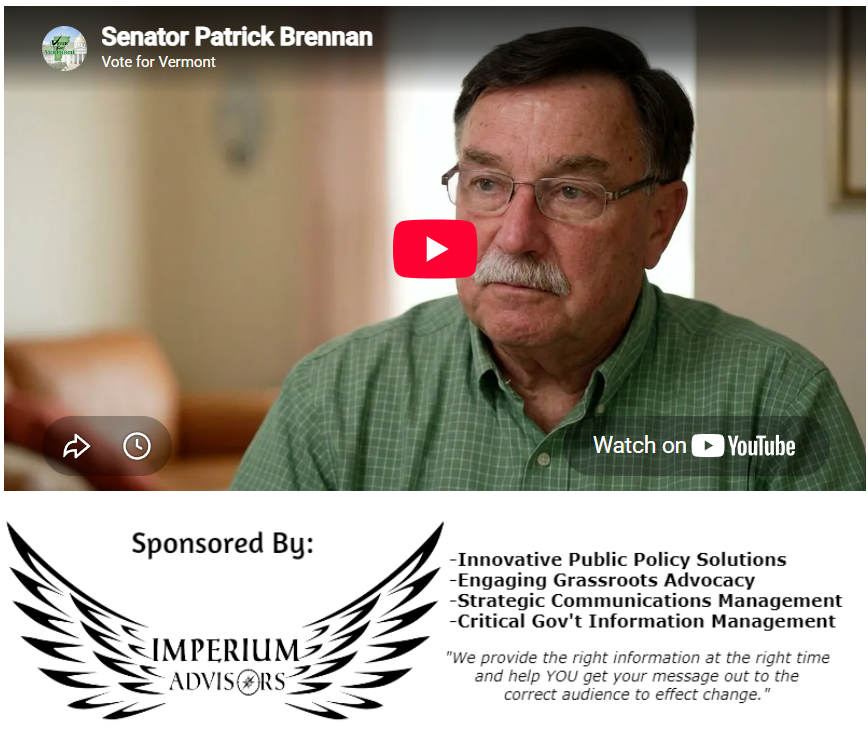
This week on Vote for Vermont, Pat interviews Senator Pat Brennan, covering his political background, transportation and appropriations roles, education and healthcare challenges, housing and permitting reforms, climate resiliency, and budgeting concerns.
https://t.co/rlBIxKrmSF
Since Act 46 passed in 2015, education spending has increased 67% ($1B) even as enrollment fell. Had spending merely kept pace with inflation, Vermont would be spending nearly $400 million less on education today.
https://t.co/T2SeF9xh5A
Here in Vermont, we value local communities and local connections. Small is valuable, and rural is an asset (not a liability). Yet in education policy, many Vermonters have embraced the assumption that bigger districts are inherently better. The evidence suggests otherwise...
https://t.co/szPd8vOr6p
June Goodband, candidate for Vermont Governor from the Peace and Justice Party, joins Pat this week to outline a transformative platform focused on climate resilience, affordable housing through cooperative models, universal healthcare, community power redistribution, and ending inequality.
https://t.co/IALSMDFp0g
"Over the last decade, Vermont needed roughly 22,000 additional homes just to keep up with the way Vermonters are already living. That is not 22,000 homes for a big wave of new people moving in. That is 22,000 homes for the folks already paying taxes, working jobs, raising families, plowing driveways, volunteering at fire departments, coaching Little League, and trying to stay in this state."
https://t.co/Bp1PTLT2qr
The Governor is telling legislators to prepare for a tough budget year as he prepares to propose a 1% increase in state government spending to make room for tax cuts.
Which taxes should the state cut?
https://t.co/QZdLLsHaBk
This week on VFV, Pat leads an interview with a group critical of Vermont's Proposition 4 (a proposed Equal Rights Amendment to the state constitution), arguing the wording is flawed, could create a hierarchy of rights, and could lead to unintended consequences like preferential treatment and ambiguous court interpretation.
https://t.co/CQZYl3EjKa
State income tax receipts fell short 7.5% in July. Hopefully that is not an indicator of how the rest of the fiscal year will go...
https://t.co/6bxA8YW6VX
At the end of last month, we released what our priorities are for the next year.
1. Student Outcomes
2. Ethics, Oversight, and Public Trust
3. Connecting Vermonters to Their Government
4. More Housing People Can Actually Afford
5. Health Care That Isn't the Most Expensive in the US
Details here 👉 https://t.co/batk7XI8hA
Act 177, Vermont’s career technical education (CTE) reform, aims to expand access, modernize delivery, consolidate governance/funding, and align with workforce needs, while noting concerns about funding and implementation timelines.
Watch 👉 https://t.co/J9zJxKodAO